Global career opportunities in tourism management

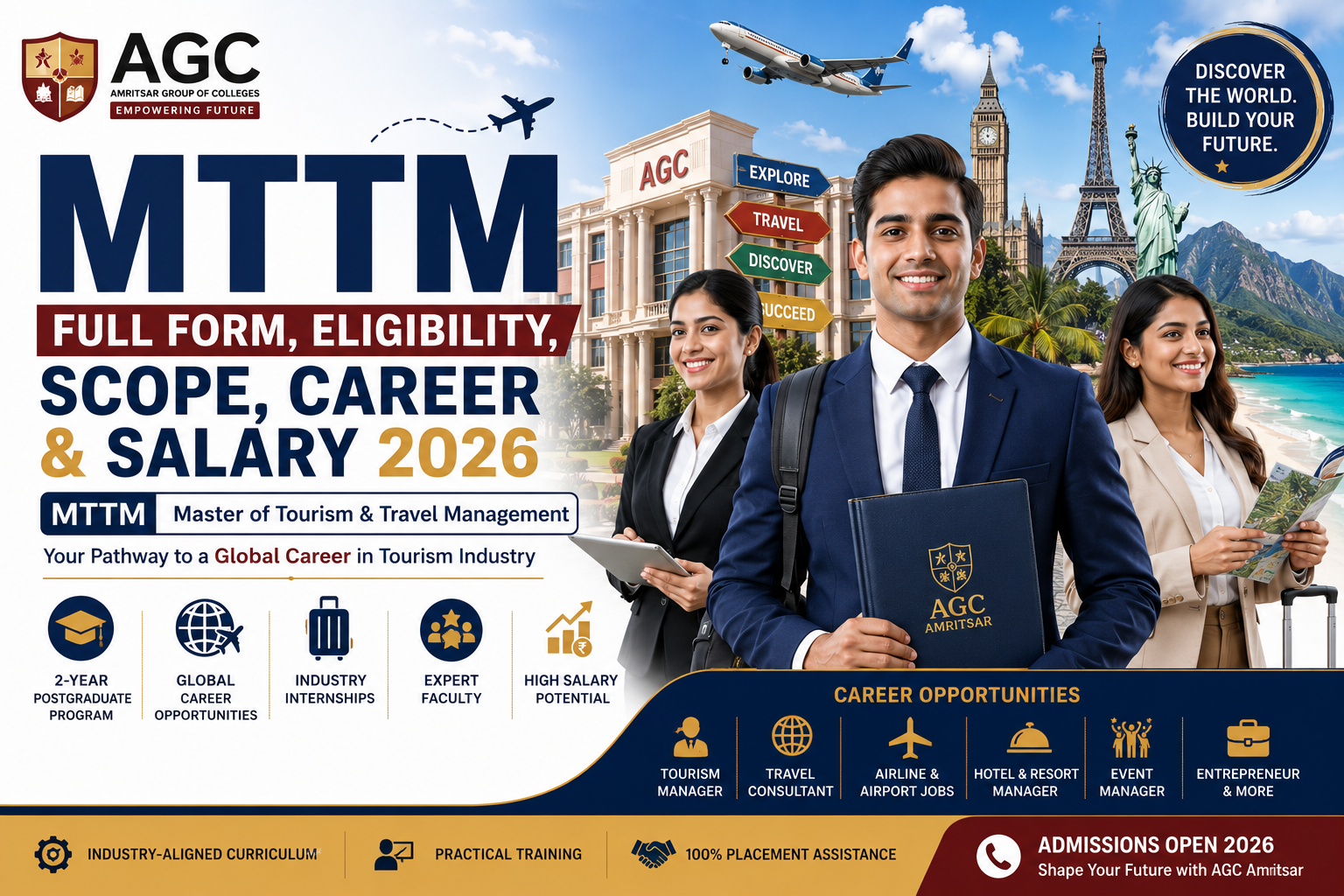
Already hold a Bachelor’s degree and want to step into leadership roles across the tourism industry? MTTM (Master of Tourism and Travel Management) is built exactly for that transition. This guide covers the complete picture of the MTTM program at AGC Amritsar — eligibility, structure, career scope, salary, and how it compares to other postgraduate hospitality options.

What Is MTTM?

MTTM stands for Master of Tourism and Travel Management — a postgraduate degree designed to build advanced industry knowledge and leadership-level managerial skills on top of an existing Bachelor’s foundation. You can review the complete MTTM program details on AGC’s official course page.

At AGC, the program combines theoretical depth with practical exposure, guided by experienced industry professionals. Rather than re-teaching the basics of tourism, MTTM pushes students toward strategic thinking — destination management, tourism policy, advanced marketing, and the kind of decision-making expected at senior levels in the industry.

2 YearsCourse Duration
4Semesters
₹3.5-8LStarting Salary Range

Eligibility Criteria

The eligibility for MTTM at AGC is kept open to allow flexibility for students from different academic backgrounds:

  • A Bachelor’s degree in any stream from a recognized university
  • Minimum 50% aggregate marks in the qualifying examination

This means Tourism & Travel Management graduates, BHMCT graduates, and even students from unrelated bachelor’s degrees who want to specialize in tourism leadership can apply.

Course Structure: What MTTM Covers

MTTM runs for 2 years across 4 semesters, building advanced competencies across the tourism business. While specific syllabi vary slightly by institution, the core areas typically covered include:

Focus Area What It Covers
Tourism Geography & Heritage Global and Indian tourism patterns, cultural heritage management
Travel Trade Management Tour operations, ticketing systems, vendor and partner management
Tourism Marketing & Branding Destination marketing, digital promotion, brand positioning
Tourism Policy & Sustainability Government tourism policy, eco-tourism, sustainable destination planning
Research & Specialization Dissertation or industry research project in a chosen focus area

Most MTTM programs include field trips, industry visits, and service-oriented internships, so students apply classroom concepts to live tourism operations rather than learning everything in theory alone.

Career Opportunities After MTTM

An MTTM degree opens one of the widest career landscapes in hospitality education. Graduates can pursue roles across tourism boards, airlines, cruise lines, hotels, resorts, travel agencies, and online travel platforms — with the global nature of the industry making international placements realistic too.

Tourism Marketing ManagerDestination ManagerTourism Development OfficerTravel Agency ManagerResort ManagerHotel General ManagerTourism Policy AnalystEvent PlannerEco-Tourism ConsultantCorporate Travel ManagerCruise Ship DirectorCultural Tourism Coordinator

Starting salaries for MTTM graduates in India typically range from ₹3.5 LPA to ₹8 LPA, with top recruiters including the India Tourism Development Corporation (ITDC), state tourism departments, Thomas Cook, Cox & Kings, Taj Hotels, Oberoi Hotels, and airlines like IndiGo and Vistara. Senior roles such as Tourism Marketing Specialist or Hotel General Manager can reach ₹10-15 LPA with experience.

Is an MTTM Degree Worth It? An Honest Look

This is worth addressing directly, because the answer genuinely depends on your career goal. For operational, customer-facing roles — travel consultant, tour operator, airline ticketing — a master’s degree doesn’t offer a dramatic salary premium over a diploma combined with solid work experience and GDS certification.

Where MTTM clearly pays off is in government tourism roles, destination management, tourism policy positions, and academic or training careers. These paths typically require the credibility and depth that only a postgraduate degree provides. MTTM is also valuable if you’re aiming for senior management positions faster — recruiters consistently favor postgraduate candidates for department-head and leadership-track roles over bachelor’s-only candidates with comparable experience.

The practical takeaway: if your career goal involves strategic, policy-level, or senior leadership work in tourism, MTTM is a strong investment. If you’re aiming purely for operational travel agency or airline roles, the degree still helps but isn’t strictly mandatory for entry.

Building a Career After MTTM: A Realistic Roadmap

An MTTM degree opens doors, but the first few years after graduation shape where your career actually lands. Here’s how most successful graduates progress:

Step 1: Enter Through a Management Trainee or Coordinator Role

Most MTTM graduates start in roles like Tourism Marketing Coordinator, Travel Operations Manager, or Destination Marketing Associate. Unlike bachelor’s-level entry roles, these positions already carry some management responsibility — coordinating teams, managing vendor relationships, or contributing to strategic decisions rather than purely executing tasks.

Step 2: Choose Between Government and Private Sector Tracks

This is a meaningful fork in the road for MTTM graduates specifically. The government and policy track leads toward roles in state tourism departments, the India Tourism Development Corporation (ITDC), or destination management authorities — often through competitive exams, but offering long-term stability and influence over tourism policy. The private sector track moves toward corporate roles in hotel chains, travel companies, and tourism marketing agencies, generally offering faster salary growth and more geographic flexibility, including international postings.

Step 3: Move Into Senior Strategy or Specialized Consulting

With 5+ years of experience, MTTM graduates often move into senior tourism marketing roles, destination management leadership, or specialized consulting — particularly in growing niches like eco-tourism and sustainable destination planning, where demand for qualified experts is rising faster than supply. Some graduates also transition into academic or training roles, teaching the next generation of tourism professionals.

Throughout this path, the postgraduate credential consistently opens doors that a bachelor’s degree alone takes significantly longer to access — which is the core value proposition of choosing MTTM over jumping straight into the workforce after a Bachelor’s.

MTTM vs MHMCT: Which Master’s Should You Choose?

Students often weigh MTTM against AGC’s other postgraduate option, MHMCT. The distinction follows the same logic as their respective bachelor’s programs:

  • Choose MHMCT if your career goal centers on hotel operations leadership — general management, F&B direction, or revenue management within a property
  • Choose MTTM if you’re drawn to the broader travel ecosystem — destination marketing, tourism policy, travel agency leadership, or government tourism roles

Both degrees share the same entry eligibility (a Bachelor’s degree in any stream with 50% marks), so the decision really comes down to which side of the hospitality industry excites you more — running a property, or shaping how people travel and experience destinations.

Why Study MTTM at AGC Amritsar?

AGC’s MTTM program prioritizes hands-on, practical learning through intensive service-oriented internships conducted in collaboration with established industry partners. Students also participate in field trips and industry visits, building a holistic understanding of the tourism and travel sector that goes well beyond textbook theory.

Combined with guidance from experienced industry professionals and a curriculum designed around current tourism trends, AGC’s MTTM graduates are positioned to step confidently into leadership roles — whether in India or internationally.

Want fee details, intake information, or a campus visit before applying? Talk to AGC’s admission team today.

Get Free Counselling

Other Hospitality Programs at AGC

If you’re still deciding on the right postgraduate path, here are the other related programs AGC offers:

1

Hotel Management & Tourism (Overview)

See the complete picture of all hospitality programs at AGC and the broader career scope across this industry.

View Overview →

2

Tourism & Travel Management (Bachelor’s)

The undergraduate foundation that prepares students for advanced study at the MTTM level.

Explore Program →

3

MHMCT

The hotel-operations-focused master’s degree, ideal if your interest leans toward property management rather than the broader travel industry.

Explore MHMCT →

Seats for MTTM 2026 admissions are filling up at AGC Amritsar — apply today to secure your spot.

Apply Now

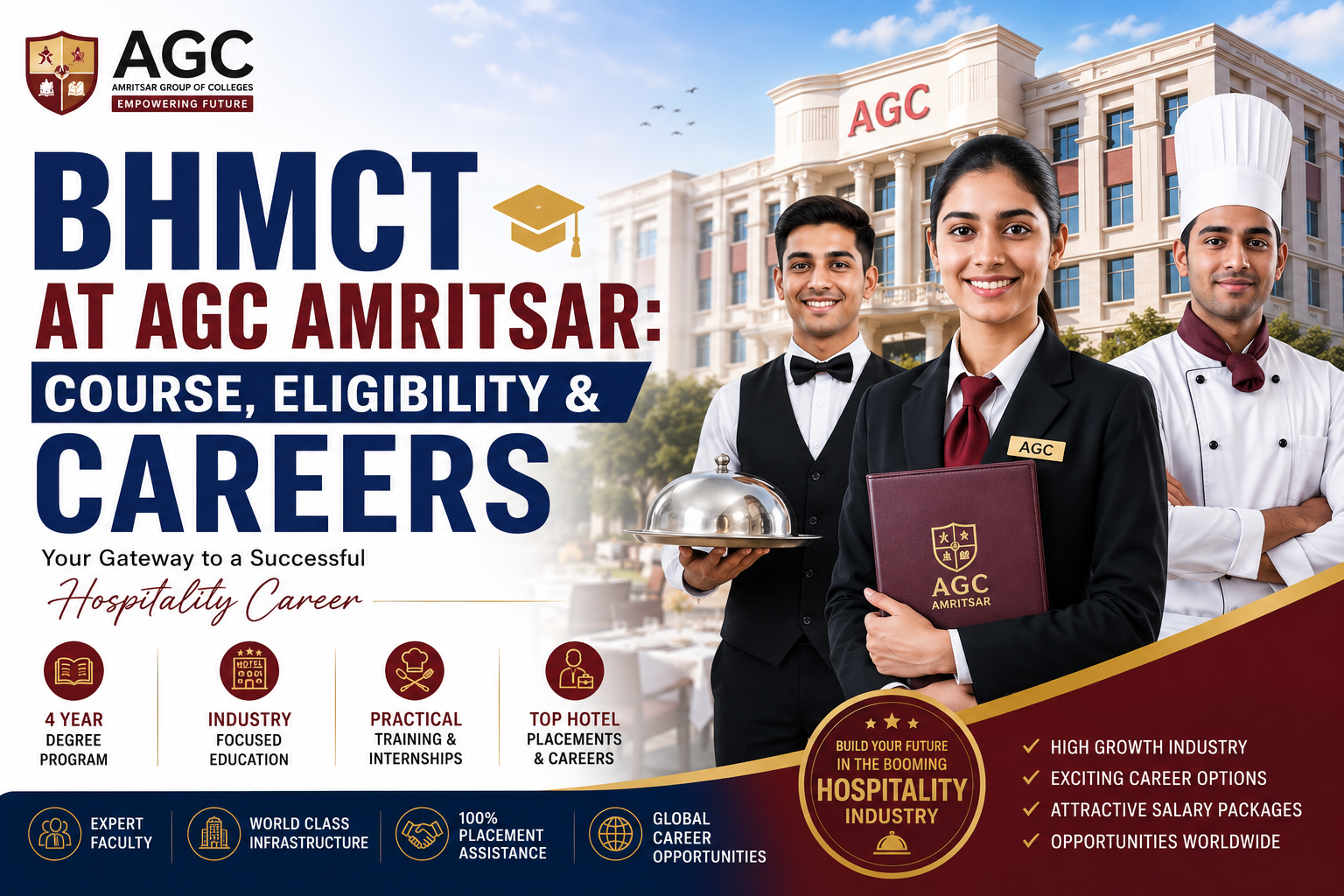
If hotel operations, guest service, and the culinary world excite you, BHMCT (Bachelor of Hotel Management and Catering Technology) is the degree that opens doors at top hotel chains like Taj, Marriott, Oberoi, and Lalit. This guide breaks down everything — course structure, subjects, eligibility, careers, and salary — so you can decide if BHMCT at AGC Amritsar is the right fit for you.

What Is BHMCT?

BHMCT stands for Bachelor of Hotel Management and Catering Technology — a 4-year undergraduate degree spread across 8 semesters that prepares students for management-level roles across the hospitality industry. Unlike shorter diploma programs, BHMCT combines in-depth theory with extensive hands-on training, making graduates ready for both operational and managerial positions from day one.

The course blends hotel operations, culinary arts, hospitality management, and business skills — covering everything from how a five-star kitchen runs to how a hotel’s finances and marketing are managed.

4 YearsCourse Duration
8Semesters
₹2.5-6LStarting Salary Range

Eligibility for BHMCT

The eligibility criteria for BHMCT is kept open so students from any academic background can apply:

  • 10+2 (any stream — Science, Commerce, or Arts) from a recognized Board or University
  • Minimum 50% aggregate marks in qualifying examination
  • No specific subject requirement — the course is designed to train students from scratch

BHMCT Course Structure: Semester-Wise Overview

The BHMCT syllabus is structured across four years, progressively moving from foundational hospitality concepts to advanced management and specialization. Here’s how the structure generally breaks down:

Year Focus Area
1st Year Foundation subjects — Front Office, Food Production, Housekeeping, F&B Service basics
2nd Year Intermediate management studies, departmental operations, communication & soft skills
3rd Year Advanced management topics, financial accounting, marketing, research projects
4th Year Industrial training, specialization electives, project work, placement preparation

Core subjects you’ll study throughout the program include Front Office Management, Food Production and Culinary Arts, Food & Beverage Service, Housekeeping Operations, Hotel Accounting, Marketing, and Event Management — along with mandatory semester-long industrial training in a live hotel environment.

What You’ll Actually Learn

  • Food Production — Indian and continental cooking techniques, kitchen organization, menu planning
  • Front Office Operations — guest handling, reservations, check-in/check-out, hospitality software
  • Food & Beverage Service — restaurant, bar, and banquet service styles and etiquette
  • Housekeeping Management — room standards, linen management, sanitation protocols
  • Financial & Business Skills — hotel accounting, revenue management, marketing fundamentals

Career Opportunities After BHMCT

This is where BHMCT really stands out — the degree is recognized as close to mandatory for placement at reputed hotel chains. AGC’s BHMCT graduates have access to opportunities at major domestic and international names including Taj Hotels, JW Marriott, Oberoi Hotels and Resorts, The Lalit, and Eros Hotel.

Beyond traditional hotels, the degree opens doors across a much wider range of sectors:

  • Hotel & Restaurant Management
  • Cruise Line Operations
  • Hospital Administration and Catering
  • Guest Relations & Customer Service Executive roles
  • Institutional Management (forest lodges, armed forces catering, shipping companies)
  • Self-employment and hospitality entrepreneurship
  • Facility Management

Entry-level BHMCT graduates typically start as Front Office Executives, Housekeeping Supervisors, or Room Attendants, while experienced professionals move into Food & Beverage Manager, Hotel Manager, or Operations Manager roles — with average salaries ranging from ₹2.5 LPA at entry level to ₹6 LPA and beyond with experience.

Skills You Need to Succeed

BHMCT isn’t just about technical knowledge — the hospitality industry rewards a specific set of personal qualities just as much:

  • Strong communication skills
  • A pleasing, professional personality
  • Ability to handle diverse types of customers calmly
  • Confidence and leadership skills
  • Time management and punctuality
  • Adaptability under pressure

Why the Hospitality Industry Is Booming Right Now

If you’ve been hesitant about hospitality as a career choice, the numbers tell a different story. India’s hospitality sector is on track to reach ₹2.5 trillion by 2030, growing at 8-10% annually — and this growth is fueled by record domestic tourism, rapid expansion of luxury hotel brands, and a surge in destination weddings and experiential travel. Cities beyond the metros — including Tier-II hubs — are now seeing major hotel chains actively hiring, which means opportunities are no longer concentrated in just Delhi, Mumbai, or Bangalore.

There’s also a technology shift reshaping the industry. Modern hotels now run on Property Management Systems, Revenue Management software, and AI-driven guest personalization tools. BHMCT graduates who pick up these digital skills alongside their core training tend to command noticeably higher starting packages than peers with purely traditional operational training — and an entirely new career track, Hotel Technology Specialist, has emerged as a direct result.

For BHMCT students specifically, this means the degree is becoming more valuable over time, not less. The combination of a strong operational foundation plus exposure to digital hospitality tools is exactly what recruiters at major chains are screening for during placement drives.

BHMCT vs Other Hospitality Courses: How to Choose

A common question among 12th-pass students is whether to go for BHMCT, a shorter diploma, or a tourism-focused degree instead. Here’s a simple way to think about it:

  • Choose BHMCT if you want broad exposure across hotel operations, F&B, housekeeping, and front office — and you’re open to working in 5-star hotels, cruise lines, or even building toward entrepreneurship later
  • Choose a shorter diploma only if you need to enter the workforce faster and are fine with limited progression to management roles
  • Choose Tourism & Travel Management instead if your real interest is travel planning and tour operations rather than hotel-floor operations

Most students who are unsure end up choosing BHMCT specifically because of its flexibility — a BHMCT graduate can pivot into tourism, event management, or even hospital administration roles, while the reverse (a tourism graduate moving into hotel operations) is much harder without additional training.

Why Study BHMCT at AGC Amritsar?

AGC’s Hotel Management department goes beyond classroom learning — students get semester-long industrial internships, live training workshops with industry professionals, and visits to iconic tourist destinations and hotels that connect theory directly with real-world practice. The goal is simple: turn every student into an industry-ready professional before they graduate.

With experienced faculty, modern training infrastructure, and strong placement tie-ups with leading hotel groups, AGC positions itself among the top hotel management colleges in Punjab for students serious about building a long-term career in hospitality.

Want detailed fee structure, intake details, or a campus visit? Talk to AGC’s admission team today.

Get Free Counselling

Other Hospitality Programs at AGC

If BHMCT isn’t an exact match for your career goals, AGC offers three other related programs worth exploring:

1

Hotel Management & Tourism (Overview)

See the complete picture of all hospitality programs offered at AGC, along with the broader career scope in this industry.

View Overview →

2

Tourism & Travel Management

A Bachelor’s program focused on travel consultancy, tour operations, and the fast-growing tourism sector.

Explore Program →

3

MHMCT (Master’s)

For BHMCT graduates ready to step into senior management and leadership roles in hospitality.

Explore Program →

Seats for BHMCT 2026 admissions are filling up fast at AGC Amritsar — apply today to secure your spot.

Apply Now

agc-btech-ce-featured-image


AGC Amritsar
Autonomous • AICTE Approved • NAAC & NBA Accredited

B.Tech Computer Engineering in Punjab: Why AGC Amritsar Leads the Way in 2026

A complete guide to course structure, eligibility, career scope and why this autonomous Amritsar college is becoming the preferred choice for engineering aspirants across Punjab.

Why Computer Engineering Is the Smartest Degree Choice Right Now

Every industry today runs on code, data and connected systems, and the people who build that backbone are computer engineers. From banking apps to hospital management software, from e-commerce platforms to AI-driven recommendation engines, the demand for trained computer engineering graduates has never been higher. For students in Punjab specifically, finding a college that combines a recognised curriculum with real placement outcomes is the difference between a degree on paper and a career that actually takes off.

That is exactly the gap a Computer Engineering College in Punjab like AGC Amritsar is built to fill. Instead of treating B.Tech Computer Engineering as a generic four-year program, the course is structured around the same architecture, networking, AI and cybersecurity skills that recruiters are actively hiring for.

Course Snapshot: Duration, Structure and Eligibility

The B.Tech Computer Course in Amritsar offered at AGC follows the standard AICTE-approved format, but the depth of lab work and industry exposure built into it is what sets it apart.

  • Duration: 4 academic years, divided into 8 semesters, giving students a gradual progression from core fundamentals to specialised electives.
  • Eligibility: Candidates must have passed 10+2 with Physics, Chemistry and Mathematics (PCM), or an equivalent qualification.
  • Lateral entry: Diploma holders are also eligible to apply directly, skipping the first year where applicable.
  • Affiliation: Recognised under IKGPTU affiliation with full AICTE approval, so the degree carries nationwide validity.

What You Actually Learn: Curriculum Highlights

A computer engineering degree is only as good as the breadth of subjects behind it. Over eight semesters, the program blends theoretical computer science with hands-on systems engineering, covering areas such as:

  • Computer architecture and digital logic design
  • Data structures, algorithms and software engineering practices
  • Operating systems, networking and distributed computing
  • Artificial intelligence, machine learning and data science fundamentals
  • Cybersecurity, cryptography and ethical hacking basics
  • Database management systems and cloud computing

This kind of curriculum is what makes a degree from a genuine Software Engineering College in Punjab stand apart from colleges that still teach outdated, theory-only syllabi.

Career Prospects After B.Tech Computer Engineering

The real test of any engineering program is where its graduates end up. Computer Engineering opens doors across nearly every sector because almost every business today depends on software, data and infrastructure. Common career paths include:

  • Software Engineer / Developer — designing and maintaining applications used by businesses and consumers alike.
  • Network Engineer — building and securing the networks organisations rely on daily.
  • Data Scientist / Analyst — turning raw data into business insight using statistical and AI tools.
  • Cybersecurity Analyst — protecting systems and data from breaches and threats.
  • AI Engineer — building machine learning models and intelligent automation systems.
  • Web Developer — creating the websites and web apps businesses use to reach customers.
  • Embedded Systems Engineer — working on robotics, automotive and IoT hardware-software integration.

Graduates pursuing a Computer Engineering Degree in Amritsar from a well-placed college can move into any of these roles with the right blend of academics, internships and placement support, which is where the choice of college becomes critical.

Why AGC Amritsar Specifically?

Plenty of colleges offer the same degree name, but the outcomes differ sharply based on accreditation, infrastructure and placement support. A few things make AGC Amritsar worth shortlisting for Computer Engineering Admissions 2026:

  • Autonomous status — giving the college flexibility to keep its curriculum updated with industry trends rather than being locked into a rigid, outdated syllabus.
  • AICTE approval and NAAC / NBA accreditation — the academic quality benchmarks that matter most to recruiters and parents.
  • 100% placement assistance — structured training and recruiter tie-ups designed to convert a degree into an actual job offer.
  • Modern computer labs — built around current industry tools rather than legacy software.
  • Scholarship support via AGC Nest — the college’s own entrance-cum-scholarship test lets eligible students save up to ₹1.5 Lakh on total academic fees, a meaningful difference for most families.

Together, these factors are why AGC Amritsar is increasingly mentioned alongside the established names whenever someone searches for the Best Computer Engineering college in Punjab.

How to Apply

Admission into the B.Tech Computer Engineering program at AGC Amritsar starts with the AGC Nest scholarship-cum-entrance test, which doubles as both a screening exam and a fee-discount opportunity. Students who complete 10+2 with PCM, or hold an equivalent diploma, can register directly through the college’s admission portal and lock in their seat for the 2026 academic session.

Frequently Asked Questions

Is AGC Amritsar’s B.Tech Computer Engineering program AICTE approved?

Yes. The program is AICTE-approved and affiliated with IKGPTU, which means the degree is recognised across India for both higher studies and employment.

What is the duration of the course?

The course runs for four academic years, split into eight semesters, following the standard B.Tech structure.

Can diploma holders apply for B.Tech Computer Engineering at AGC?

Yes, diploma holders are eligible to apply, often through lateral entry depending on their diploma stream.

Does AGC Amritsar offer any scholarship for engineering students?

Yes. Through the AGC Nest entrance-cum-scholarship test, eligible students can get a fee discount of up to ₹1.5 Lakh on their total academic cost.

What kind of jobs can I get after this degree?

Graduates commonly move into roles such as software developer, network engineer, data analyst, cybersecurity analyst, AI engineer and web developer, among others.

Ready to start your engineering journey?

Visit AGC Amritsar — B.Tech Computer Engineering Page

AGC Amritsar: Building Skills Beyond the Classroom

In today’s highly competitive world, academic qualifications alone are no longer enough to ensure long-term career success. Employers are increasingly looking for candidates who possess strong communication skills, leadership qualities, practical knowledge, teamwork abilities, and the confidence to solve real-world challenges. While classroom learning remains an important part of higher education, students also need opportunities that help them grow personally and professionally. This shift in educational priorities has encouraged institutions to focus on holistic development rather than simply delivering academic content.

Among the institutions embracing this modern approach to education, AGC Amritsar has emerged as a notable name in higher education. The institution focuses on creating an environment where students can develop valuable skills beyond the classroom while pursuing their academic goals. Through a combination of academic excellence, practical exposure, innovation, and professional development initiatives, AGC Amritsar continues to help students prepare for the challenges and opportunities of the modern world.

The Changing Expectations of Higher Education

The purpose of higher education has evolved significantly over the last decade. Earlier, students primarily focused on obtaining degrees and securing employment. Today, industries require professionals who can think critically, communicate effectively, collaborate with teams, and adapt to changing environments. As technology transforms workplaces across sectors, educational institutions must equip students with skills that remain relevant beyond graduation.

Students entering colleges today understand that employers expect more than academic knowledge. They seek institutions that provide opportunities to learn practical skills, gain industry exposure, and build professional confidence. This is where institutions like AGC Amritsar play an important role by encouraging learning experiences that extend beyond textbooks and examinations.

Why Skill Development Matters More Than Ever

Skill development has become one of the most important aspects of modern education. Regardless of the field a student chooses, success often depends on the ability to apply knowledge effectively in practical situations. Companies value employees who can solve problems, communicate ideas clearly, work in teams, and contribute to organizational goals.

Academic knowledge provides the foundation, but professional skills determine how effectively individuals perform in real-world environments. Students who focus on developing both technical and interpersonal abilities often enjoy greater career opportunities and professional growth.

Educational institutions that encourage skill development help students become more confident and adaptable. They also improve employability by preparing students to meet workplace expectations.

AGC Amritsar’s Student-Centered Educational Philosophy

One of the key strengths of AGC Amritsar is its commitment to student development. The institution recognizes that every student has unique talents, interests, and aspirations. Rather than focusing exclusively on academic performance, AGC promotes a balanced approach that encourages intellectual growth, professional readiness, and personal development.

The institution believes that education should prepare students not only for examinations but also for life beyond college. This philosophy is reflected in various academic and extracurricular initiatives designed to support holistic development.

Students are encouraged to participate actively in learning experiences that help them build confidence, creativity, leadership qualities, and problem-solving abilities.

Academic Programs Designed for Modern Careers

AGC Amritsar offers a wide range of programs that cater to students from diverse academic backgrounds. The institution provides opportunities across multiple disciplines, helping learners pursue careers aligned with their interests and professional goals.

Students interested in technology and innovation can explore the institution’s Engineering Programs. These programs emphasize technical expertise, analytical thinking, and practical problem-solving. Engineering students benefit from opportunities that encourage innovation and technical skill development.

Similarly, students interested in healthcare and pharmaceutical sciences can explore the institution’s Pharmacy Programs. These programs focus on scientific learning while helping students prepare for careers in healthcare, pharmaceuticals, research, and related sectors.

In addition to engineering and pharmacy, AGC offers programs in management, law, computer applications, commerce, hospitality, agriculture, and other professional fields. This diversity allows students to choose educational pathways that match their aspirations.

Learning Beyond Traditional Classrooms

One of the defining features of modern education is the emphasis on experiential learning. Students often learn best when they apply concepts to practical situations rather than simply memorizing information from textbooks.

AGC Amritsar promotes learning opportunities that extend beyond traditional classroom settings. Students are encouraged to participate in activities that help them understand real-world applications of academic concepts.

  • Industry interaction programs
  • Technical workshops and seminars
  • Project-based learning activities
  • Research and innovation initiatives
  • Skill development sessions
  • Entrepreneurship programs
  • Professional training opportunities

Such experiences contribute to deeper understanding while helping students build practical competence and confidence.

Communication Skills and Personality Development

Communication is one of the most valuable skills in any profession. Whether a student plans to become an engineer, pharmacist, manager, lawyer, entrepreneur, or researcher, the ability to communicate effectively plays a crucial role in career success.

AGC Amritsar recognizes the importance of communication and personality development. Students are encouraged to participate in presentations, discussions, events, and collaborative projects that help improve their communication abilities.

These opportunities allow students to express ideas confidently, improve public speaking skills, and develop professional behavior. Strong communication skills often enhance employability and help graduates succeed in interviews, workplace interactions, and leadership roles.

Developing Leadership and Teamwork Abilities

Leadership is another important quality valued by employers. Modern organizations require individuals who can take initiative, motivate others, and contribute positively to team environments.

At AGC Amritsar, students have opportunities to participate in student organizations, cultural activities, technical events, and community initiatives. These experiences encourage teamwork and leadership development.

Working with peers on projects and events helps students learn how to manage responsibilities, coordinate efforts, and solve challenges collectively. Such experiences prepare students for collaborative professional environments where teamwork is essential.

Innovation and Entrepreneurial Thinking

Innovation has become a driving force behind economic growth and technological advancement. Students who develop innovative thinking and entrepreneurial mindsets are often better prepared for future opportunities.

AGC encourages students to explore creativity, innovation, and entrepreneurship through various academic and extracurricular initiatives. Exposure to innovation-focused activities helps learners develop critical thinking abilities and encourages them to explore new ideas.

Entrepreneurial thinking is valuable not only for students interested in starting businesses but also for those seeking careers in established organizations. The ability to identify opportunities and solve problems creatively remains relevant across industries.

The Role of Campus Life in Student Development

Campus life plays a significant role in shaping student experiences. Educational institutions are not merely places for academic learning; they are environments where students develop friendships, build networks, and discover new interests.

AGC Amritsar promotes a vibrant campus culture that encourages participation in cultural events, sports activities, competitions, and student engagement programs. Such experiences contribute to confidence building and overall personality development.

Students often discover talents and interests through extracurricular activities that they may not encounter in traditional academic settings. Participation in campus life helps create a balanced educational experience that supports both personal and professional growth.

Career Readiness and Professional Preparation

The ultimate goal of higher education is to prepare students for successful careers. AGC Amritsar places considerable emphasis on helping students become industry-ready professionals.

Career development initiatives help students understand industry expectations while developing skills required for employment. Students are encouraged to participate in professional training programs that enhance employability and career readiness.

  • Resume-building workshops
  • Interview preparation sessions
  • Aptitude training programs
  • Career counseling activities
  • Professional communication development
  • Industry engagement opportunities

Such initiatives contribute significantly to professional confidence and help students approach future opportunities with greater preparation.

True education is not limited to textbooks and examinations. It is about developing the skills, confidence, and mindset required to succeed in a constantly changing world.

Preparing Students for Future Challenges

The future workplace will continue evolving due to technological advancements, globalization, and changing industry requirements. Students entering colleges today may work in industries that look very different by the time they graduate.

This reality highlights the importance of adaptability, continuous learning, and skill development. Educational institutions that encourage these qualities help students remain relevant in dynamic professional environments.

AGC Amritsar’s focus on practical learning, innovation, leadership development, and professional readiness positions students to navigate future challenges successfully.

Why Students Choose AGC Amritsar

  • Career-focused academic programs
  • Industry-oriented learning environment
  • Practical skill development opportunities
  • Modern educational approach
  • Leadership and communication enhancement
  • Innovation and research exposure
  • Supportive campus culture
  • Professional growth opportunities
  • Holistic student development
  • Future-ready learning environment

These strengths have contributed to the institution’s growing reputation among students seeking quality higher education and professional development opportunities.

Conclusion

In an era where success depends on much more than academic qualifications, students need educational experiences that prepare them for real-world challenges. Institutions that focus on skill development, practical learning, leadership, innovation, and career readiness provide significant value to learners.

Through its commitment to holistic education and student growth, AGC Amritsar continues to help students build skills beyond the classroom. By combining academic excellence with professional development opportunities, the institution creates an environment where students can grow into confident, capable, and future-ready professionals.


CA Finalist  •  Pinterest Creator  •  Founder of an Upcoming Story-Driven Fashion Brand

Rimsha Feroz aesthetic collage visual world soft luxury storytelling

The visual world that inspires Rimsha’s creative projects — blending femininity, nature, storytelling, and soft luxury aesthetics.

Rimsha Feroz doesn’t fit neatly into a box — and she’s not trying to. She’s a Chartered Accountancy Finalist currently completing her articleship, a Pinterest creator with more than 55,000 followers and over 100 million monthly impressions, and the founder behind an upcoming fashion brand quietly taking shape behind the scenes.

Most people spend years choosing between logic and creativity.

Rimsha chose both.
55K+
Pinterest Followers
100M+
Monthly Impressions
CA
Finalist & Articleship

The Finance Mind Behind the Creative Vision

Fashion wasn’t where the story started. Finance was.

As a CA Finalist undergoing articleship training, Rimsha spends her professional life immersed in financial reporting, business processes, strategic thinking, and problem-solving. It may not sound like the traditional foundation for a fashion founder — but it has given her something many entrepreneurs spend years trying to develop: the ability to understand how businesses actually work.

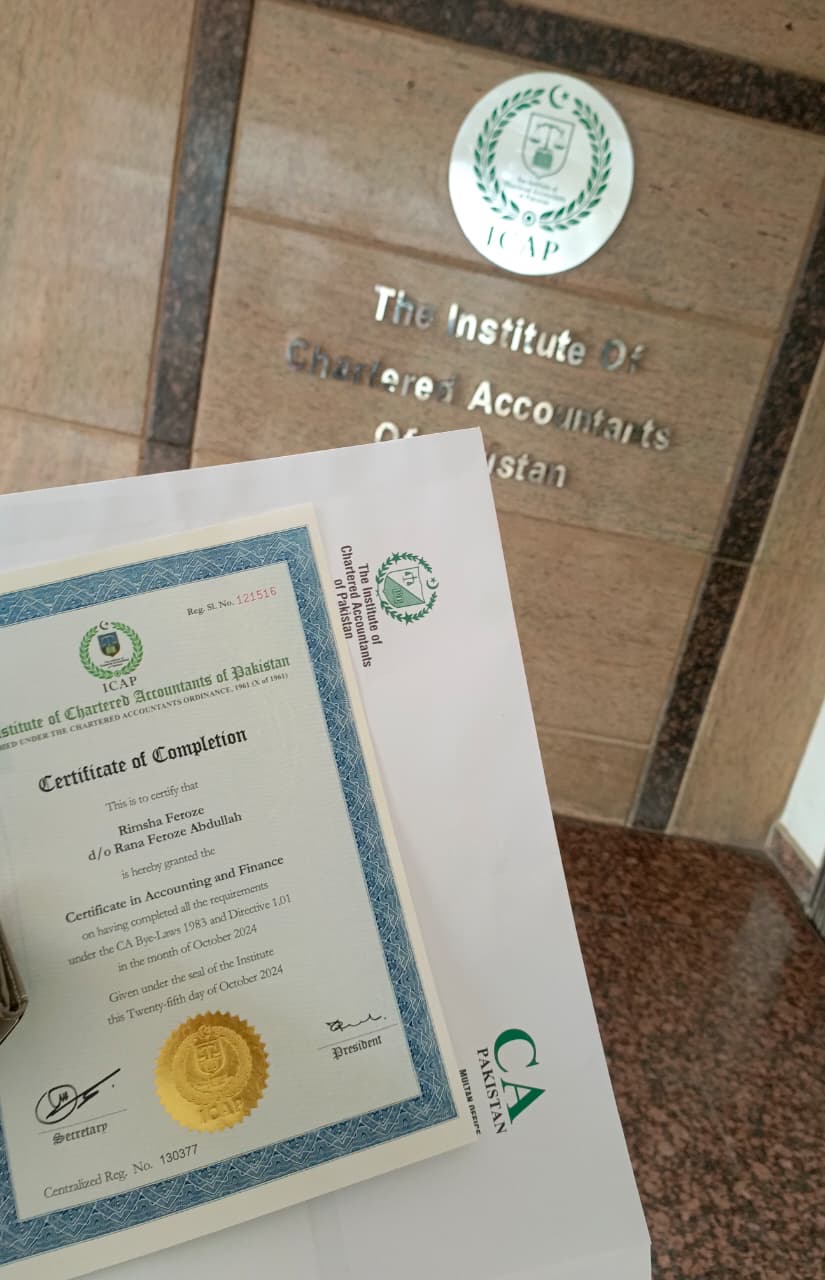
Rimsha Feroz ICAP Certificate Chartered Accountants of Pakistan CA milestone

A milestone from Rimsha’s Chartered Accountancy journey at ICAP — the analytical foundation behind her entrepreneurial ambitions.

Finance taught her patience. It taught her long-term thinking. It taught her that sustainable growth is often more valuable than rapid growth.

Rather than seeing creativity and finance as opposites, she views them as partners. One builds the systems. The other builds the story.

Everyday moments of beauty — the kind of quiet femininity that runs through everything Rimsha creates.

Building an Audience Before Building a Brand

Rimsha Feroz Pinterest profile 55k followers 100 million monthly impressions

Rimsha’s Pinterest account — 55,000+ followers, 100M+ monthly impressions, and a growing community built around aesthetic storytelling.

Long before there was a fashion label, there was Pinterest. Through visual storytelling, content strategy, and a deep understanding of how people discover ideas online, Rimsha built an audience around aesthetics, creativity, and inspiration.

What appears effortless from the outside is often the result of strategy behind the scenes. Her Pinterest journey became more than a creative outlet. It became proof.

Rimsha Feroz Pinterest profile open on MacBook behind the scenes content creation strategy

Behind the scenes — building a Pinterest strategy that now reaches over 100 million people monthly.

Proof that she understood visibility before building products. Proof that she understood audience behavior before launching a brand.

A Brand That Starts With a Universe

Many fashion brands begin with products. Rimsha’s begins with a story.

The upcoming brand is inspired by flowers, fairies, femininity, elegance, and quiet magic. Rather than creating collections around trends, the vision is to build an immersive universe where each release feels like a chapter.

Rimsha Feroz Bloom fashion sketches floral collection concept designs brand universe

Early concept sketches from the “Bloom” series — each design named after a flower, each carrying its own symbolism and story.

A flower may symbolize resilience. A fairy may symbolize freedom. A garment may carry a story beyond its fabric.

The goal isn’t simply to sell clothing. It’s to create pieces people connect with emotionally.

From Idea to Design

Rimsha Feroz Pinterest fashion concept Harbor Style Blazer popular pin 288 saves

One of Rimsha’s fashion concept pins — “Popular this week” with 288 saves in 7 days, proving audience resonance before the brand’s official launch.

The creative process extends beyond clothing. From jewelry concepts and fabric painting to digital fashion illustrations and visual storytelling, the brand is being developed as a complete creative ecosystem rather than a collection of products.

Some ideas remain sketches. Others evolve into prototypes. But each begins with imagination.

The Creative Who Creates

Details, textures, and storytelling elements — the soft luxury aesthetic that defines the brand’s visual identity.

What makes Rimsha’s journey compelling isn’t any single achievement. It’s the combination.

  • The CA Finalist navigating the corporate world.
  • The Pinterest creator generating more than 100 million monthly impressions.
  • The strategist building visibility before launching products.
  • The founder designing a fashion universe inspired by flowers, fairies, and storytelling.
  • The creative exploring jewelry design, fabric art, fashion concepts, and visual aesthetics.

In a world that encourages specialization, she’s building across disciplines. And that blend of analytical thinking, creative storytelling, and entrepreneurial ambition may ultimately become her greatest advantage.

Looking Ahead

Rimsha Feroz vision board creative universe fashion brand aesthetic story

The vision board behind an evolving creative universe — still being written, one chapter at a time.

The brand has not officially launched.

Many details remain intentionally undisclosed.

The full story is still being written.

Creative  ·  Strategic  ·  Intentional

And that’s usually how the most interesting journeys begin.

Engineering Fees vs Real ROI: How to Calculate the True Value of a College Seat

In India, pursuing an engineering degree is often treated as a major financial investment for the entire family. With private universities charging anywhere between 10 Lakh to 25 Lakh rupees for a four-year B.Tech program, the financial stakes are higher than ever before. Unfortunately, most families make their final enrollment decisions based on emotional impulses or the visual grandness of a university infrastructure. They blindly assume that a higher fee structure automatically guarantees a high-paying corporate job upon graduation. This is a dangerous misconception that frequently leads to massive education loan traps and long-term career frustration. To safeguard your family’s hard-earned savings, you must approach engineering admissions like a calculated business investment, performing a cold, data-backed assessment of the actual Return on Investment (ROI).

1. Breaking Down Hidden Charges in University Fee Structures

When you read a college admission prospectus, the number displayed under the ‘Tuition Fee’ column is almost never the final amount you will pay. Many average institutes use complex pricing structures to hide the actual cost of education until you lock in your seat. A smart family must ask for a complete, itemized breakdown of the yearly expenses before signing any admission document.

Look out for hidden annual costs such as mandatory laboratory development fees, examination fees, library deposits, campus Wi-Fi infrastructure charges, and compulsory uniform or book kit packages. Additionally, hostel and mess charges often increase by 10% to 15% every single year, a crucial detail that is rarely mentioned during the initial counseling stage. If you do not factor in these compounded operational costs from year one, your overall educational budget can easily overshoot by 2 to 3 Lakh rupees by the time you reach your final semester.

2. The Scientific Formula to Calculate True Engineering ROI

Calculating the actual return on your educational investment is a simple mathematical exercise, yet it is rarely performed by applicants. To find the true value of a seat, you need to compare the total cost of graduation (including accommodation and lifestyle expenses) directly against the median entry-level salary offered by the department, not the highest packages flashed on banners.

For instance, if a private college costs you a total of 16 Lakh rupees for four years, and their verified median placement salary stands at 4 Lakh rupees per annum, it will take an average graduate roughly 4 full years of post-college work just to recover the principal cost of education. On the flip side, if a government-aided or regional state college costs 4 Lakh rupees in total fees and offers a median salary of 5 Lakh rupees, your ROI is immediate and exceptionally highly profitable. Always target institutions where the ratio between the total four-year expenditure and the starting annual median package is as close to 1:1 as possible.

3. Relying on Verified Cross-Platform Admission Databases

Because individual college websites often showcase filtered or highly manipulated data matrices, tracking real-world cut-offs, authentic fee setups, and direct scholarship eligibility criteria can become a messy and unorganized process. Trying to visit multiple state-level counseling websites or local admission offices manually often leads to data fatigue and missed registration deadlines. This is why experienced digital marketers and education consultants rely heavily on modern aggregated educational platforms.

By utilizing a specialized web engine, you can access transparent, centralized metrics to filter out the genuine Top Engineering Colleges in India. These independent digital portals allow you to bypass misleading marketing brochures and analyze raw fee data side-by-side. Getting structured, real-time insights regarding the best engineering courses helps families cross-verify scholarship brackets, national entrance criteria, and direct state seat matrices without dealing with third-party commission agents or deceptive institutional counseling desks.

4. Evaluating the Direct Value of Institutional Scholarships

High fees shouldn’t completely discourage you if the institution offers a transparent, legally binding merit-based scholarship framework. Many premier universities reward high performers from national entrance tests or state boards by slashing up to 50% to 100% of their annual tuition costs. However, you must carefully read the fine print associated with these fee waiver programs.

A common issue inside private setups is that they grant a major fee waiver in the first year based on your high school marks, but put severe academic restrictions for its renewal in the subsequent semesters. For example, they might require you to maintain a continuous 8.5 CGPA every single year without a single backlog, while following a strict bell-curve grading system that makes it mathematically impossible for 90% of the class to sustain that score. If you lose your scholarship in the second year, your entire calculated financial blueprint will fall apart instantly.

5. Up-Skilling vs Campus Brand: Where Does the Value Lie?

There is an ongoing debate in the Indian tech industry about whether a student should pay a massive financial premium just for a legacy college brand name, or choose an affordable tier-3 campus and spend their energy on self-paced industrial up-skilling. The ground reality is a combination of both approaches, leaning heavily toward practical competence.

A premium college brand name grants you an easier path to your very first corporate job interview, as global tech companies regularly visit elite campuses out of long-standing habits. However, the moment you sit inside the interview room, the brand name on your resume fades into the background. The technical panel will judge you solely on your live software repositories, open-source code contributions, system architecture design mastery, and raw problem-solving speed. If you choose a budget-friendly college, you can easily bridge the branding gap by utilizing online tech communities and industrial boot camps to build an undeniably superior technical skill set.

6. Assessing the Infrastructure Depreciation Factor

When you visit a college campus during an open-day tour, do not be fooled by massive glass buildings, air-conditioned seminar halls, or beautifully landscaped gardens. These aesthetic assets do not contribute to your day-to-day engineering competence or ultimate corporate placement value. Instead, perform a strict functional audit of the actual departmental infrastructure.

Walk directly into the computing labs and check if the hardware setups can run advanced data pipelines, deep learning models, or heavy engineering simulation softwares smoothly. Visit the mechanical or electronics workshops to see if the testing machines and oscilloscopes are fully calibrated and operational, or if they are simply sitting there as dusty showcase items. Paying high tuition fees for a campus that possesses grand architecture but outdated, non-functional laboratory equipment is a failing investment strategy that will leave you completely unprepared for modern corporate product cycles.

Conclusion: Making a Smart Financial Choice

Your engineering degree should be a launching pad for your professional growth, not a heavy financial burden that drains your family’s savings for decades. If you blindly hand over high admission fees based on aggressive billboard advertisements or unverified recommendations, you are setting yourself up for an uphill battle. Be a calculated applicant. Demand an open itemized fee schedule, prioritize long-term median salary outcomes over flash metrics, check the renewal rules of academic scholarships, and base your comparisons on trusted, independent educational portals. Treat your college selection process with strict analytical discipline today, and you will secure a high-value, high-ROI engineering career tomorrow.

Every student dreams of building a successful career after completing school, but the journey begins with choosing the right college. In today’s competitive world, students are no longer satisfied with only classroom learning. They want practical exposure, modern technology training, internships, and placement opportunities. This is why many students and parents search for the best BTech college in Punjab before taking admission.

Punjab has become an emerging destination for technical education because of its modern institutions and career-oriented learning environment. Among the colleges gaining strong recognition, AGC Amritsar has developed a reputation for providing quality engineering education with a strong focus on practical skills and professional development.

Why Engineering Still Offers Strong Career Opportunities

Engineering continues to remain one of the most valuable professional courses because technology is transforming every industry. From healthcare and banking to construction and artificial intelligence, engineers are needed everywhere.

Students pursuing engineering today can explore careers in:

  • Software development
  • Artificial Intelligence
  • Data analytics
  • Cybersecurity
  • Civil infrastructure
  • Automation industries
  • Renewable energy
  • Robotics and manufacturing

This growing demand makes selecting the best engineering college in Punjab extremely important for students who want a stable and successful future.

AGC Amritsar – Combining Education with Real Skills

AGC Amritsar Official Website focuses on more than just academic performance. The institution believes students should graduate with confidence, practical experience, and professional knowledge.

The college environment encourages students to participate in technical activities, industrial training, innovation programs, and personality development sessions. This helps students improve both technical expertise and communication skills.

The institution offers:

  • Modern laboratories
  • Digital classrooms
  • Technical workshops
  • Internship opportunities
  • Placement preparation programs
  • Innovation and startup support
  • Industry interaction sessions

These features help students prepare for real workplace challenges instead of only theoretical examinations.

Best BTech Courses in Punjab for Future Technologies

Students today prefer engineering branches that offer future growth and strong placement opportunities. AGC provides multiple engineering programs designed according to industry demand and technological advancements.

Computer Science Engineering (CSE)

Computer Science Engineering remains one of the top choices among students because of the growing technology sector.

Students learn:

  • Programming languages
  • Software development
  • Web technologies
  • Artificial Intelligence
  • Cloud computing
  • Cybersecurity
  • Database management

The IT industry continues expanding rapidly, making CSE one of the best BTech courses in Punjab for long-term career growth.

Mechanical Engineering – Core Industry Backbone

Mechanical Engineering remains highly valuable in industrial sectors including manufacturing, automobile production, robotics, and automation.

Students gain practical understanding of:

  • Industrial machines
  • Manufacturing systems
  • Robotics technology
  • Production management
  • Thermal engineering

This branch is ideal for students interested in industrial operations and machinery innovation.

Civil Engineering – Building the Future Infrastructure

India’s infrastructure sector is growing continuously through highways, smart cities, commercial buildings, and urban development projects.

Civil Engineering students study:

  • Structural design
  • Transportation systems
  • Construction management
  • Surveying technology
  • Environmental engineering

The increasing construction sector keeps creating opportunities for skilled civil engineers across the country.

Electrical and Electronics Engineering

Electrical and Electronics Engineering is becoming more important because of renewable energy systems, electric vehicles, industrial automation, and smart communication technologies.

Students receive training in:

  • Power systems
  • Electrical circuits
  • Embedded systems
  • Automation technologies
  • Communication equipment

This branch provides opportunities in both private industries and government sectors.

Practical Learning Makes the Difference

One major problem students face at many colleges is lack of practical exposure. Modern industries want candidates who already understand technical applications and work environments.

AGC focuses heavily on practical learning through:

  • Industrial visits
  • Coding competitions
  • Technical seminars
  • Laboratory projects
  • Internship programs
  • Live workshops

Students are encouraged to apply their classroom learning to real technical situations. This approach helps improve confidence and professional understanding.

Strong Placement Support for Engineering Students

Placement opportunities remain one of the biggest factors while selecting a college. Students want assurance that their education will help them secure good career opportunities after graduation.

AGC Amritsar Placement Programs provide students with career guidance and professional preparation through:

  • Interview training
  • Aptitude preparation
  • Resume building sessions
  • Corporate interaction
  • Communication skill development

Many well-known companies recruit students from AGC for technical and professional roles.

Campus Environment and Student Growth

A good college environment helps students grow academically and personally. AGC offers students opportunities to participate in extracurricular and leadership activities alongside academics.

Students can participate in:

  • Technical fests
  • Sports activities
  • Cultural programs
  • Entrepreneurship events
  • Leadership workshops
  • Innovation competitions

These activities help students build confidence, teamwork abilities, and leadership qualities that are valuable in professional careers.

Modern Facilities for Better Education

AGC provides modern facilities designed to support technical education and student comfort.

Campus features include:

  • Wi-Fi enabled campus
  • Smart classrooms
  • Advanced engineering labs
  • Hostel facilities
  • Transportation support
  • Library and research resources

These facilities help students experience a professional and technology-driven learning environment.

Why AGC is Considered Among the Best Engineering Colleges in Punjab

Students searching for the best engineering college in Punjab usually look for institutions that provide:

  • Quality education
  • Practical learning
  • Placement support
  • Career-oriented training
  • Modern infrastructure
  • Industry exposure

AGC successfully combines these elements to help students prepare for future opportunities in engineering and technology sectors.

Skill-Based Careers for Students

Skill-Based Careers for Students: The Future of Education and Employability

In today’s rapidly evolving world, traditional career paths are no longer the only route to success. Industries are shifting their focus from degrees alone to practical skills, hands-on experience, and real-world problem-solving abilities. As a result, skill-based careers have emerged as one of the most promising pathways for students aiming to build sustainable and rewarding futures.

At Amritsar Group of Colleges (AGC), this transformation is at the heart of education. The institution emphasizes not just academic excellence but also industry-relevant skills, ensuring that students are job-ready from day one.

What Are Skill-Based Careers?

Skill-based careers focus on what you can do, rather than just what you know. These careers prioritize competencies such as technical expertise, creativity, communication, and adaptability. Whether it’s coding, designing, managing operations, or delivering healthcare services, employers today value candidates who can apply knowledge effectively in real-world situations.

Why Skill-Based Careers Are the Future

The demand for skilled professionals is growing across all sectors. With the rise of automation, artificial intelligence, and digital transformation, industries require individuals who can adapt quickly and continuously upgrade their skills. Skill-based careers offer:

  • Higher employability due to practical expertise
  • Faster career growth through continuous learning
  • Entrepreneurial opportunities for self-driven individuals
  • Global exposure with transferable skills across industries

Top Skill-Based Career Options for Students

Engineering & Technology

Careers in software development, AI, data science, and cybersecurity

Healthcare & Allied Sciences

Roles in medical lab technology, radiology, and nutrition

Management & Business

Skills in marketing, finance, entrepreneurship, and leadership

Hospitality & Tourism

Careers in hotel management, travel planning, and event management

Creative & Design Fields

Fashion design, digital media, and content creation

Each of these fields demands a strong combination of technical skills and soft skills, making students versatile and industry-ready.

How AGC Prepares Students for Skill-Based Careers

AGC stands out by integrating practical learning with academic programs. Through modern laboratories, industry collaborations, internships, workshops, and live projects, students gain hands-on experience that aligns with industry expectations.

Key highlights include:

  • Industry-oriented curriculum designed with expert input
  • Internship opportunities with leading companies
  • Skill development programs and certifications
  • Entrepreneurship support for aspiring innovators
  • Global exposure through international collaborations

Conclusion

The future belongs to those who are skilled, adaptable, and ready to embrace change. Skill-based careers empower students to take control of their professional journeys, offering flexibility, growth, and long-term success.

At AGC, students are encouraged to discover their strengths, develop their skills, and transform their passion into a profession. Because in today’s world, success is not defined by degrees alone — it is defined by what you can do with them.

collage of bizarre fountains including Kindlifresserbrunnen ogre statue Crown Fountain digital faces and floating tap fountain around the world

Water is often associate with tranquility, serenity, and the gentle bubbling of a backyard pond. However, some artists and architects have taken the concept of a water feature and turned it completely on its head. From stone ogres devouring infants to high-tech faces that “spit” at passersby, the world is full of fountains that are as unsettling as they are impressive.

In this deep dive, we’re exploring the top 10 most shocking and bizarre fountains on the planet. Whether they are marvels of modern engineering or haunting relics of the past, these landmarks prove that water can be use to tell some very strange stories.

1. Kindlifresserbrunnen (The Child-Eater Fountain) – Bern, Switzerland

Tucked away in the picturesque city of Bern, Switzerland, lies what many consider the most terrifying fountain in existence. Built in the 16th century, the Kindlifresserbrunnen depicts a giant ogre mid-snack, devouring a naked human infant while holding a sack filled with more terrified children.

  • The Mystery: No one knows exactly why it was built. Theories range from a depiction of the Greek god Cronus to a simple “boogeyman” designed to scare local children into behaving.
  • The Aesthetic: The statue is paint in vivid, lifelike colors, making the macabre imagery even more startling for unsuspecting tourists.

2. The Charybdis Vortex Fountain – Seaham, UK

Named after the mythical sea monster from Homer’s Odyssey, this fountain is a masterpiece of fluid dynamics. Created by William Pye, it consists of a giant clear acrylic cylinder that houses a massive, swirling water vortex.

  • The Tech: High-pressure water is pump into the cylinder, creating a perfect air-core vortex that looks like a literal whirlpool trapped in a jar.
  • The Experience: Spectators can walk up a staircase to peer directly into the eye of the storm. It’s a mesmerizing example of how modern art can manipulate the elements.

3. Crown Fountain – Chicago, USA

Located in the heart of Millennium Park, the Crown Fountain is a bizarre blend of technology, art, and community. It features two 50-foot glass towers that display LED videos of the faces of diverse Chicago residents.

  • The “Spit”: At specific intervals, the digital faces on the screen pucker their lips, and a physical stream of water shoots out of their “mouths” into the pool below.
  • The Interactive Element: During the summer, it becomes a giant urban playground where children wait to get “spat” on by the towering digital giants. It’s an interactive sculpture that is both weird and wonderful.

4. Metalmorphosis – Charlotte, USA

Created by the controversial Czech artist David Černý, Metalmorphosis is a massive, rotating human head made of polished stainless steel layers.

  • Kinetic Art: The 40 layers of the head rotate independently 360 degrees, constantly deconstructing and reconstructing the face.
  • The Water Feature: When the layers align to form a perfect head, water pours from the mouth. It is a stunning display of mechanical engineering and surrealist vision.

5. Swarovski Crystal Head Fountain – Wattens, Austria

Guarding the entrance to Swarovski Kristallwelten (Crystal Worlds), this iconic fountain is a giant, grass-covered head with sparkling crystal eyes.

  • The Visuals: Water cascades out of the giant’s mouth into a large pond, creating a mystical, fairy-tale vibe that is both beautiful and slightly eerie.
  • The Setting: Set against the lush Austrian Alps, the Crystal Head has become one of the most photographed landmarks in the country, blending nature with luxury branding.

6. The Big Giving – London, UK

Located on the South Bank of the Thames, this series of fountains by Klaus Weber is perhaps the most “biological” on our list. It features several stone figures that appear to be made of volcanic rock.

  • The Bizarre Twist: The water doesn’t just flow—it spews, vomits, and leaks from various “bodily orifices” of the figures.
  • The Intent: It was design to provoke a reaction regarding the “overflow” of modern society. It is undeniably shocking and often leaves tourists doing a double-take.

7. Magic Tap Fountain – Cadiz, Spain

This fountain is a classic optical illusion that leaves people scratching their heads. It appears to be a giant golden tap floating in mid-air, with a massive volume of water gushing out into a pool.

  • The Secret: There is a hidden pipe conceale within the column of falling water that supports the entire structure and provides the water supply.
  • The Popularity: Despite the “trick” being well-known, it remains a bizarre spectacle that makes for the perfect “logic-defying” vacation photo.

8. The Fountain of Wealth – Suntec City, Singapore

Once recognize by Guinness World Records as the largest fountain in the world, this structure is a massive bronze ring supported by four slante pillars.

  • The Ritual: During certain times of the day, the main fountain is turn off, and visitors are invite to walk around a smaller fountain in the center three times for good luck and wealth.
  • Feng Shui Design: The inward flow of water symbolizes riches flowing into the city, making it a masterpiece of symbolic architecture.

9. Manneken Pis – Brussels, Belgium

No list of bizarre fountains is complete without the world’s most famous peeing boy. This small bronze statue has been a symbol of Brussels since the 17th century.

  • The Folklore: There are numerous legends about why he exists, including a story of a boy who extinguished a fuse on a bomb by… well, you know.
  • The Wardrobe: The statue is regularly dress in elaborate costumes (he has over 900!). On special occasions, the fountain has even been known to pump Belgian beer instead of water.

10. Keller Fountain – Portland, USA

While not “gross” or “scary,” the Keller Fountain is shocking for its brutalist, concrete design. Instead of delicate statues, it features massive, jagged concrete slabs that create a series of powerful waterfalls.

  • The Vibe: It looks more like a set from a sci-fi film than a city park.
  • Urban Oasis: Despite its harsh appearance, it was design to mimic the cascades of the Columbia River Gorge, bringing the raw power of Pacific Northwest nature into an urban environment.

Why Are We Drawn to the Strange?

Fountains were originally designed for the practical purpose of providing water. However, as these 10 examples show, they have evolved into a medium for shock art and cultural expression. Whether it’s the horror of the Child-Eater or the illusion of the Magic Tap, these landmarks challenge our expectations and force us to look at the world a little differently.

Cameron Diaz and Benji Madden with newborn baby in a warm home setting symbolizing emotional motherhood journey and family life

In a world where Hollywood secrets rarely stay secret for long, Cameron Diaz and Benji Madden have managed to pull off the ultimate surprise once again. At 51, the Charlie’s Angels icon has officially become a mother of two, welcoming a beautiful baby boy into the fold. The news has sent shockwaves of joy through the entertainment industry, proving that for this power couple, family and privacy are the ultimate priorities.

From the secret journey to motherhood to the raw, emotional reaction Diaz reportedly shared with those closest to her, we are diving deep into the details of the newest addition to the Madden-Diaz clan. This isn’t just a celebrity birth; it’s a story of resilience, mid-life motherhood, and a love story that continues to defy the odds.

The Surprise Announcement: Meet Cardinal Madden

While most stars announce their expanding families with elaborate maternity shoots, Cameron and Benji chose a more understated path. In a joint Instagram post that featured a whimsical piece of art, the couple shared their gratitude with the world.

  • The Name: The couple revealed their son’s name is Cardinal Madden.
  • The Message: “We are blesse and excite to announce the birth of our son, Cardinal Madden. He is awesome and we are all so happy he is here!”
  • The Privacy Pledge: True to their nature, they confirmed they would not be sharing photos of Cardinal. “For the kids’ safety and privacy, we won’t be posting any pictures – but he’s really cute!”
  • The Timing: The announcement came as a complete shock to fans, as Cameron had not hinted at a second child during her recent public appearances.

Why Cameron Diaz is “Very Emotional” Right Now

Sources close to the couple report that Cameron is experiencing a whirlwind of feelings. After years of focusing on her career and eventually taking a step back from Hollywood, the reality of having a “full house” has hit her deeply.

  • The Long Journey: Insiders say Cameron gets “very emotional” when reflecting on her long path to motherhood. She reportedly spent years hoping for children before the arrival of her daughter, Raddix, in 2019.
  • The Family of Four: Now that Cardinal has arrived, the actress feels her family is finally “complete.” Seeing 5-year-old Raddix step into her role as a big sister has reportedly moved Cameron to tears on several occasions.
  • A “Beyond Lucky” Feeling: At 51, Cameron is well aware of how rare and precious this moment is. She has described herself as feeling “beyond lucky” to embrace motherhood in her 50s.

Mid-Life Motherhood: Defying the Odds at 51

Cameron Diaz is now a leading figure in the conversation surrounding older moms in Hollywood. By welcoming a child at 51, she joins the likes of Naomi Campbell and Janet Jackson,

challenging the societal norms of the “right age” to have a baby.

  • Surrogacy Speculation: While the couple has not officially confirm the method, reports suggest both Raddix and Cardinal were welcome via surrogacy. This path allowed the couple to maintain the “secret” nature of their expanding family.
  • The Retirement Factor: Cameron famously walked away from a multi-million dollar acting career in 2014. While she has recently returned for the film Back in Action, she has made it clear that her entrepreneurship and motherhood come first.
  • Wisdom Over Youth: In interviews, Cameron has expressed that being an older mom gives her a level of patience and presence she wouldn’t have had in her 20s.

Benji Madden: The Rock Behind the Scenes

While Cameron is the global superstar, Benji Madden is the grounding force of their household. The Good Charlotte rocker, 45, has been praise by his wife as being the ultimate partner in their parenting journey.

  • Hands-On Dad: Benji is known to be an incredibly “present” father, often taking the lead on diaper changes and late-night feedings so Cameron can rest.
  • The Protective Guard: Both Benji and his brother, Joel Madden (married to Nicole Richie), are notoriously private. This “Madden circle” of privacy has been instrumental in keeping the children out of the paparazzi’s lens.
  • A Love Story for the Ages: Since their wedding in 2015, the couple has remained one of Hollywood’s most stable pairs, rarely appearing in tabloid drama and focusing entirely on their private life.

Life in the “Madden-Diaz” Household

What does a typical day look like for the stars of this secretive family?

  • No Nannies in Sight? While they likely have help, Cameron has often spoken about doing the heavy lifting herself, from cooking healthy meals to managing the bedtime routine.
  • Privacy First: You won’t find Raddix or Cardinal on a red carpet. The couple is adamant about giving their children a “normal” upbringing away from the glitz of Tinseltown.
  • Entrepreneurial Spirit: Between parenting, Cameron continues to grow her wine brand, Avaline, which focuses on organic, clean ingredients—a lifestyle she mirrors in her home.

The Celebrity Support Network

The arrival of Cardinal Madden has been met with a wave of love from the couple’s A-list inner circle.

  • The Madden/Richie Clan: Nicole Richie and Joel Madden are reportedly “overjoyed” to have a new nephew. The cousins are said to be very close, creating a tight-knit family unit in Los Angeles.
  • Gwyneth Paltrow: A long-time friend of Cameron, Gwyneth has often praised her friend’s transition into motherhood, calling her a “natural.”
  • The Industry Reacts: From Katy Perry to Andy Cohen, the comments section of their announcement was filled with blue-checkmarked accounts offering their best wishes.

Final Thoughts: A New Chapter of Joy

Cameron Diaz’s story is a powerful reminder that it is never too late to find your happily ever after. From being the world’s highest-paid actress to finding profound peace as a “secretive” mom of two,

her evolution is nothing short of inspiring.

As she navigates the “emotional” early days with baby Cardinal, the world watches with admiration. Cameron and Benji have proven that you can be in the spotlight while keeping your heart—and your nursery—entirely to yourself.