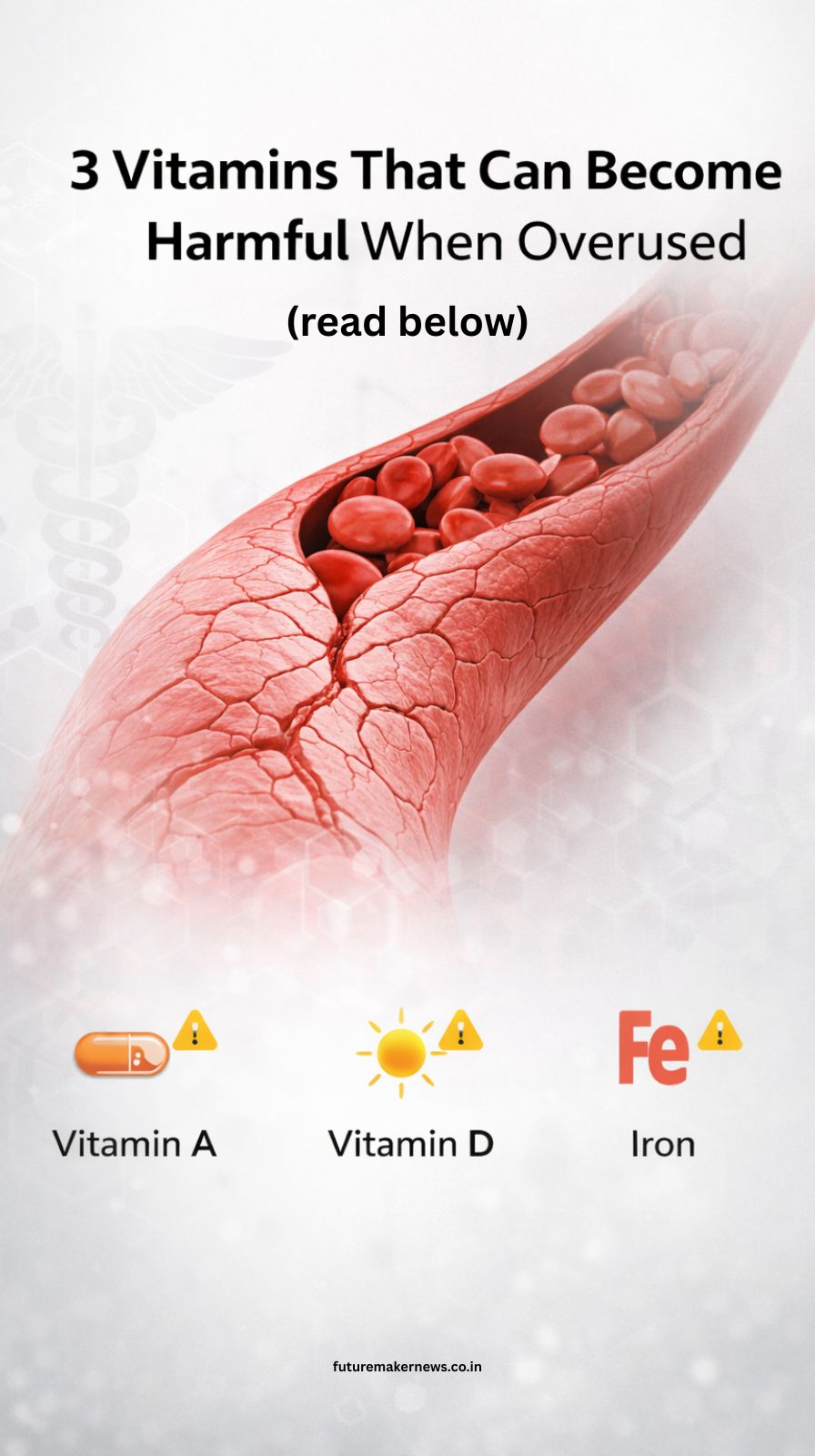
Infographic showing three commonly overused vitamins with warnings about long-term health risks, including effects on blood, liver, and organs.

Vitamins are marketed as harmless insurance policies for health.
Bright labels promise energy, immunity, and longevity — no prescription required. But medical research has revealed a less comfortable truth: Some vitamins, when taken in high doses for months without medical supervision, can quietly damage the liver, kidneys, blood vessels, and heart.Not because vitamins are “poison,”
but because the body was never designed to process chronic megadoses of isolated nutrients.

Here are three supplements most commonly linked to long-term toxicity when misused, and why the risk often goes unnoticed.

1. Vitamin A (Retinol): The Fat-Soluble Accumulator

Vitamin A is essential for vision, immunity, and cell growth — but only in small amounts. The danger lies in synthetic preformed vitamin A (retinol, retinyl palmitate), commonly found in supplements and fortified foods. Unlike water-soluble vitamins, vitamin A is stored in the liver.
When intake consistently exceeds the body’s needs, it accumulates.

What long-term excess can cause:

  • Liver inflammation and fibrosis
  • Headaches, nausea, hair thinning
  • Bone loss and increased fracture risk
  • Fatigue often misdiagnosed as stress or burnout

Clinical cases of hypervitaminosis A have been documented after months of daily over-supplementation — even at doses people assumed were “safe.” Key issue: the liver cannot flush excess vitamin A efficiently.

2. Vitamin D Megadoses: When “More” Backfires

Vitamin D is vital for bone health and immune regulation.
But modern supplement culture often promotes 5,000–10,000 IU daily without blood testing.

Vitamin D increases calcium absorption.
When taken excessively for long periods, this can lead to hypercalcemia — too much calcium in the blood.

Documented risks include:

  • Kidney stones and kidney damage
  • Calcification of blood vessels
  • Heart rhythm disturbances
  • Increased cardiovascular strain

The problem isn’t vitamin D itself — it’s unsupervised megadosing without monitoring blood calcium and vitamin D levels. Medical guidelines consistently emphasize: Vitamin D should be personalized, not blindly stacked.

3. Iron Supplements: Helpful — Until They Aren’t

Iron is lifesaving for people with diagnosed deficiency.
But for those without anemia, excess iron becomes dangerous.

The human body has no active mechanism to excrete excess iron.
Instead, it stores it in organs like the liver, pancreas, and heart.

Long-term excess iron can lead to:

  • Oxidative damage to blood vessels
  • Increased cardiovascular risk
  • Liver and pancreatic stress
  • Elevated inflammation markers

This is why physicians test ferritin levels before recommending iron — and why routine supplementation without diagnosis is discouraged.

Iron isn’t a daily “energy vitamin.”
It’s a medical intervention.

Why This Happens: Pills vs. Physiology

Whole foods deliver vitamins in balanced, bio-regulated forms, alongside fiber, enzymes, and cofactors that limit overabsorption.

Supplements deliver isolated compounds, often in doses far beyond evolutionary exposure.

Your liver and kidneys don’t interpret them as “health” —
they interpret them as chemical inputs that must be processed or stored.

Over time, storage becomes strain.

The Real Takeaway (Not Fear — Awareness)

This isn’t an argument against vitamins.
It’s an argument against chronic, unsupervised supplementation driven by marketing rather than medicine.

Evidence-based principles:

  • Test before supplementing
  • Respect upper intake limits
  • Be cautious with fat-soluble vitamins
  • Treat iron and high-dose vitamin D as medical tools, not wellness trends

Health isn’t built by swallowing more pills.
It’s built by understanding what the body can — and cannot — safely handle.

Final Thought

Nature didn’t design the body for constant megadoses of isolated nutrients.
It designed it for balance.

Supplements can support health —
but misuse over time can quietly undermine it.

Infographic illustrating NASA-inspired psychological anchors that limit ambition, including zero gravity drag, echo loops, redundancy traps, mission creep, and afterglow paralysis.

Most people don’t lose ambition overnight.
They drift away from it — slowly, invisibly, and almost politely.

Inside NASA’s behavioral research and mission psychology studies, scientists identified recurring mental patterns that derail performance even among elite astronauts. These patterns aren’t flaws. They’re psychological anchors — forces that quietly pull momentum to zero.

What’s disturbing is this:
Over 80% of people get trapped by at least one of these anchors without ever realizing it — losing years, sometimes decades.

Here are the five anchors, how they work, and why recognizing them changes everything.

1. Zero Gravity Drag: Why Starting Is Harder Than Continuing

In space, nothing moves without force.
On Earth, ambition works the same way.

NASA research shows the first 10 minutes of action determine whether momentum forms at all. The problem isn’t laziness — it’s hesitation. You open the document. Check a message. Rethink the plan. Pause.

The brain slips into what psychologists call the calm zone — a state where everything feels “under control,” so urgency disappears. Energy fades. Motivation evaporates. And suddenly, nothing launches.

Key insight:
Action creates energy — not the other way around.
Without immediate thrust, ambition stalls at zero.

2. The Echo Loop Effect: When Approval Replaces Progress

NASA learned early that crews exposed to a single dominant voice develop false confidence. They stop questioning. Errors compound quietly.

Modern ambition suffers the same fate.

You consume advice from familiar sources. You get encouragement from friends. Likes, comments, praise — all reinforcing comfort. But the insight that would actually challenge you gets filtered out.

You mistake validation for clarity.

Meanwhile, others — less applauded but more focused — move forward.

Key insight:
If everyone agrees with you, you’re probably not growing.
Ambition dies when feedback feels good instead of useful.

3. The Redundancy Trap: Planning Every Failure Until Nothing Happens

NASA builds redundancies for survival — not momentum.
Too many backups slow decisions.

In life, redundancy becomes avoidance.

You create fallback careers. Backup plans. Side options. Emergency exits. Each one reduces commitment to the main mission. You prepare for failure so thoroughly that success never gets a real chance.

Risk is diluted. Action weakens. Launch never happens.

Key insight:
Commitment creates pressure — and pressure creates movement.
Ambition fades when nothing is truly on the line.

4. Mission Creep Spiral: Losing the Original Why

NASA missions fail when objectives expand without discipline. What starts as exploration becomes safety management, system optimization, endless adjustments.

People do the same.

You start a business to build something meaningful. Then shift to content, monetization. Then optimization. Eventually, you’re busy — but directionless.

The mission hasn’t failed.
It’s dissolved.

Key insight:
Ambition requires a stable “why.”
When purpose drifts, effort multiplies — but progress disappears.

5. Afterglow Paralysis: How Success Can Quietly End the Climb

NASA warns that every successful maneuver requires a counter-thrust. Without it, a spacecraft stalls in orbit.

Human ambition stalls the same way.

You achieve something meaningful. The brain releases reward chemicals. Hunger shuts down. The sense of “we made it” settles in. Instead of using success as fuel, you pause — expecting momentum to carry itself.

It doesn’t.

Most ambition dies not from failure — but from comfort after a win.

Key insight:
Success must be followed by deliberate discomfort.
Without it, growth plateaus permanently.

Final Thought: Breaking the Loop

These anchors don’t mean you lack discipline.
They mean you’re human.

But awareness is escape velocity.

When you understand why ambition stalls — at the start, in feedback loops, in overplanning, in drift, and after success — you stop blaming yourself and start correcting the system.

Ambition isn’t about doing more.
It’s about removing what silently holds you still.

And once those anchors lift, momentum returns — fast.

A middle-aged man sitting alone at night reviewing bills and finances, symbolizing the financial trap of debt, status pressure, and loss of freedom after 40.

Financial Trap – For decades, men are taught a simple equation: more money equals more freedom. Work harder, earn more, buy the house, upgrade the car, secure the lifestyle. But somewhere after 40, many men wake up to a brutal realization:

They don’t feel free at all.

They feel trapped.

1. When Ownership Turns Into Captivity

Mortgages, car payments, credit cards, subscriptions, school fees, insurance—each one seems reasonable on its own. Together, they form a quiet cage.

You don’t own the house.
The house owns your schedule.

You don’t control your job.
Your job controls your nervous system.

What feels like stability is often dependency in disguise. Men believe they’re “building a life,” but in reality, they’re maintaining liabilities that demand constant sacrifice. Missing one paycheck doesn’t mean inconvenience—it means panic.

That’s not freedom. That’s pressure with better furniture.

2. Status: The Most Expensive Prison

Few men admit it, but much of modern spending isn’t about comfort—it’s about comparison.

The car that stretches your finances.
The watch that signals success.
The holidays posted online, funded by debt.

These purchases are rarely for personal fulfillment. They’re social armor—protection against being seen as “less.” And the cost isn’t just money. It’s years of additional work, stress, and obligation spent paying off things that don’t actually improve life.

Status doesn’t make you powerful.
It makes you predictable—and expensive to maintain.

3. The Debt That Matters Most: Time

Financial debt can be measured. Time debt cannot.

A man can recover money.
He cannot recover missed years.

While chasing income targets and promotions, many men quietly trade away what actually matters: health, presence, relationships. Children grow up while they’re working late. Partners feel emotionally alone. The body weakens under stress and neglect.

Banks don’t charge interest on this debt—but life does.

And there are no refunds.

4. Why “Work Harder” Is the Wrong Advice

When a man feels financially trapped, the default advice is always the same: earn more.

But earning more inside the wrong system only tightens the chain.

A man making £200,000 can be drowning under obligations.
A man making £50,000 can breathe freely.

The difference isn’t income—it’s outflow.

More money without control doesn’t buy freedom. It buys larger cages with better branding. Real leverage comes not from constant growth, but from intentional reduction.

5. What Financial Freedom Actually Looks Like

Freedom is not a number in a bank account.
It’s not early retirement fantasies.
It’s not impressing other men.

Freedom is the ability to say no.

  • No to overtime that drains your health.
  • No to purchases that don’t add real value.
  • No to lifestyles built for applause instead of peace.

A man who controls his spending controls his life.
A man who doesn’t will always feel tired—no matter how much he earns.

The Real Question

The financial trap after 40 isn’t about money.

It’s about living unconsciously inside systems designed to keep you busy, dependent, and distracted.

The strongest men don’t ask, “How can I make more?”
They ask, “What can I remove?”

Because the lighter your life becomes, the freer you are to actually live it.

Japanese Zen monk practicing cold water face immersion at dawn, illustrating an ancient morning ritual proven by Harvard research to strengthen willpower and self-control.

For centuries, Japanese Zen monks practiced a simple morning ritual long before neuroscience existed to explain it.

Now, modern science has caught up.

After three years of observation and brain imaging, Harvard-affiliated researchers uncovered something striking: monks who practiced this ritual daily showed measurable structural changes in the brain regions responsible for discipline, focus, and impulse control.

This wasn’t spiritual metaphor.
It was biology.

The Discovery: Willpower Has a Physical Structure

MRI scans revealed that long-term practitioners had a significantly thicker prefrontal cortex—the area of the brain responsible for:

  • Self-control
  • Focus
  • Decision-making under pressure

On average, monks who maintained the practice showed up to 43% greater prefrontal cortical thickness compared to control groups.

In simple terms:
Their willpower wasn’t stronger because of belief—it was stronger because the brain itself had changed.

The Ritual: Cold Water Face Immersion

The practice itself is deceptively simple.

Each morning, monks immerse only the face—not the body—into cold water for about 60 seconds, while calmly counting breaths.

This is not a cold shower.
It is targeted, intentional exposure.

The cold activates the body’s dive response, a powerful reflex that:

  • Slows heart rate
  • Stimulates the vagus nerve
  • Forces rapid nervous system regulation

The brain must override panic signals almost instantly.

That override is the training.

Why It Rewires Discipline

Neuroscientists found that cold face immersion activates the same neural circuits elite athletes use under extreme pressure.

Here’s what happens:

  • The limbic system triggers discomfort and stress
  • The prefrontal cortex is forced to regain control
  • Repeated exposure strengthens this control loop

Each session becomes a micro-workout for self-regulation.

Over time, the brain learns:
Discomfort does not require escape.

That lesson transfers directly to:

  • Cravings
  • Anger
  • Procrastination
  • Fear-based decisions

Ancient Wisdom, Modern Proof

Ancient Zen texts reveal monks never used this ritual for mystical enlightenment.

They used it for mastery of impulses.

Anger.
Desire.
Fear.

Modern studies now support this intent. Participants who practiced daily cold face immersion for 30 days showed:

  • Improved resistance to temptation
  • Reduced stress-driven decisions
  • Increased emotional regulation

Some studies reported improvements of up to 67% in self-control metrics.

Why One Simple Habit Beats Complex Routines

Many people exhaust themselves trying to follow elaborate morning routines:

  • Multiple habits
  • Perfect sequences
  • Constant optimization

The monks did the opposite.

They focused on one foundational practice that strengthened the system responsible for all discipline.

One path leads to burnout.
The other builds capacity.

When willpower improves, everything else becomes easier.

Final Thought

Discipline isn’t a personality trait.
It’s a trained biological function.

The monks understood this intuitively centuries ago.
Science is only now confirming it.

You don’t need fifteen habits to master your mornings.
You need one practice that teaches your brain how to stay calm, focused, and in control—especially when it wants to quit.

And sometimes, mastery begins with sixty seconds of cold water and a steady breath.

Moody illustration of a solitary person sitting in quiet reflection, symbolizing the emotional intensity, silence, and inner strength experienced during early sobriety.

People love to say, “Sobriety is freedom.”
What they rarely mention is that the first year often feels like walking barefoot through fire.

The initial high fades quickly.
The clarity stops feeling heroic.
And what remains is the real work: you, alone, without anesthetic.

Sobriety doesn’t immediately feel like peace.
It feels like confrontation.

1. The Great Unmasking

When the haze lifts, something painful becomes clear:
many of the people you called friends were really just companions in escape.

The parties, the noise, the endless small talk—none of it survives sobriety.
And when it disappears, the loneliness hits hard.

This loss hurts, but it serves a purpose.
Pain clears the room.

Only when the distractions leave can space open for people who actually see you—not the version numbed into compliance, but the one who is awake, present, and honest.

Sobriety doesn’t take people from you.
It reveals who was never meant to stay.

2. The Screaming Silence

Alcohol, nicotine, sugar, and other habits were never real comforts.
They were mute buttons.

Without them, every unresolved wound makes itself known.
Anxiety rises. Restlessness sharpens. Thoughts get louder.

Science explains this as elevated cortisol and nervous system recalibration.
Lived experience calls it something simpler: reality returning.

This stage feels unbearable—but it’s also where rebuilding begins.
Not in dramatic breakthroughs, but in quiet, repeated choices.

Minute by minute.
Day by day.

3. The Return of Feeling

Sobriety brings sensation back online.

Without chemicals to dull the edges:

  • Anger burns hotter
  • Sadness sinks deeper
  • Joy hits harder

Every emotion arrives unfiltered.

It can feel overwhelming—sometimes terrifying.
But it’s also proof that you’re no longer a spectator in your own life.

You’re not numbing anymore.
You’re participating.

Feeling everything again is the price of being fully alive.

4. The Forging

  • No bottle.
  • No smoke.
  • No crutch.

Just you, the quiet, and the thoughts you’ve been avoiding.

This is the hardest phase—and the most transformative.

In the silence, something unexpected happens:
you stop leaning on the counter of escape and start standing on your own spine.

Strength isn’t discovered here.
It’s forged.

If you survive this chapter, you don’t just recover—you evolve.

Final Thought

Sobriety isn’t the absence of substances.
It’s the presence of self.

The silence you once feared is the same silence you once prayed for—
and learning to live inside it is what turns survival into strength.

Not everyone makes it through this stage.
But those who do emerge different.

Quieter.
Stronger.
Unbreakable in ways they never imagined.

Scientific illustration showing how a father’s exercise habits influence sperm microRNA, symbolizing epigenetic changes passed to children that improve endurance, metabolism, and heart health.

For decades, people believed discipline couldn’t be inherited.
Character, strength, and resilience were thought to be learned—not passed down.

Science is now challenging that belief.

New research suggests that a father’s exercise habits can biologically influence his children, even before they are born. And the mechanism isn’t traditional genetics—it’s epigenetics.

In simple terms: how you live can shape how your children are built.

This Isn’t Genetics — It’s Epigenetics

Your DNA sequence doesn’t change when you exercise.
What changes is how certain genes are switch on or off.

This regulation happens through molecular messengers called microRNAs—tiny strands that help control gene expression.

Researchers have found that:

  • Exercise alters microRNA profiles in sperm
  • These changes influence how genes related to energy, metabolism, and heart health are expressed in offspring

Your behavior doesn’t rewrite DNA—it rewrites the instructions that tell DNA how to behave.

What the Research Found

In controlled studies, scientists observed that:

  • Children of physically active fathers showed stronger cardiovascular function
  • They had better metabolic efficiency
  • They displayed higher endurance and improved energy regulation

In a striking experiment, researchers transferred sperm RNA from trained fathers into eggs from sedentary mothers.
The offspring still showed the benefits—despite never being expose to exercise themselves.

The conclusion was clear:

The physiological advantages were transmitt through sperm microRNA.

How Exercise Becomes a Biological Legacy

The pathway looks like this:

Exercise → microRNA changes in sperm → activation of energy-related genes → improved endurance and metabolism in offspring

These are not temporary boosts.
They act more like biological blueprints.

Reported benefits included:

  • Improved endurance capacity
  • More efficient metabolism
  • Increased mitochondrial function (the cell’s energy engines)

This suggests that a father’s physical habits help shape how efficiently a child’s body produces and uses energy.

The Bigger Question: What Else Transfers?

If exercise can influence future generations, it raises a deeper question:

What about:

  • Chronic stress?
  • Poor sleep?
  • Long-term diet habits?

Epigenetic research increasingly shows that the body records patterns, not just traits.
Those patterns can echo across generations.

Your habits may be whispering instructions long after you’re gone.

The Takeaway

This research doesn’t say children are guarantee success—or that effort replaces parenting.

It says something quieter, but more powerful:

Preparation for the next generation begins before they exist.

Before you raise a child, you raise your standard.
Before you pass on advice, you pass on biology.

Train with intention.
Rest with discipline.
Live like someone’s future depends on it.

Because it does.

Symbolic illustration representing Harvard-backed techniques for focus, learning, and high performance

Success isn’t about talent alone. It’s about how you learn, think, focus, and adapt.
Research from Harvard and other top institutions consistently shows that elite performers don’t work more—they work deliberately.

These 13 techniques separate the top 1% from everyone else.

1. Teach to Learn

The fastest way to master anything is to teach it.

When you study as if you’ll explain it to others, your understanding deepens and gaps surface immediately. This method is strongly supported by cognitive science.

Action: After studying, explain the lesson out loud—without notes.

2. Practice with Purpose

Not all practice is equal.

Focused, feedback-driven repetition beats endless hours of unfocused effort. Improvement happens at the edge of discomfort.

Action: Target your weakest areas and seek feedback every session.

3. Think in Mental Models

Top performers simplify complexity using mental frameworks.

Models help you make faster, smarter decisions by filtering noise and highlighting patterns.

Action: Learn and apply one new mental model each week.

4. Protect Deep Work

One 90-minute block of deep focus outperforms an entire day of multitasking.

Distraction fragments attention. Depth compounds results.

Action: Schedule 2–3 distraction-free focus sessions weekly.

5. Run Pre-Mortems

High performers plan for failure before it happens.

A pre-mortem exposes risks early, reducing blind spots and costly mistakes.

Action: Spend 10 minutes asking, “What could go wrong—and why?”

6. Build an Advisor Circle

Growth accelerates when you’re challenged.

An inner circle of mentors provides perspective, accountability, and course correction.

Action: Maintain 5–7 trusted advisors with quarterly check-ins.

7. Apply the 80/20 Rule

Roughly 80% of outcomes come from 20% of actions.

Success isn’t about doing more—it’s about cutting what doesn’t matter.

Action: Review weekly and eliminate low-impact tasks.

8. Build Resilience

Setbacks are data, not defeat.

Resilient people extract lessons instead of dwelling on losses.

Action: After failure, write 3 lessons and 1 clear next step.

9. Read Widely

Diverse inputs create deeper insight.

Cross-disciplinary reading strengthens creativity and strategic thinking.

Action: Read one practical book and one unexpected book each month.

10. Negotiate Smart

The best negotiators don’t battle egos—they solve problems.

Shifting focus to shared outcomes creates better long-term results.

Action: Ask, “What are we solving together?”

11. Reflect Daily

Reflection outperforms overwork.

Progress accelerates when you consistently analyze what’s working and what isn’t.

Action: End each day by noting wins, failures, and priorities.

12. Design for Success

Willpower is unreliable. Systems are not.

Your environment shapes your behavior more than motivation ever will.

Action: Remove friction from good habits and add friction to bad ones.

13. Compound Relationships

Relationships grow like interest—the earlier you invest, the greater the return.

Value multiplies when you give first.

Action: Help, connect, encourage—without immediate expectation.

Final Insight

Rising above the 99% isn’t about luck or hustle.

It’s about thinking better, learning faster, focusing deeper, and designing systems that compound over time.

Master these 13 techniques, and success stops being accidental—it becomes inevitable.

Symbolic illustration representing strategic thinking and mental laws used to gain an unfair advantage

Success rarely comes from working harder than everyone else.
It comes from thinking more clearly.

These seven laws aren’t secrets—they’re mental frameworks used by high performers to reduce confusion, eliminate wasted effort, and move faster while others hesitate.

Master them, and the advantage compounds.

1. Kidlin’s Law: Clarity Solves Half the Problem

“If you can write a problem down clearly and specifically, you’ve already solved half of it.”

Most people don’t fail from lack of intelligence—they fail from vagueness.
Clarity forces precision. Precision exposes solutions.

Write it out. Define it. Strip away emotion.
What remains is actionable.

2. Pareto’s Law: Focus Creates Leverage

Roughly 80% of results come from 20% of effort.

The mistake isn’t working too little—it’s working on the wrong things.
Identify the few actions that produce the majority of outcomes, and ignore the rest.

Leverage beats effort every time.

3. Murphy’s Law: Fear Programs Failure

The more you obsess over something going wrong, the more attention and energy you give it.

Fear narrows perception.
Narrow perception invites mistakes.

Prepare—but don’t catastrophize. Calm awareness outperforms anxious control.

4. Wilson’s Law: Intelligence Attracts Opportunity

Prioritize knowledge, skill, and insight, and money follows.

People don’t pay for effort.
They pay for thinking, problem-solving, and perspective.

If your goal is income, aim first for competence.

5. Gilbert’s Law: Responsibility Is Non-Transferable

When you take on a task, finding the best way to achieve the result is your job.

Waiting for perfect instructions is a form of avoidance.
Ownership sharpens judgment.
Excuses dull it.

Results belong to the responsible.

6. Falkland’s Law: Unnecessary Decisions Create Noise

“If you don’t have to decide, don’t decide.”

Every decision costs mental energy.
Waste it on trivial choices, and you’ll have none left for critical ones.

Delay, eliminate, or automate where possible.

7. Hick’s Law: Fewer Choices, Faster Action

The more options you have, the slower you decide.

Complexity creates paralysis.
Simplicity creates speed.

Reduce choices. Increase momentum.

Final Insight

An unfair advantage isn’t about secrets hidden in the dark.
It’s about principles ignored in plain sight.

The Red Room doesn’t hide truths—
it reveals them to those willing to think clearly.

Use these laws not to dominate—but to operate with precision, speed, and intent.

Spartan warrior standing calmly in an ancient courtyard symbolizing mental discipline and unbreakable focus

Spartan warriors didn’t just sculpt powerful bodies—they forged unshakable minds.

Before a recruit ever touched a spear, he faced a psychological test known as the Agora Trial. He was ordered to stand silently in the public courtyard while elders hurled insults, accusations, and impossible questions—designed not to inform, but to break his focus.

  • No instructions.
  • No reaction allowed.
  • No movement.

Only breath.

The Furnace of the Mind

Minutes stretched into hours.

The lesson was brutal but precise:
If you can command your mind, your body will obey—no matter the pressure.

Each session became a furnace for the spirit. Thoughts rose. Emotions flared. Ego screamed for response. But the warrior learned something rare: do not chase the mind—observe it.

That discipline hardened into armor stronger than bronze.
A shield no enemy could pierce.

Why Modern Minds Are Weak by Comparison

Today, the battlefield has changed.

We don’t face insults in the Agora—we face notifications.
Pings. Cravings. Distractions. Endless noise.

Attention has become the new warzone—and most people surrender without realizing a fight even exists.

  • We twitch.
  • We react.
  • We fracture.

Focus is no longer trained. It’s consumed.

The Ritual Still Works—If You Do

The Spartans understood something modern neuroscience now confirms: focus is a muscle.

To reclaim it, start small:

  • Sit still for one minute
  • Breathe slowly
  • Watch your thoughts drift like clouds
  • Don’t engage. Don’t judge. Don’t suppress.

Each moment of stillness is a push-up for the mind.

What Happens in Five Weeks

Practice this daily.

In five weeks, something shifts.

  • When stress hits—you won’t shatter.
  • When pressure rises—you won’t panic.
  • When chaos surrounds you—you’ll stand calm, focused, and unbreakable.

Not because life got easier.
But because you got stronger.

Final Thought

If something stirred inside you while reading this—pay attention.

That feeling isn’t motivation.
It’s not hype.

It’s your mind remembering what freedom feels like.

And asking you to take it back.

Wolf standing calmly on a mountain ridge symbolizing loyalty, honor, and disciplined strength

The wise often say, “Live your life like a wolf.”
Not because the wolf is ruthless—but because it lives by a code many humans have forgotten.

  • In silence, strength.
  • In loyalty, honor.
  • In discipline, freedom.

Wolves Don’t Live Off What’s Already Dead

Wolves refuse carcasses.
They don’t scavenge what others leave behind.

They hunt—or they go hungry.

  • No shortcuts.
  • No borrowed success.
  • No handouts dressed as opportunity.

A wolf earns its survival. Every time.

Wolves Don’t Perform for Approval

You will never see a wolf in a circus.

  • They don’t beg for applause.
  • They don’t follow commands for entertainment.
  • They don’t trade dignity for attention.

A wolf doesn’t need to be seen to know who it is.

Loyalty Is Not Optional

Wolves do not mate within their family.
They choose one partner—and they choose for life.

When that partner dies, wolves mourn.
Not briefly.
Sometimes for months. Sometimes for a year.

Love, to a wolf, is not disposable.

They Honor Their Elders

Few animals do this—but wolves do.

When aging parents can no longer hunt, the younger wolves feed them.
They protect them.
They stay.

Until the very end.

This is not instinct alone.
This is respect.

The Truth About Wolves

  • Wolves are not savages.
  • They are disciplined.
  • They are structured.
  • They are loyal to the pack, the bond, and the past.

They understand hierarchy without cruelty.
Strength without ego.
Freedom without chaos.

And Humans?

We call ourselves more evolved.

Yet we abandon elders.
Trade loyalty for convenience.
Consume what others built.
Perform for approval.
Confuse noise with power.

Perhaps evolution isn’t about intelligence alone.

Perhaps it’s about character.

Final Thought

To live like a wolf doesn’t mean living alone.
It means living with standards.

Hunt your own path.
Choose loyalty carefully.
Honor those who came before you.
And never trade dignity for comfort.

The wolf remembers what it means to live with honor.

Maybe it’s time we did too.