CA Finalist  •  Pinterest Creator  •  Founder of an Upcoming Story-Driven Fashion Brand

Rimsha Feroz aesthetic collage visual world soft luxury storytelling

The visual world that inspires Rimsha’s creative projects — blending femininity, nature, storytelling, and soft luxury aesthetics.

Rimsha Feroz doesn’t fit neatly into a box — and she’s not trying to. She’s a Chartered Accountancy Finalist currently completing her articleship, a Pinterest creator with more than 55,000 followers and over 100 million monthly impressions, and the founder behind an upcoming fashion brand quietly taking shape behind the scenes.

Most people spend years choosing between logic and creativity.

Rimsha chose both.
55K+
Pinterest Followers
100M+
Monthly Impressions
CA
Finalist & Articleship

The Finance Mind Behind the Creative Vision

Fashion wasn’t where the story started. Finance was.

As a CA Finalist undergoing articleship training, Rimsha spends her professional life immersed in financial reporting, business processes, strategic thinking, and problem-solving. It may not sound like the traditional foundation for a fashion founder — but it has given her something many entrepreneurs spend years trying to develop: the ability to understand how businesses actually work.
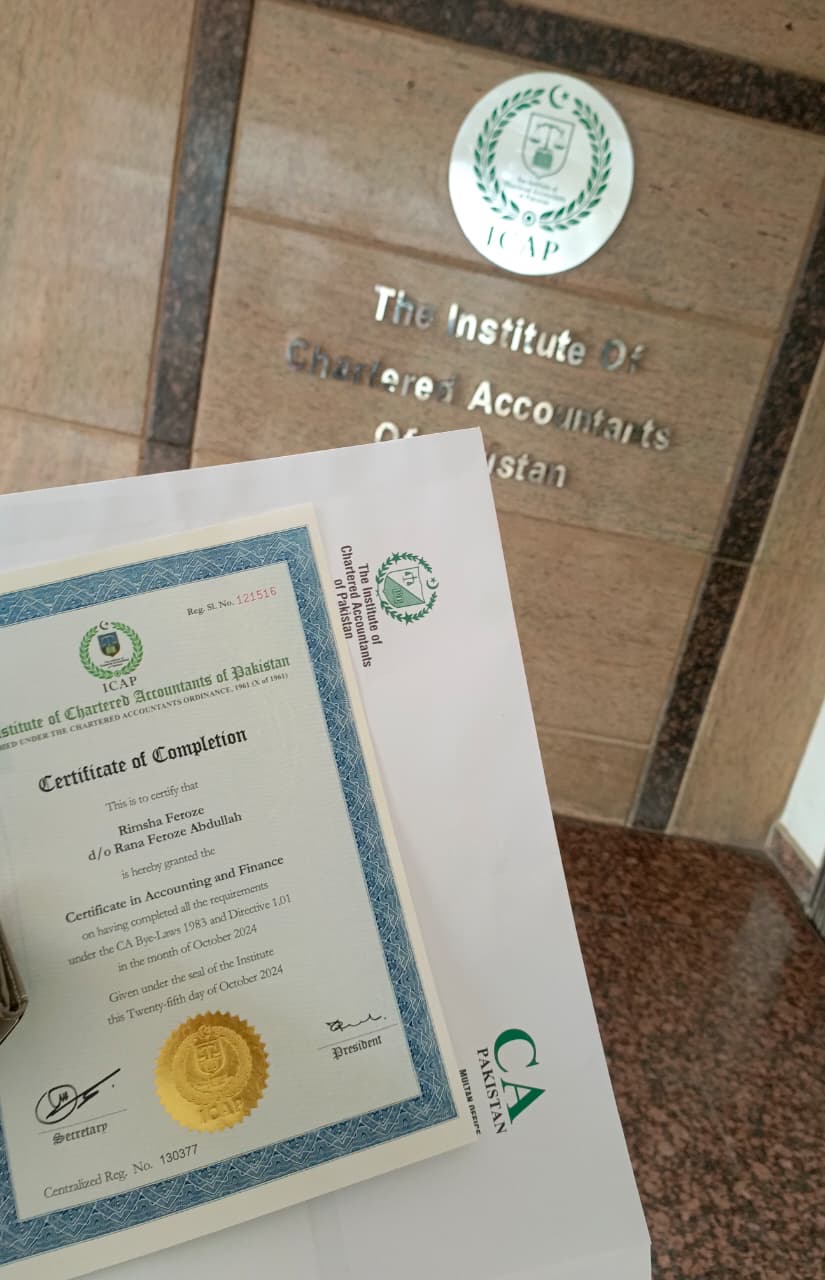
Rimsha Feroz ICAP Certificate Chartered Accountants of Pakistan CA milestone

A milestone from Rimsha’s Chartered Accountancy journey at ICAP — the analytical foundation behind her entrepreneurial ambitions.

Finance taught her patience. It taught her long-term thinking. It taught her that sustainable growth is often more valuable than rapid growth.

Rather than seeing creativity and finance as opposites, she views them as partners. One builds the systems. The other builds the story.

Everyday moments of beauty — the kind of quiet femininity that runs through everything Rimsha creates.

Building an Audience Before Building a Brand
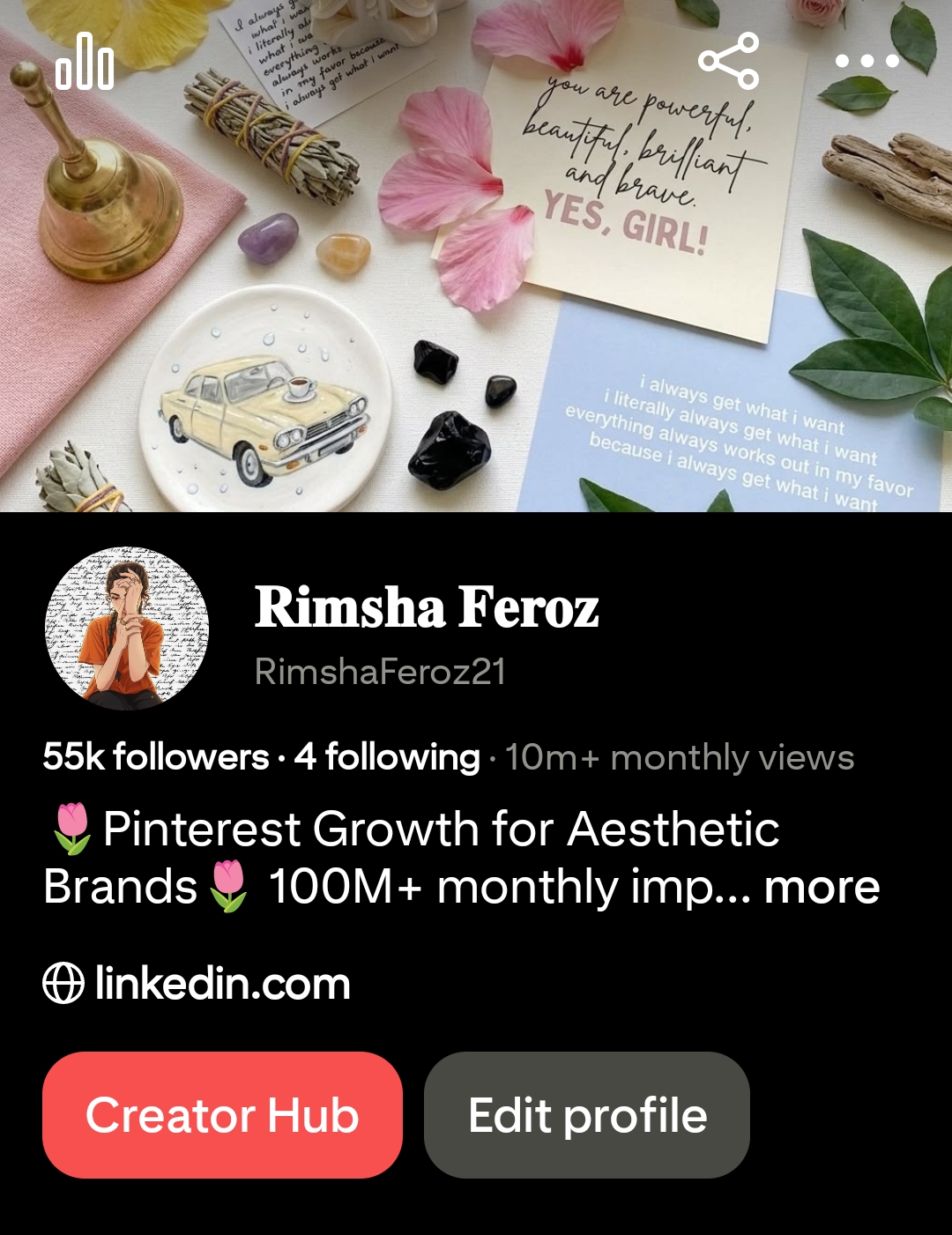
Rimsha Feroz Pinterest profile 55k followers 100 million monthly impressions

Rimsha’s Pinterest account — 55,000+ followers, 100M+ monthly impressions, and a growing community built around aesthetic storytelling.

Long before there was a fashion label, there was Pinterest. Through visual storytelling, content strategy, and a deep understanding of how people discover ideas online, Rimsha built an audience around aesthetics, creativity, and inspiration.

What appears effortless from the outside is often the result of strategy behind the scenes. Her Pinterest journey became more than a creative outlet. It became proof.
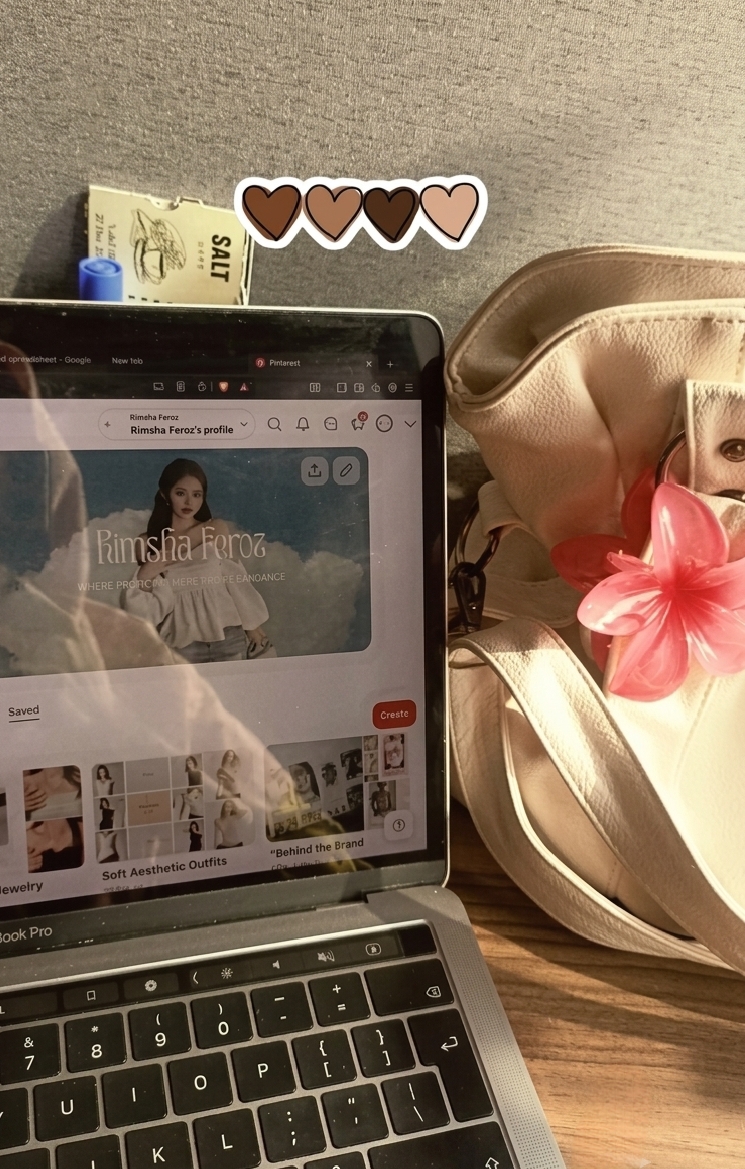
Rimsha Feroz Pinterest profile open on MacBook behind the scenes content creation strategy

Behind the scenes — building a Pinterest strategy that now reaches over 100 million people monthly.

Proof that she understood visibility before building products. Proof that she understood audience behavior before launching a brand.

A Brand That Starts With a Universe

Many fashion brands begin with products. Rimsha’s begins with a story.

The upcoming brand is inspired by flowers, fairies, femininity, elegance, and quiet magic. Rather than creating collections around trends, the vision is to build an immersive universe where each release feels like a chapter.
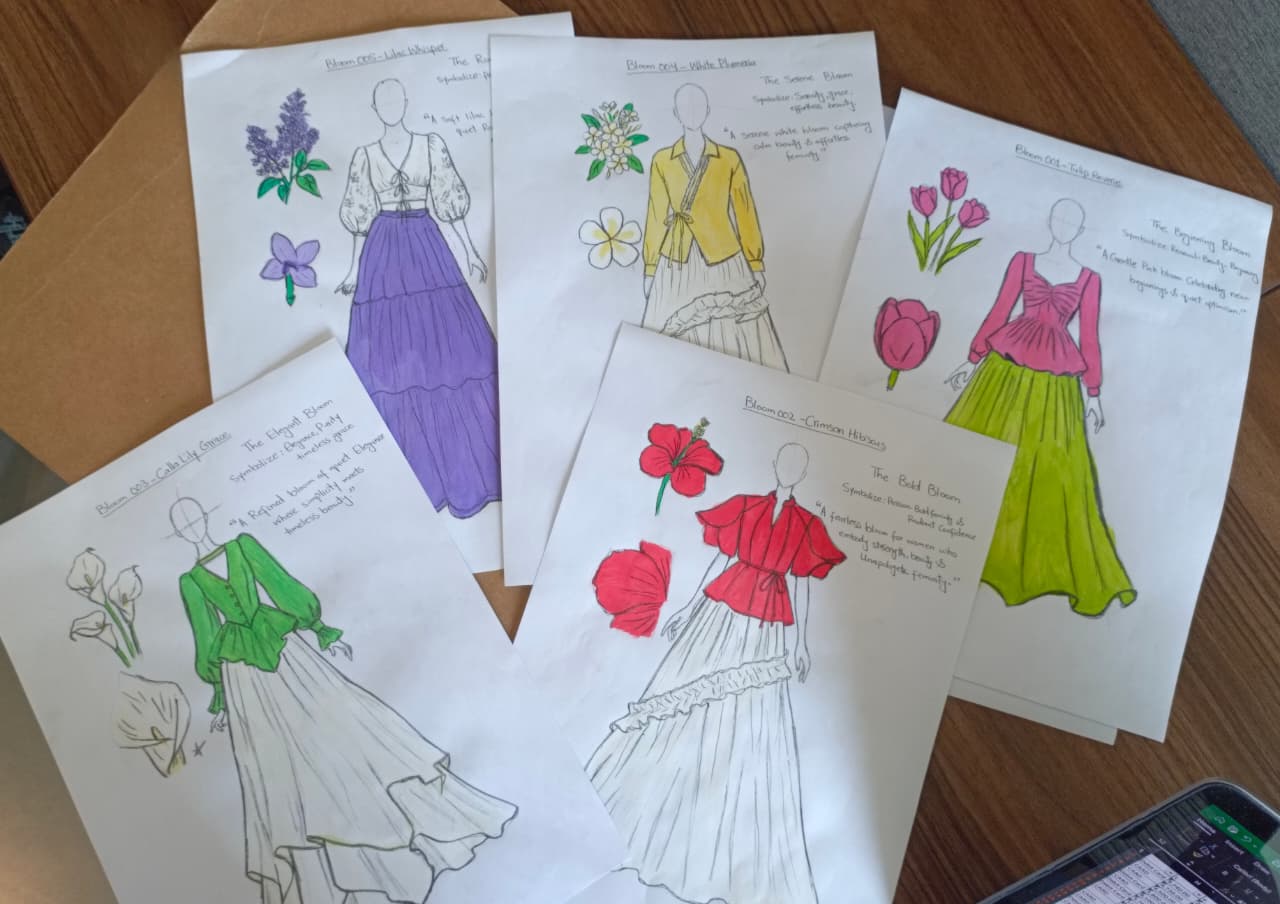
Rimsha Feroz Bloom fashion sketches floral collection concept designs brand universe

Early concept sketches from the “Bloom” series — each design named after a flower, each carrying its own symbolism and story.

A flower may symbolize resilience. A fairy may symbolize freedom. A garment may carry a story beyond its fabric.

The goal isn’t simply to sell clothing. It’s to create pieces people connect with emotionally.

From Idea to Design

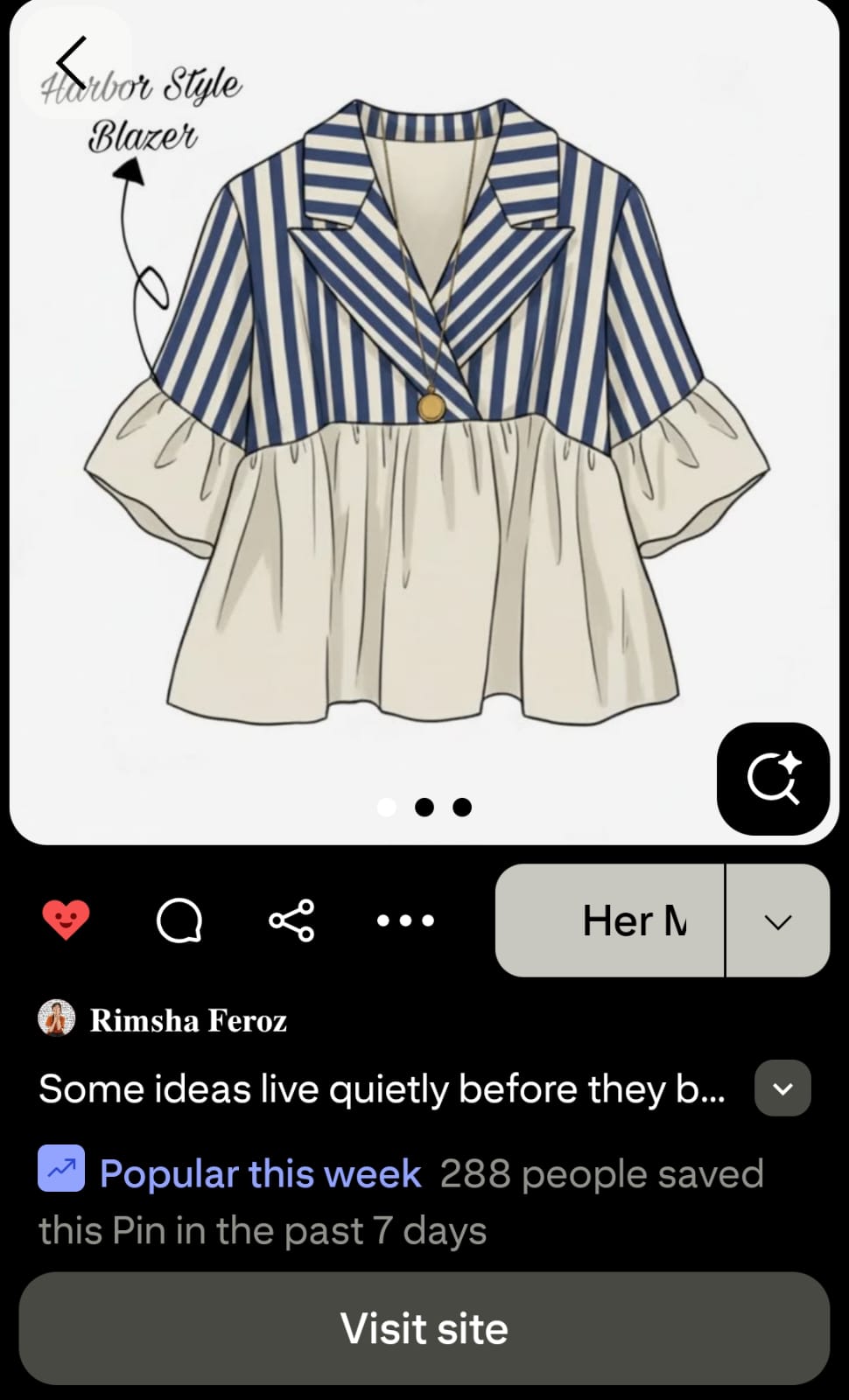
Rimsha Feroz Pinterest fashion concept Harbor Style Blazer popular pin 288 saves

One of Rimsha’s fashion concept pins — “Popular this week” with 288 saves in 7 days, proving audience resonance before the brand’s official launch.

The creative process extends beyond clothing. From jewelry concepts and fabric painting to digital fashion illustrations and visual storytelling, the brand is being developed as a complete creative ecosystem rather than a collection of products.

Some ideas remain sketches. Others evolve into prototypes. But each begins with imagination.

The Creative Who Creates

Details, textures, and storytelling elements — the soft luxury aesthetic that defines the brand’s visual identity.

What makes Rimsha’s journey compelling isn’t any single achievement. It’s the combination.

  • The CA Finalist navigating the corporate world.
  • The Pinterest creator generating more than 100 million monthly impressions.
  • The strategist building visibility before launching products.
  • The founder designing a fashion universe inspired by flowers, fairies, and storytelling.
  • The creative exploring jewelry design, fabric art, fashion concepts, and visual aesthetics.

In a world that encourages specialization, she’s building across disciplines. And that blend of analytical thinking, creative storytelling, and entrepreneurial ambition may ultimately become her greatest advantage.

Looking Ahead
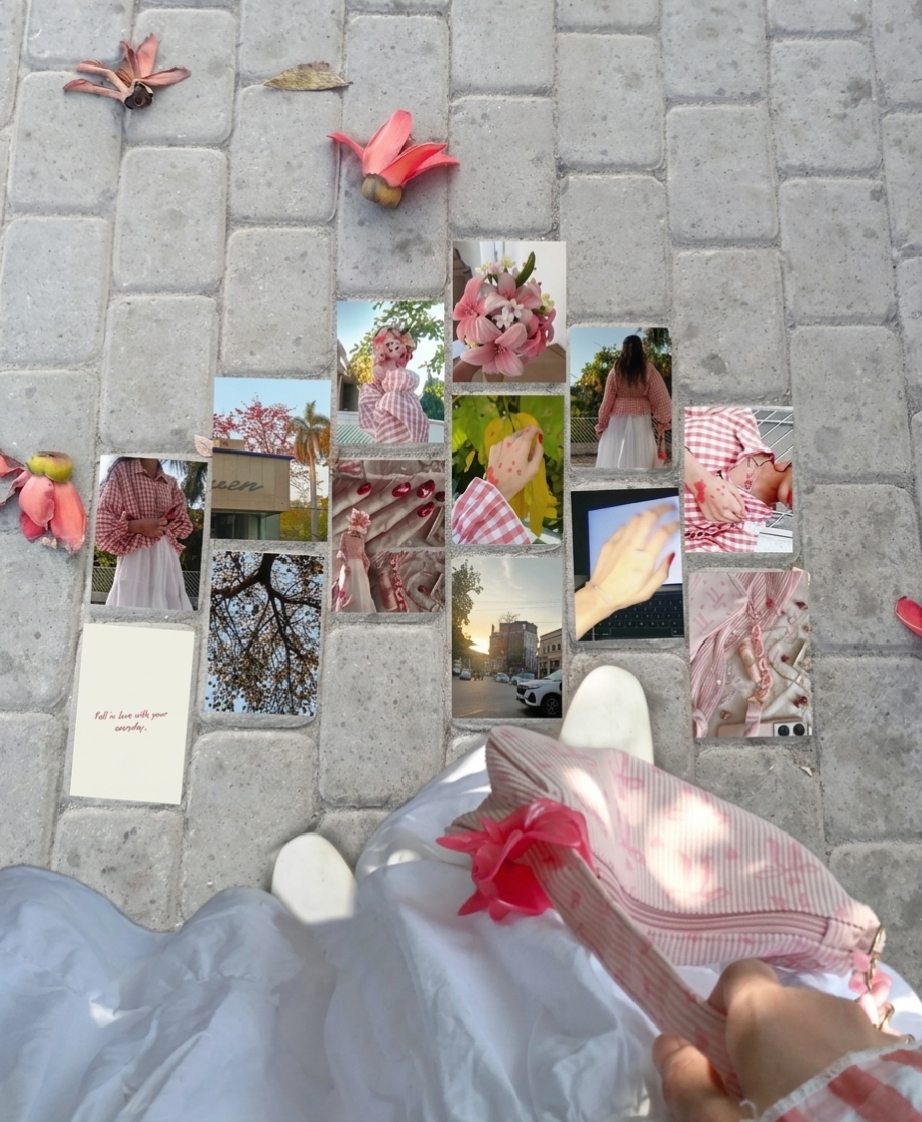
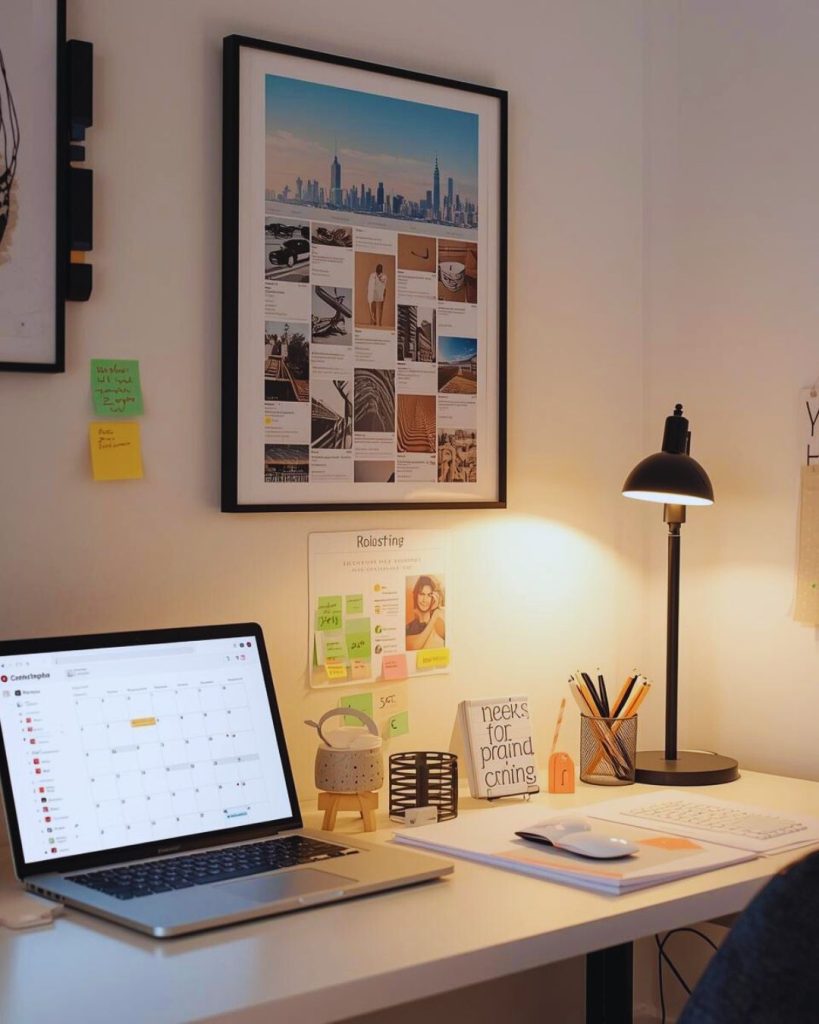
Rimsha Feroz vision board creative universe fashion brand aesthetic story

The vision board behind an evolving creative universe — still being written, one chapter at a time.

The brand has not officially launched.

Many details remain intentionally undisclosed.

The full story is still being written.

Creative  ·  Strategic  ·  Intentional

And that’s usually how the most interesting journeys begin.

Glass skyscraper reflecting sunlight melting a car and collapsing bridge showing dangerous architectural design failures

Architecture is often hailed as the perfect marriage between art and engineering. But what happens when the honeymoon ends in a catastrophic divorce? Across the globe, we see towering monuments to human ego that are either hilariously dysfunctional or terrifyingly unsafe.

From skyscrapers that melt luxury cars to bridges that “dance” in the wind, these architectural fails serve as a grim reminder that a pretty blueprint doesn’t always translate to a safe reality. Here are 40 of the most bizarre and dangerous design disasters that deserve a spot in the hall of shame.

The “Death Ray” Skyscrapers

In the quest for sleek, glass-heavy aesthetics, some architects forgot the basic laws of physics—specifically, how concave mirrors work.

  • 20 Fenchurch Street (London): Nicknamed the Walkie Talkie, this building’s curved glass focused sunlight so intensely it melted Jaguars and fried eggs on the sidewalk.
  • Vdara Hotel (Las Vegas): Designed by the same architect, this hotel features a “death ray” that singed guests’ hair and melted plastic cups by the pool.
  • The Solution: Both buildings had to be retrofitted with non-reflective film and sunshades at a massive cost.

The “Plywood Palace”: John Hancock Tower

Boston’s tallest building, the John Hancock Tower, was a marvel of modernism until its 500-pound glass panes started falling out and crashing onto the streets below.

  • The Hazard: During windstorms, the building’s sway caused the double-paned glass to delaminate and shatter.
  • The Shame: For years, empty window sockets were covered with plywood, earning it a mocking nickname and a $5 million repair bill.
  • Structural Integrity: Engineers eventually had to add 1,600 tons of steel bracing to stop the building from potentially falling over.

“Galloping Gertie”: The Tacoma Narrows Bridge

Perhaps the most famous engineering disaster in history, this Washington bridge became a viral sensation long before the internet existed.

  • The Fail: To save costs, the bridge was built with shallow plate girders that caught the wind like a sail.
  • The Outcome: Just four months after opening in 1940, the bridge began to twist and undulate violently in 42 mph winds before snapping like a twig.
  • The Lesson: It revolutionized the study of bridge aerodynamics and resonance.
  • The Lotus Riverside Collapse (Shanghai)

Imagine waking up to find your 13-story apartment complex has simply laid down for a nap.

  • The Blunder: Workers piled excavated dirt on one side of the building while digging a parking garage on the other.
  • The Physics: Heavy rain turned the ground into mud, and the pressure difference caused the entire structure to topple over—almost completely intact.
  • The Fallout: Several company executives were jailed for structural negligence.

The “Trousers” and the Wind Tunnels

Some buildings are so strangely shaped they actually change the local climate.

  • CCTV Headquarters (Beijing): Known as “The Big Trousers,” its cantilevered design creates massive wind tunnels that make walking near the base a hazardous chore for pedestrians.
  • Bridgewater Tower (Leeds): This residential skyscraper created such strong wind gusts at its base that it actually flipped over several cars and caused a pedestrian fatality.

The Ghost Town of Ordos Kangbashi

Luck isn’t always about a building falling down; sometimes it’s about a city that never “woke up.”

  • The Scale: China built a massive, futuristic city designed for one million people.
  • The Fail: High property prices and a lack of infrastructure meant the city remained 90% empty for a decade.
  • The Shame: It stands as a monument to top-down urban planning gone wrong.

Dangerous Playgrounds: The Brooklyn Bridge Park Domes

Sometimes, the “fail” is small but painful.

  • The Design: Shiny metal domes were installed in a high-end New York playground for kids to climb.
  • The Danger: In the summer sun, the metal reached temperatures hot enough to cause second-degree burns on toddlers.
  • The Public Shame: The equipment had to be removed almost immediately after its debut.

The Ryugyong Hotel: The “Hotel of Doom”

North Korea’s attempt at a 105-story pyramid has been “under construction” since 1987.

  • The Financial Toll: It cost an estimated 2% of the country’s GDP.
  • The Structural Issue: For decades, it sat as a hollow concrete shell with no windows, leading experts to question if the concrete quality was even safe for occupancy.
  • The Current State: It now sports a fancy LED facade, but remains largely empty and unopened.

Why Architectural Fails Keep Happening

Looking at these 40 examples, a few common themes emerge that explain why modern architecture often fails so spectacularly:

  • Aesthetics Over Function: Designers prioritizing “the look” over the reality of wind, sun, and gravity.
  • Cost-Cutting Measures: Substituting high-quality materials for substandard steel or concrete to meet a budget.
  • Lack of Communication: As seen in the Walkie Talkie case, vital safety features (like sun-louvres) are often cut during the final planning stages without the architect’s input.
  • Illegal Construction: The tragic 2026 collapse in Johannesburg highlights the danger of building without approved plans or structural shoring.

The Psychological Impact of Shoddiness

When a building fails, it doesn’t just hurt the wallet; it hurts the public’s trust in their environment.

  • Anxiety: People living near “Plywood Palaces” or wind-prone skyscrapers experience genuine stress.
  • Economic Ruin: For apartment owners in failing buildings, their life savings vanish the moment a structural crack appears.
  • Cultural Trauma: Great disasters like the Rana Plaza or the St. Francis Dam leave scars on the collective memory of a nation.

Can These Fails Be Prevented?

In the age of BIM (Building Information Modeling) and AI, we should be past the era of “Death Rays.”

  • Simulations: Architects can now simulate wind, heat, and seismic stress before a single brick is laid.
  • Intricacy Coordination: Clash detection software ensures that plumbing doesn’t run through structural beams.
  • Public Accountability: Social media and “public shaming” blogs ensure that developers can’t hide their design blunders from the world.

Final Thoughts: The Beauty of Resilience

The world of architecture will always have its villains, but it also has its heroes—the engineers who step in to fix the unfixable. Whether it’s the Leaning Tower of Pisa being stabilized or the John Hancock Tower finally getting its glass right, we learn more from our failures than our successes.

Laptop displaying blog analytics and income notifications representing passive income from blogging

The “dream” of waking up to notification pings from Stripe or PayPal isn’t a myth reserved for the lucky few. In 2026, the digital economy has matured, and the most reliable way to generate passive income is through a high-authority, search-optimized blog.

I didn’t build this by “writing what I felt like.” I built it by treating my blog like a piece of high-yield real estate. By mastering SEO structure, strategic internal linking, and the power of pillar posts, I created a machine that attracts micro-traffic and converts it into revenue 24/7.

If you are tired of the content treadmill and want to build a long-term traffic asset, this is the exact technical and creative framework I used.

1. The Foundation: Why Structure Beats Content

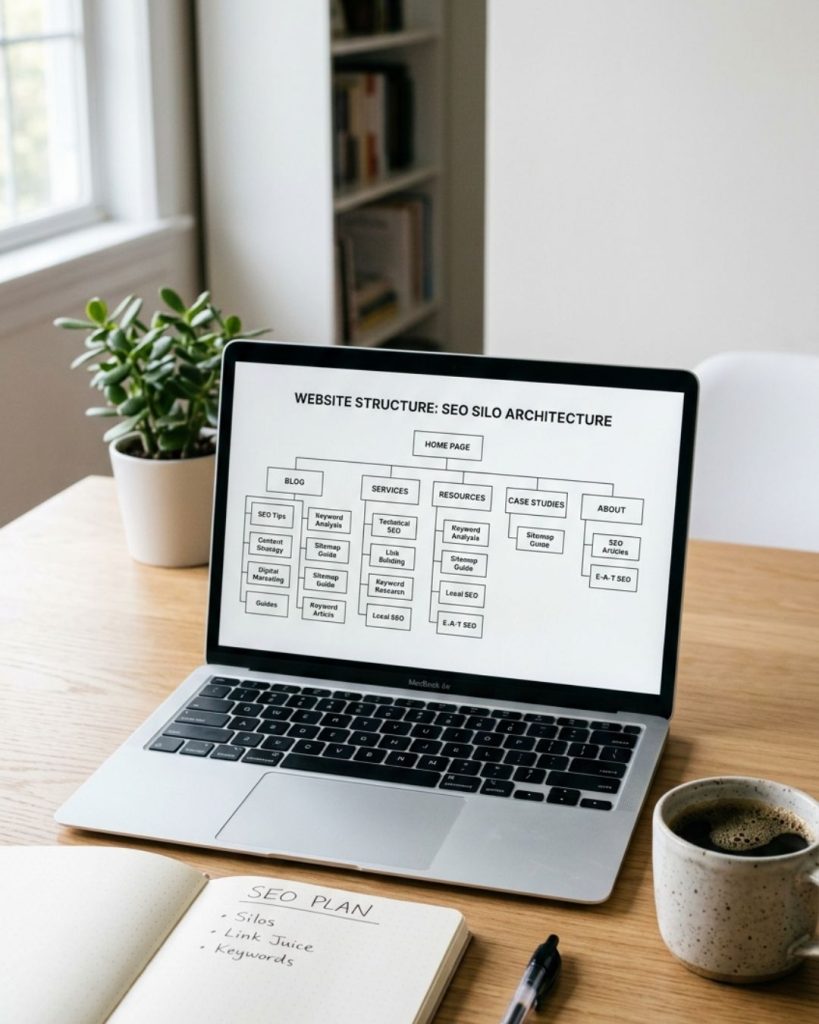
Laptop displaying organized website structure with content silos representing SEO-friendly blog architecture
A well-structured blog isn’t just easier to navigate—it’s the foundation of SEO success and long-term growth.

Most bloggers fail because they treat their site like a diary. Success in 2026 SEO requires you to treat your site like a library.

  • Logical Hierarchy: A search engine needs to know exactly what your site is about within seconds. If your structure is messy, your rankings will suffer.
  • The “Silo” Method: Group your content into clear categories. If you write about “Personal Finance,” your silos should be “Investing,” “Budgeting,” and “Debt Recovery.”
  • User Experience (UX): A clean structure isn’t just for robots. When a human can find what they need in two clicks, your dwell time increases, signaling to Google that your site is valuable.
  • Crawl Budget: By organizing your site properly, you ensure that search engine bots find your most important “money pages” first.

2. The Power of Pillar Posts: Your Content Skyscrapers

Illustration of a pillar blog post connected to smaller articles showing hub and spoke SEO content strategy
Pillar posts are your content skyscrapers—built to dominate search and support everything around them.

A pillar post (also known as a cornerstone content piece) is a massive, comprehensive guide that covers a core topic in your niche from A to Z.

  • Deep Value: These posts are usually 3,000+ words. They provide so much value that they become the “go-to” resource for that specific high-intent keyword.
  • Topical Authority: When you write the definitive guide on a subject, you prove to AI search engines that you have the E-E-A-T (Experience, Expertise, Authoritativeness, and Trustworthiness) required to rank #1.
  • The “Hub” Concept: Your pillar post acts as the “hub.” All smaller, more specific articles (the “spokes”) will link back to this giant resource.
  • Evergreen Nature: A well-researched pillar post on a topic like “How to Start a Faceless YouTube Channel” will stay relevant for years with only minor updates.

3. Mastering Internal Linking: The Secret “SEO Juice”

Connected blog pages with linking pathways representing internal linking strategy and SEO authority distribution
Internal linking turns isolated posts into a powerful network that boosts rankings and keeps traffic flowing.

If your blog posts are islands, they will sink. Internal linking is the bridge system that keeps your “SEO juice” flowing throughout your entire site.

  • Distributing Authority: When an old post gets a backlink from an external site, you can “pass” that authority to your new posts by linking to them.
  • Contextual Relevance: Use descriptive anchor text. Instead of “click here,” use “advanced keyword research strategies.” This tells the search engine exactly what the next page is about.
  • Reducing Bounce Rate: Strategic links keep readers on your site longer. If they finish an article on “SEO Structure,” give them a link to “Internal Linking” to keep them in your ecosystem.
  • The “Link Circle”: Ensure your pillar posts link to your sub-topics, and every sub-topic links back to the pillar. This creates a closed loop of authority.

4. Keyword Research for High-Intent Traffic

Laptop showing keyword research with long-tail and high-intent search queries for SEO traffic and conversions
High-intent keywords bring the right audience—not just more traffic, but better conversions.

I stopped chasing “high volume” and started chasing “high intent.” I’d rather have 100 visitors who want to buy than 10,000 who just want to browse.

  • Long-Tail Keywords: These are specific phrases like “best budget cameras for faceless channels 2026.” They have lower competition and much higher conversion rates.
  • Commercial Intent: Focus on keywords that include words like best, review, vs, comparison, or how to. These users are at the bottom of the funnel.
  • The “People Also Ask” Goldmine: Use Google’s own data to find the exact questions your audience is asking and answer them in your sub-headings.
  • Semantic SEO: Use LSI keywords (latent semantic indexing) to help AI models understand the context of your writing without keyword stuffing.

5. On-Page SEO: The 2026 Checklist

Laptop and smartphone showing optimized blog page with headings, URL structure, and SEO elements for better rankings
Perfect on-page SEO turns your content into a high-ranking, traffic-generating machine.

To rank in 2026, your on-page technicals must be flawless. The competition is too high for “good enough.”

  • H1, H2, and H3 Tags: Use your headers to create an outline. Your primary keyword should be in the H1, and secondary keywords in the H2s.
  • URL Slugs: Keep them short and descriptive. /seo-structure-guide is better than /blog/post/2026/04/01/how-to-do-seo-structure.
  • Mobile Optimization: More than 80% of your “sleep income” will come from mobile users. If your site doesn’t load in under 2 seconds, you’re losing money.
  • Image Alt Text: Don’t just describe the image; use it as an opportunity for semantic keywords to help you show up in visual search.

6. Monetization: Turning Traffic into “Sleep Income”

Laptop showing passive income streams like affiliate marketing, ads, and digital products generating revenue overnight
Turn your traffic into income streams that work for you—even while you sleep.

A blog that pays you while you sleep needs a diversified monetization strategy that doesn’t require active selling.

  • Affiliate Marketing: This is the king of passive income. By recommending products within your pillar posts, you earn a commission every time someone clicks and buys.
  • Display Ads: Once you hit a certain traffic threshold, platforms like Mediavine or AdThrive (Raptive) will pay you premium rates just for people viewing your content.
  • Digital Products: Sell what you know. A $29 SEO checklist or a $99 content calendar template can be sold an infinite number of times with zero overhead.
  • Automated Email Funnels: Use your blog to capture emails. An automated sequence can then sell your high-ticket courses or consulting services on autopilot.

The 28-Day “Update” Cycle

The internet moves fast. To keep your blog paying you, you have to keep your assets “fresh” in the eyes of the algorithm.

  • Content Refreshing: Every few months, go back to your top-performing pillar posts. Update the dates, check for broken links, and add new data or insights.
  • Link Audits: Ensure your internal linking is still pointing to your most relevant and profitable pages.
  • User Feedback: Look at your comments and “time on page” metrics. If people are leaving a page quickly, it means the content isn’t hitting the mark. Fix it.
  • AI Integration: Use AI tools to help you summarize your long posts for “Featured Snippets,” ensuring you take up the most real estate on the Search Engine Results Page (SERP).

Why “Skin in the Game” (E-E-A-T) is Your Moat

In a world full of AI-generated fluff, personal experience is the only thing that cannot be automated.

  • Case Studies: Don’t just say “SEO works.” Show a screenshot of your traffic growth.
  • Personal Tone: Use “I” and “Me.” Share your failures. Readers in 2026 crave authenticity over corporate perfection.
  • Unique Data: If you can conduct your own small experiments and share the results, you become a “source” that other blogs will link to, skyrocketing your authority.

The Snowball Effect: From $0 to $10,000+

Building a blog is slow at first, then incredibly fast. It is the definition of exponential growth.

  • The 6-Month Ghost Town: Most people quit here. This is when you are building your pillar posts and nobody is reading them yet.
  • The Tipping Point: Around month 9-12, Google starts to trust your SEO structure. Your older posts start to rank, and your traffic begins to double every few months.
  • The Authority Phase: This is when you can rank for new keywords within days because your site is a recognized leader in your evergreen niche.

Final Thought: Build Assets, Not Just Content

If you want to make money while you sleep, stop thinking like a writer and start thinking like a developer. Every post you publish should be a long-term traffic asset designed to solve a problem and lead to a conversion.

Master the SEO structure, weave a tight web of internal linking, and invest your time in pillar posts. The work you do today can pay your rent three years from now. That is the true power of a well-built blog.

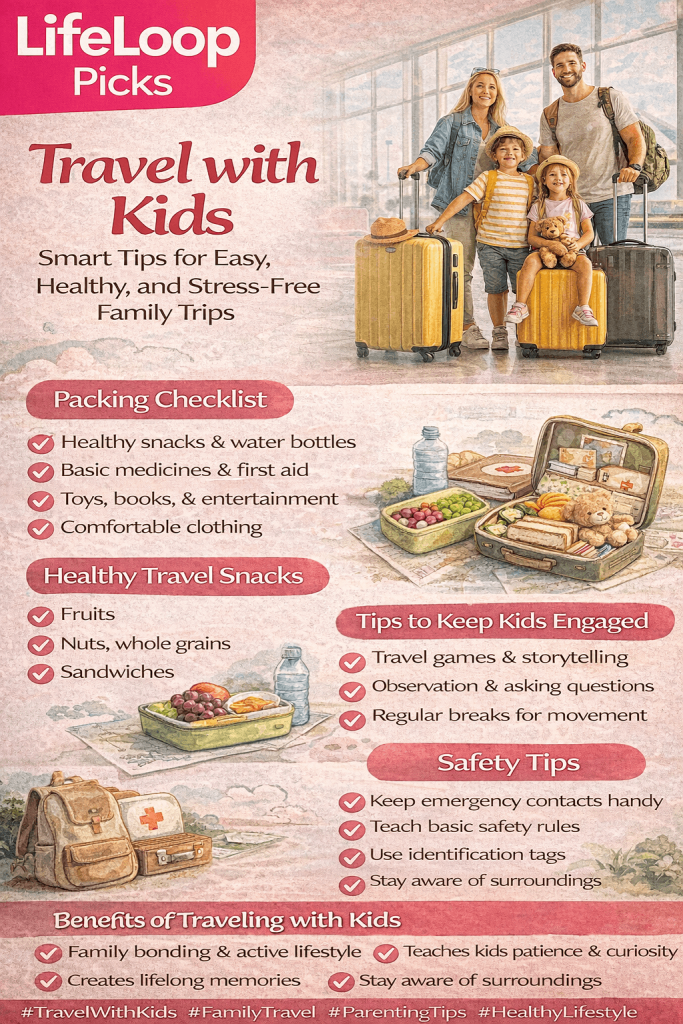
Why Travel with Kids Can Be a Beautiful Experience

Travel with kids may seem challenging at first, but with the right approach, it can become one of the most rewarding experiences for both parents and children.

For health conscious families, travel is not just about visiting places. It is about bonding, learning, and creating a balanced lifestyle filled with movement, fresh air, and new experiences.

With a little planning and the right mindset, traveling with kids can be smooth, enjoyable, and even relaxing.


Why Traveling with Kids is Important for Their Growth

Travel with kids plays a significant role in their physical, emotional, and mental development. It exposes them to new environments, cultures, and experiences.

Children learn adaptability, patience, and curiosity while traveling. It also helps reduce screen time and encourages outdoor activity, which is essential for overall health.

For parents, it creates meaningful family moments that strengthen relationships and build lasting memories.


Planning Ahead: The Key to Stress-Free Travel with Kids

Proper planning is the foundation of a successful family trip. When you travel with kids, preparation reduces unexpected stress and keeps everything organized.

Start by choosing kid-friendly destinations and accommodations. Look for places with open spaces, safety, and easy accessibility.

Make a checklist of essentials such as clothes, snacks, medicines, and entertainment items. Planning ahead allows you to focus more on enjoying the journey.


Packing Smart for Travel with Kids

Packing efficiently can make a huge difference when traveling with children. Overpacking can create unnecessary stress, while underpacking can lead to discomfort.

Essentials to Carry:

  • Healthy snacks and water bottles
  • Basic medicines and first aid
  • Comfortable clothing
  • Toys or books for entertainment

Keeping everything organized in separate pouches helps you access items quickly during travel.


Healthy Eating While Traveling with Kids

Maintaining healthy eating habits during travel is important, especially for kids. Junk food may seem convenient, but it can affect energy levels and mood.

Carry homemade snacks like fruits, nuts, or sandwiches. Choose balanced meals whenever possible. Hydration is equally important, so encourage kids to drink water regularly.

Healthy eating keeps children active and reduces fatigue during the trip.


Keeping Kids Engaged During the Journey

Long journeys can be tiring for children, which often leads to boredom or restlessness. Keeping them engaged is essential for a smooth experience.

You can involve kids in activities like storytelling, simple games, or travel journals. Allowing them to observe surroundings and ask questions also keeps them interested.

Engagement not only passes time but also enhances their learning experience.


Choosing the Right Travel Mode

Selecting the right mode of transport can greatly impact your experience when you travel with kids. Each option has its own advantages.

Flights are faster but may require more planning. Road trips offer flexibility and frequent breaks. Train journeys can be comfortable and enjoyable for children.

Choose what suits your schedule, budget, and comfort level.


Managing Routine While Traveling

Children feel more comfortable when their routine is maintained. While traveling, try to keep basic habits consistent.

Maintain regular meal times and ensure they get enough sleep. Even small routines like bedtime stories can provide a sense of familiarity.

Balancing routine with flexibility helps children stay calm and happy throughout the trip.


Safety Tips for Traveling with Kids

Safety should always be a priority when traveling with children. Simple precautions can prevent major issues.

  • Keep emergency contacts handy
  • Teach kids basic safety rules
  • Use identification tags if needed
  • Stay aware of surroundings

Being prepared ensures peace of mind for parents and a safe environment for kids.


Real-Life Example: A Smooth Family Trip

A family traveling with two young children planned their trip in advance. They packed healthy snacks, scheduled regular breaks, and included fun activities during the journey.

As a result, the children stayed engaged and energetic. The parents experienced less stress and enjoyed the trip fully.

This example shows that small efforts can lead to a much better travel experience.


Common Mistakes to Avoid

While traveling with kids, some common mistakes can create unnecessary stress. Avoid overpacking or planning too many activities in one day.

Ignoring children’s needs like rest and food can also lead to discomfort. It is important to stay flexible and adjust plans when needed.

Keeping things simple often leads to a more enjoyable trip.


Benefits of Traveling with Kids

Traveling with children offers several long-term benefits that go beyond the trip itself.

  • Builds stronger family bonds
  • Encourages physical activity
  • Enhances learning and curiosity
  • Improves emotional well-being

These benefits make travel an essential part of a healthy lifestyle.


FAQs on Travel with Kids

How do I make travel with kids easier

Plan ahead, pack smart, and keep kids engaged during the journey.


What are the best snacks for kids while traveling

Fruits, nuts, sandwiches, and homemade snacks are healthy options.


Is traveling stressful for children

It can be, but proper planning and routine management can make it enjoyable.


How can I keep my child entertained during travel

Use games, storytelling, books, and interactive activities.


What is the best age to travel with kids

There is no perfect age. With proper preparation, kids of all ages can travel comfortably.


Conclusion: Make Travel with Kids a Joyful Experience

Travel with kids does not have to be stressful. With the right planning, healthy habits, and a flexible approach, it can become one of the most enjoyable parts of your life.

Focus on creating experiences rather than perfection. Small moments, laughter, and shared memories matter the most.

Start planning your next trip and make travel a regular part of your family’s healthy lifestyle.

Entrepreneur starting an online business with laptop and free digital tools representing making money online with no investment.

AI – Being broke is not a permanent state; it is often a lack of access to the right scaling systems. In the digital economy of 2026, the barrier to entry has officially hit zero. You no longer need “seed money” or a venture capitalist to back your ideas. If you have a smartphone, an internet connection, and the discipline to execute, you have everything required to build a profitable online business.

This guide is a “zero-to-one” manual. We are stripping away the fluff and focusing on a zero investment plan that utilizes free AI tools and automation workflows to generate income from thin air. If your bank account is at zero, your greatest asset is your time—and we are going to show you how to invest it with mathematical precision.

The Psychology of the Zero-Dollar Start

Most people never start because they believe they need a “professional” setup. They want the paid software, the expensive microphone, and the premium hosting. This is a form of procrastination. The “quietly rich” started with free tools and only upgraded once the business paid for the tools.

The Rules of the Zero-Investment Model

  • Sweat Equity First: You replace capital with manual research and content batching.
  • Leverage Free Platforms: Use high-traffic “rented” land (like TikTok, Medium, or YouTube) to build your initial audience.
  • Reinvest Everything: The first $100 you make shouldn’t go to a steak dinner; it should go into a domain name or a basic automation tool.

Phase 1: The High-Demand “Skill Arbitrage”

Entrepreneur using AI writing tool to improve business content for clients.
Solve business problems using AI and get paid for the solution.

If you are broke, you need cash flow fast. The quickest way to get it is service arbitrage. This involves finding a business problem and using a free AI tool to solve it better and faster than a human could five years ago.

Step 1: Identify the “Pain Points”

Local businesses and creators are drowning in the need for content. They need SEO-optimized descriptions, social media captions, and video scripts.

  • The Opportunity: Offer “Content Refresh” packages.
  • The Tool: Use the free tiers of blogging AI or large language models to generate high-quality drafts in seconds.

Step 2: The “Outreach” Machine

Don’t wait for clients to find you on saturated gig sites.

  • Use Google Maps to find local businesses with poor descriptions.
  • Rewrite one for them for free as a “gift.”
  • Send it via email with a note: “I noticed your profile could use an SEO boost. I did this for you; if you like it, I can do your whole catalog.”

Phase 2: Building Your “Digital Real Estate” (Free)

Laptop showing blog publishing platform representing building digital assets online.
Your digital assets can work for you 24/7.

Once you have a tiny bit of breathing room, you must stop trading hours for dollars and start building digital assets. This is where passive income begins.

Creating a Content Factory

You don’t need a paid website to start a blog. Platforms like Medium, Substack, and LinkedIn Articles have massive built-in audiences and cost $0 to use.

  • Topical Authority: Choose one niche (e.g., “AI tools for accountants” or “Sustainable gardening tips”).
  • SEO Strategy: Use free keyword research tools to find long-tail keywords that have low competition but high intent.
  • The 30-Day Blitz: Commit to a content batching schedule where you produce 30 articles in 5 days. Use AI writing assistants to structure your thoughts and ensure your posts are SEO-friendly.

Phase 3: The Power of Content Batching & Repurposing

Content creator planning social media and blog posts using batching strategy.
One idea can create content for an entire week.

The biggest mistake “broke” entrepreneurs make is working too hard on one platform. To scale, you must be everywhere at once without spending a dime.

The “One-to-Many” Workflow

  1. The Anchor: Write one high-value, SEO-optimized blog post on a free platform.
  2. The Chop: Use free AI tools to break that post into 5 Twitter (X) threads, 3 LinkedIn posts, and 10 “hooks” for short-form video.
  3. The Visuals: Use free graphic design platforms (like Canva’s free tier) to create templates.
  4. The Distribution: Spend two hours on a Sunday content batching your social media for the entire week.

By doing this, you aren’t just a “blogger”; you are a multi-channel media brand. This increases your surface area for luck and income.

Phase 4: Monetization Without a Product

Affiliate marketing dashboard showing earnings growth from digital content.
A product to start making money online.

You don’t need to manufacture a product to make money. You can monetize other people’s hard work through affiliate marketing and lead generation.

Zero-Cost Monetization Models

  • Curated Affiliate Lists: Create “Top 10” lists for free software or tools that offer affiliate programs. When someone signs up through your SEO-friendly review, you get a commission.
  • Digital Lead Gen: Find a service provider (like a web designer). Tell them you will send them leads for a 20% cut. Use your free content to attract people looking for that service.
  • Ad Revenue: Platforms like YouTube and Medium pay you directly once you reach their “partner” milestones. This is the ultimate scalable digital model.

Phase 5: Implementing Automation Tools (Free Tiers)

Digital automation workflow connecting content platforms to grow online business.
Automation turns small efforts into scalable income.

As your “side hustle” grows, you will run out of time. This is the danger zone where most people quit. The solution is automation tools that have generous free tiers (like Zapier, Make, or IFTTT).

What to Automate First

  • Social Posting: Auto-post your blog links to your social channels.
  • Lead Capture: Use free Google Forms to collect email addresses of people interested in your content.
  • Email Marketing: Use the free tier of email providers to send a weekly newsletter to your growing list.

“Automation is the ’employee’ that never sleeps, never complains, and works for $0 a month until you’re ready to scale.”

The “Broke-to-Boss” 90-Day Roadmap

If you started today with $0, here is exactly what your schedule should look like:

  1. Days 1-15: The Research Phase
  1. Find your niche.
  2. Identify 50 high-intent keywords.
  3. Set up your free profiles on Medium, TikTok, and Twitter.
  4. Study successful scalable digital models in your space.
  • Days 16-45: The Content Explosion
  1. Engage in aggressive content batching. Aim for 2 posts per day.
  2. Use AI tools to maintain quality while increasing quantity.
  3. Focus on providing “insane value”—solve problems for free to build trust.
  • Days 46-75: The Outreach & Networking Phase
  1. Reach out to 10 potential “referral partners” or clients per day.
  2. Comment on 20 “big” accounts in your niche to steal their “eyeballs” and redirect them to your profile.
  3. Start your free newsletter to “own” your audience.

Days 76-90: The Monetization Pivot

  • Insert your affiliate links into your highest-performing posts.
  • Offer a “Premium” version of your service or a small digital download (created for free using AI).
  • Analyze your data to see which scaling systems are working and double down.

Common Pitfalls to Avoid When You’re Broke

When you have no money, your “time-to-money” ratio is everything. Don’t fall into these traps:

  • Over-Designing: Your logo doesn’t matter. Your font doesn’t matter. Your value proposition does.
  • The “One More Video” Trap: Stop watching “how-to” videos and start doing the “how-to.”
  • Buying Courses: Everything you need to know is available for free in the documentation of AI tools and on YouTube. Don’t spend your last $50 on a “guru” course.

The Future is Yours to Build

The gap between “broke” and “financially free” is no longer a mountain of cash—it is a mountain of content and systems. By using blogging AI, automation tools, and a rigorous content batching schedule, you are building a machine that eventually detaches your income from your time.

The “quiet wealth” being created right now is built on the backs of these free technologies. In 2026, the only thing standing between you and a $10k/month business is the willingness to learn the scaling systems and put in the “boring” work of daily execution.

The tools are free. The information is free. The platforms are free. The only thing that isn’t free is the effort.

Confident professional woman in boardroom facing skeptical colleagues, illustrating credibility bias linked to attractiveness.

We’ve all felt it—that subtle, magnetic pull toward someone who seems “put together.” Whether it’s a job interview, a first date, or a networking event, attractive individuals often seem to glide through doors that remain locked for others.

Is it fair? Perhaps not. Is it real? Absolutely. In the realm of behavioral psychology, this phenomenon is more than just vanity; it is a deeply ingrained survival mechanism. Welcome to the world of beauty bias and the Halo Effect, where your appearance acts as a silent resume before you even open your mouth.

In this deep dive, we’re breaking down the data-driven reasons why physical attractiveness translates into real-world opportunities and how you can use this knowledge to level the playing field.

1. The Halo Effect: Your Brain’s Favorite Shortcut

Interview scenario showing stronger positive reaction toward polished candidate due to halo effect.
Your appearance shapes assumptions before you speak.

At the heart of why attractive people get more opportunities is the Halo Effect. This is a cognitive bias where our overall impression of a person influences how we feel and think about their character in specific areas.

  • The Positive Projection: When we see someone who is conventionally attractive, our brains automatically “fill in the blanks” with other positive traits like kindness, intelligence, and honesty.
  • The Evolutionary Root: Historically, symmetry and clear skin were indicators of health and reproductive fitness. Our ancestors programmed us to seek out these traits as signs of “good” genes.
  • The Modern Glitch: Today, that same instinct misfires. We see a well-groomed professional and subconsciously think, “They must be great at Excel,” even though there is zero correlation between a jawline and spreadsheet proficiency.

2. The “What is Beautiful is Good” Stereotype

Professional leading meeting confidently while colleagues listen, illustrating beauty bias in leadership.
We assume attractive people are more capable.

Social psychologists Karen Dion, Ellen Berscheid, and Elaine Walster famously pioneered the study titled “What is Beautiful is Good.” Their research proved that attractive individuals are consistently rated higher in:

  • Social Competence: People assume they are more outgoing and poised.
  • Professional Potential: Employers often view them as more “leader-like.”
  • Personal Happiness: We falsely assume they lead more fulfilling lives, making us want to be in their orbit.

This stereotype creates a social lubricant. Because people expect attractive individuals to be capable, they give them more chances to prove it, creating a self-fulfilling prophecy of success.

3. The Economic “Beauty Premium”

Professional closing business deal symbolizing salary advantage linked to attractiveness.
Better perception often means better pay.

Let’s talk numbers. In labor economics, the “beauty premium” is the measurable increase in earnings for those considered above-average in looks.

  • The Wage Gap: Studies show that physically attractive men and women earn roughly 10% to 15% more than their “plain” counterparts.
  • The Hiring Edge: In a 2026 workplace study, resumes with an attractive headshot (in regions where photos are standard) received 40% more callbacks than identical resumes without one.
  • Negotiation Power: Attractive negotiators are often perceived as more persuasive. Their presence lowers the “guard” of the person across the table, leading to better deals and higher salaries.

4. Confidence: The Hidden Engine of Attractiveness

Professional adjusting blazer in mirror representing self-confidence and self-perception boost.
Confidence amplifies perceived attractiveness.

Here is where the psychology gets interesting: it’s not just about the face; it’s about the internal feedback loop.

  • Positive Reinforcement: From childhood, attractive people often receive more positive attention. This builds a baseline of high self-esteem.
  • The Boldness Bias: Because they expect to be liked, they take more risks. They speak up in meetings, apply for “reach” jobs, and initiate conversations.
  • Behavioral Confirmation: When you act confident, people treat you as competent. This reinforces your confidence, creating a powerful upward spiral of career growth.

5. The Dark Side: When Beauty Becomes a Barrier

Confident professional woman in boardroom facing skeptical colleagues, illustrating credibility bias linked to attractiveness.
Sometimes beauty opens doors. Sometimes it raises doubts.

It’s not all sunshine and roses. Pretty privilege has its own set of psychological traps that can actually hinder progress in certain niches.

  • The “Bimbo/Himbo” Myth: In highly technical or academic fields, extreme physical attractiveness can sometimes trigger a “lack of substance” bias. People might assume you didn’t have to work hard for your achievements.
  • Same-Sex Bias: Research suggests that in hiring scenarios, some managers may reject a highly attractive candidate of the same gender to avoid feelings of competition or threat within the social hierarchy.
  • The Credibility Tax: Attractive women, in particular, often report having to work “twice as hard” to prove their intellectual authority in male-dominated industries like engineering or finance.

6. Perception Management: How to “Hack” Your Opportunities

Professional grooming essentials arranged neatly to symbolize appearance investment.
Effort beats genetics.

The data shows that appearance-based advantages aren’t just about bone structure—they are about grooming, posture, and presentation. You can “manufacture” your own version of the beauty premium by focusing on perceived effort.

A. Master Your “Enclothed Cognition”

The clothes you wear don’t just change how others see you; they change how you think. Wearing “high-status” attire increases testosterone levels and lowers stress hormones, making you perform better under pressure.

B. Optimize Your Non-Verbal Cues

  • The Power of the Smile: A genuine Duchenne smile activates the reward centers in the observer’s brain, making you appear more trustworthy.
  • The Spine Hack: Standing tall isn’t just about height; it’s about occupying space. High-power poses signal to the lizard brain of others that you are a “leader.”
  • Eye Contact: Keeping steady eye contact for 3-5 seconds creates a psychological bond that mimics the intimacy of long-term rapport.

C. The Grooming Gap

Data consistently shows that “well-groomed” individuals receive nearly the same social benefits as those who are “naturally” beautiful. A tailored fit, a clean haircut, and healthy skin signal attention to detail—a trait every employer craves.

7. The Digital Dimension: Attractiveness in the 2026 Landscape

Professional on video call with clean lighting and polished appearance illustrating digital beauty bias.
Your profile picture is your silent resume.

In our world of Zoom calls and AI-generated avatars, visual branding has never been more vital.

  • Video Call Psychology: Using high-quality lighting and a clean background on video calls creates a digital “Halo Effect.” It tells your team that you are organized and professional.
  • LinkedIn Presence: Your profile picture is your 24/7 digital lobby. An optimized professional headshot can increase your “reach” by 14x compared to a casual selfie.

Why We Must Move Beyond the Surface

While we must acknowledge the reality of behavioral psychology, we also have a responsibility to mitigate these biases.

  • Blind Hiring: Progressive companies are now using “blind auditions” for resumes to ensure that meritocracy wins over beauty bias.
  • Awareness Training: By simply knowing that the Halo Effect exists, managers can consciously pause and ask, “Am I hiring this person because they are the best, or because I simply like looking at them?”

Final Thoughts: Your Strategy for Success

The truth is, attractive people get more opportunities because humans are visual, tribal, and shortcut-oriented creatures. However, pretty privilege is a “foot in the door” tool—it is never the foundation of a lasting empire.

To truly win, you must combine presentation with substance. Use the psychology of attractiveness to get the meeting, but use your unrivaled skills and relentless work ethic to close the deal.

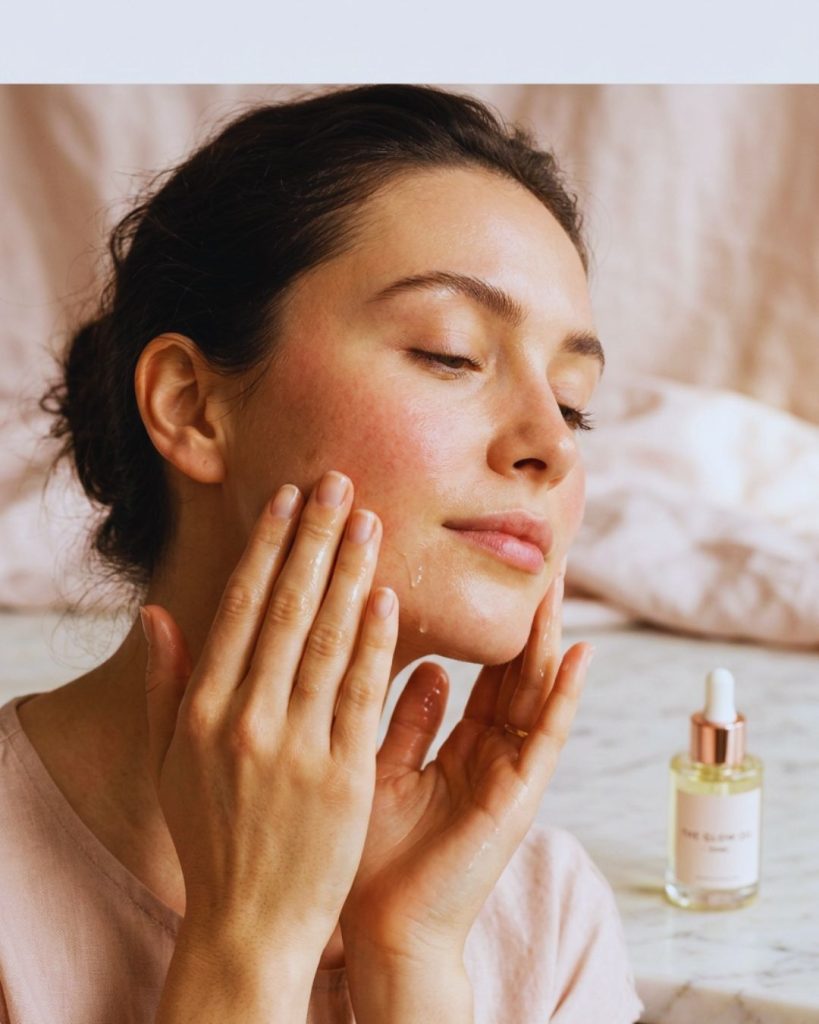
Glowing woman massaging her face with facial oil on a marble vanity, luxury skincare jars blurred in background.

In a world obsessed with luxury beauty brands and $300 serums, we have been conditioned to believe that a radiant glow requires a heavy financial investment. We see 10-step routines and high-tech facial gadgets flooding our feeds, making us feel that “real” beauty is reserved for those with deep pockets.

But what if the most transformative beauty habit in your arsenal cost less than a fancy latte?

The truth that the skincare industry doesn’t want you to know is that your skin responds far better to biological consistency than it does to expensive packaging. There is a single, $5 habit that—when done correctly—can outperform the most prestigious creams on the market.

That habit is strategic facial massage combined with a simple, high-purity carrier oil.

The Myth of the Expensive Glow

We often confuse price with potency. We assume that if a product costs more, it must contain a “miracle” ingredient that will bypass the laws of biology. However, dermatology experts agree that most luxury products are 90% water and fillers, with only a tiny fraction of active ingredients.

  • Marketing vs. Results: You aren’t paying for the glow; you’re paying for the glass bottle and the celebrity endorsement.
  • The Barrier Issue: Even the most expensive serum cannot penetrate the skin barrier if your circulation is sluggish and your lymphatic system is backed up.
  • The Natural Alternative: A $5 bottle of pure sweet almond oil or sunflower seed oil provides the same fatty acids found in luxury oils, without the irritating synthetic fragrances.

The $5 Powerhouse: Strategic Facial Massage

Woman massaging her face with facial oil using upward strokes to improve circulation and reduce puffiness.
Five minutes. A few drops of oil. Real sculpting results.

The habit that truly “changes your face” is the daily practice of manual lymphatic drainage and muscle stimulation. By using a simple lubricant (like a $5 oil), you can perform a professional-grade treatment at home.

1. Oxygenation and Blood Flow

  • When you massage your skin, you increase microcirculation.
  • This rush of blood brings fresh oxygen and nutrients to the surface cells.
  • Result: An immediate, natural rosy flush and a long-term increase in cellular repair.

2. Lymphatic Drainage

  • Our faces hold a significant amount of “stagnant” fluid, especially around the jaw and under the eyes.
  • Unlike the heart, the lymphatic system doesn’t have a pump; it requires movement.
  • Result: By gently “sweeping” this fluid toward the lymph nodes, you reduce facial puffiness and reveal your actual bone structure.

3. Muscle Tension Release

  • We hold incredible stress in our brows and jaw (bruxism).
  • Chronic tension leads to “expression lines” and a tired appearance.
  • Result: Massaging these muscles acts like a natural alternative to Botox, softening the face and preventing deep-set wrinkles.

How to Execute the $5 Routine

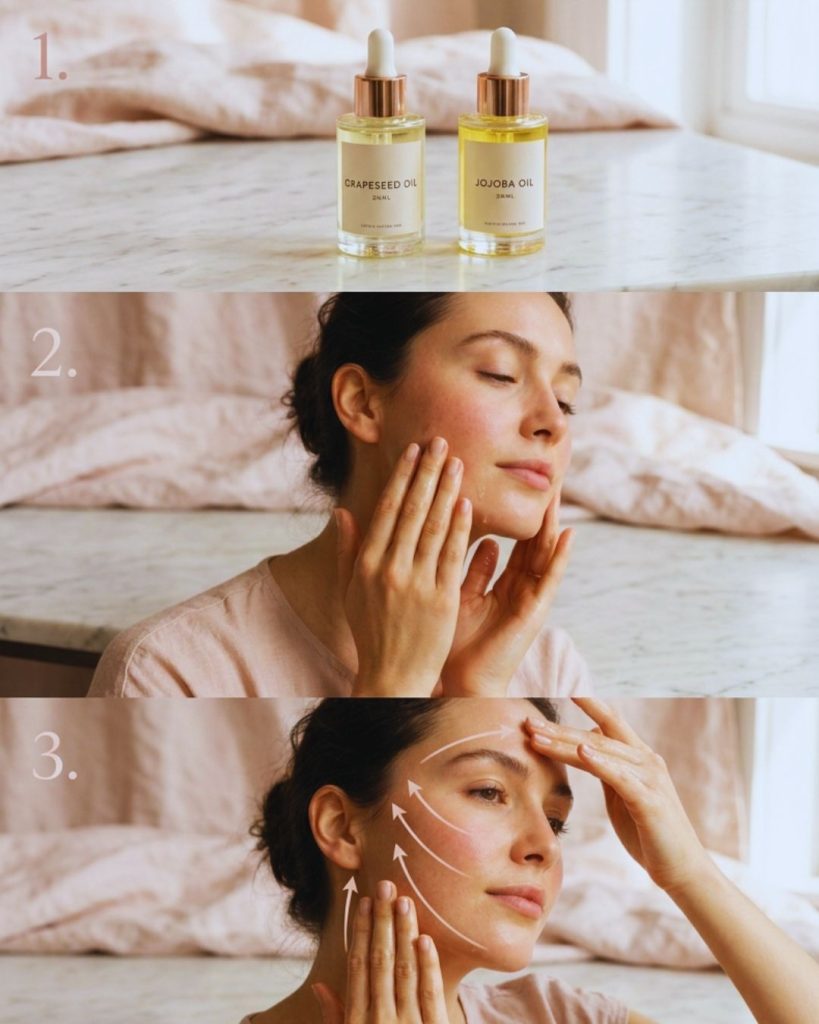
Step-by-step facial massage routine using grapeseed or jojoba oil with upward sweeping motions along the jawline and brows.
No tools needed—just your hands, a few drops of oil, and upward strokes.

To make this skincare habit effective, you don’t need a fancy jade roller. Your hands are your most powerful tools. Here is the step-by-step minimalist beauty routine:

  • Step 1: The Oil Selection
  1. Purchase a bottle of cold-pressed Grapeseed Oil or Jojoba Oil from the health section of your grocery store.
  2. These are non-comedogenic, meaning they won’t clog your pores.
  3. Cost: Usually under $5 for a bottle that lasts three months.
  • Step 2: The Warm-Up
  1. Rub 3–4 drops of oil between your palms to warm it up.
  2. Press it gently into your skin. This provides the “slip” needed to avoid pulling on the delicate skin around your eyes.
  • Step 3: The Upward Sweep
  1. Using your knuckles or fingertips, start at the center of your chin and sweep outward toward your ears.
  2. Move to your cheekbones, sweeping from the nose toward the temples.
  3. Key Rule: Always move upward and outward to defy gravity and promote lifting.
  • Step 4: The Brow Lift
  1. Use your index and middle fingers to “pinch” along your eyebrows, moving from the bridge of the nose to the ends.
  2. This releases the “11 lines” and opens up the eye area for an instant eye lift effect.

Why Consistency Trumps Luxury

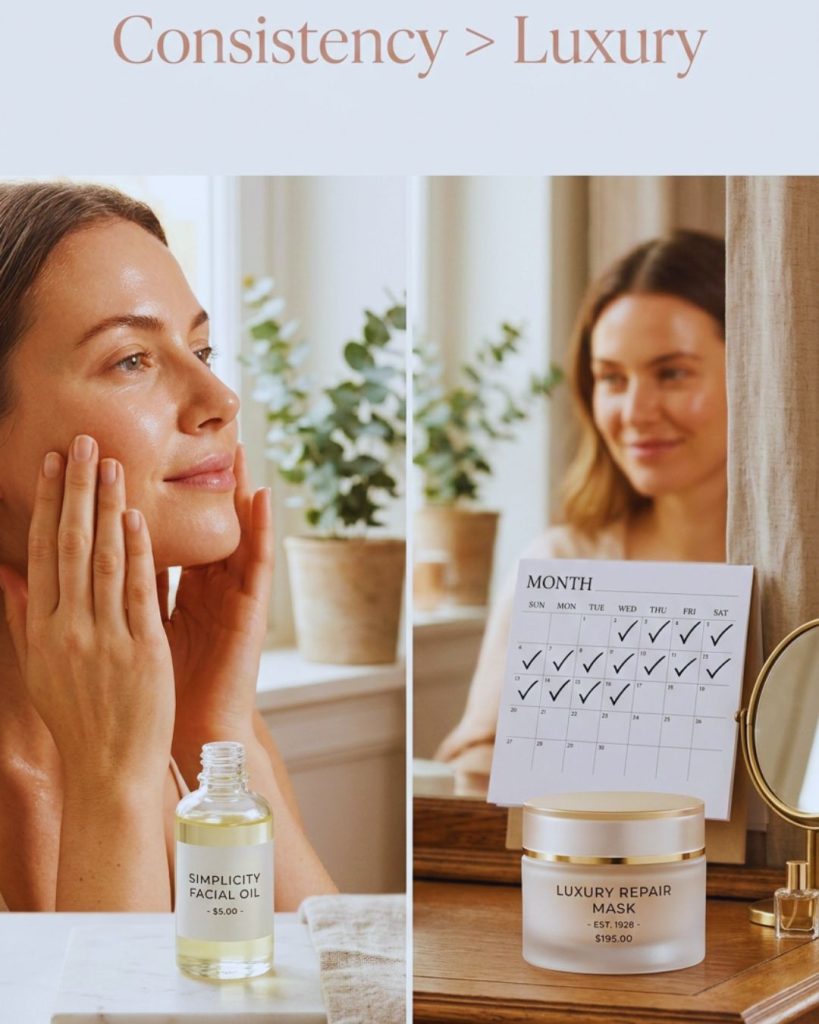
Minimal facial oil and daily massage routine contrasted with a luxury skincare jar to represent consistency over expensive products.
Daily habits beat expensive products—every single time.

The reason people fail with skincare isn’t because their products are cheap; it’s because they are inconsistent. A $5 habit performed daily is infinitely more powerful than a $200 mask used once a month.

  • The Compound Effect: Just like exercise, the benefits of facial massage build over time.
  • Cellular Memory: Your skin “learns” to stay toned and drained when you stimulate it every morning or night.
  • The Ritual Mindset: This 2-minute habit forces you to slow down. Lowering your cortisol levels (the stress hormone) is the ultimate secret to preventing hormonal acne and inflammation.
Boosting the $5 Habit: The Lifestyle Add-ons

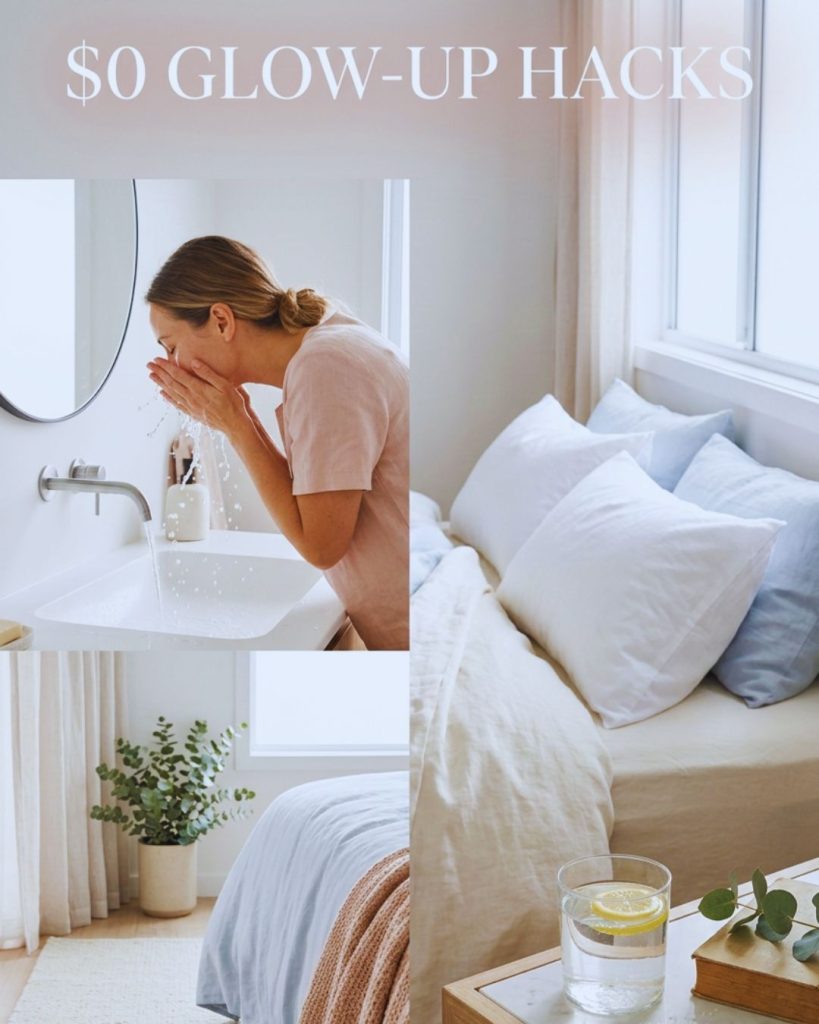
Morning skincare lifestyle setup showing cold water splash, clean pillowcase, and a glass of salted lemon water in soft natural light.
Small $0 habits can amplify your glow more than expensive products.

While the massage is the core habit, you can amplify your glow-up for almost zero extra dollars by optimizing your environment.

1. The Ice Water Hack

  • Every morning, splash your face with ice-cold water.
  • This causes vasoconstriction, which tightens the appearance of pores and wakes up the nervous system.
  • Cost: $0.

2. Pillowcase Hygiene

  • Flip your pillowcase every night and wash it every three days.
  • Bacteria buildup on linens is a leading cause of clogged pores.
  • Cost: $0 (just the price of laundry).

3. Strategic Hydration

  • Add a pinch of sea salt to your first glass of water in the morning.
  • This improves cellular hydration better than plain water, ensuring your skin looks “plump” from the inside.
  • Cost: Less than $0.01 per day.

The Science of “Glass Skin” Without the Price Tag

The “Glass Skin” trend originates from K-Beauty, emphasizing a smooth, translucent, and luminous complexion. While the media suggests you need an 11-step kit, science suggests you need moisture retention.

  • Occlusion: Applying your $5 oil on top of damp skin “locks” the water in.
  • The Dewy Finish: This creates a natural light-reflecting surface that mimics the look of high-end highlighters.
  • Skin Health: When your skin is properly lubricated, the acid mantle (your skin’s protective layer) stays intact, shielding you from breakouts and redness.

Breaking the Shopping Addiction

We often buy new beauty products because we want the “hit” of dopamine that comes with a new purchase. However, that dopamine wears off, while the frustration of dull skin remains.

  • Audit Your Stash: Look at how many half-finished bottles you own.
  • The Challenge: Commit to the $5 facial oil massage for 30 days without buying anything new.
  • The Observation: Notice how your skin texture changes. You will likely find that your skin becomes softer, more “awake,” and significantly more vibrant.

Real Results: What to Expect

If you start this daily beauty ritual today, here is the timeline of your transformation:

TimelineThe Transformation
Day 1Immediate reduction in morning puffiness; a healthy, temporary glow.
Day 7Improved skin texture; makeup applies smoother due to better exfoliation.
Day 14Jawline appears more defined; under-eye circles start to brighten.
Day 30The “Soft Girl” glow becomes permanent; skin feels firmer and more resilient.

Final Thoughts: Beauty is a Verb, Not a Product

A “glow” isn’t something you can buy in a jar and smear on your face. It is the physical manifestation of circulation, hydration, and care. By choosing a $5 habit over a $500 routine, you are taking back control from the beauty industry and putting it back into your own hands—literally.

Stop waiting for a “miracle product” to arrive in the mail. The miracle is already in your fingertips and your consistency. Start your massage tonight, and watch your face transform.

Flat lay of Rococo-inspired fashion pieces including lace gloves, pearls, floral corset, and pastel puff-sleeve dress on a soft blush background.

If you’ve ever found yourself mesmerized by the lavish gowns of Marie Antoinette, the shimmering silks, and the ornate pastel palettes of the 18th century — welcome to the world of Rococo Revival fashion. This enchanting style is making a grand comeback, blending luxury, femininity, and artistry into modern wardrobes. But here’s the best part — you don’t need royal wealth to embrace this aesthetic. With the right strategy, you can create your own Rococo-inspired wardrobe on a budget, and still look like you stepped out of a palace.

Let’s dive deep into how you can capture the essence of opulent Rococo fashion without breaking the bank.

What Is Rococo Revival Fashion?

Flat lay of Rococo Revival fashion pieces, including ruffled blouses, floral skirts, lace gloves, pearls, and satin ribbons on a soft pastel background.
“Rococo Revival fashion blends 18th-century French opulence with modern wearability — think lace, ruffles, pastels, and pearls without the costume feel.”

The Rococo style originated in 18th-century France — think Versailles, powdered wigs, pastel gowns, and intricate lace. It was a celebration of luxury, art, and femininity. The modern Rococo Revival movement brings back that same lavish aesthetic with a fresh, wearable twist.

Instead of full corsets and floor-length panniers, you’ll find:

  • Soft ruffles and bows on blouses
  • Pastel tones and floral embroidery
  • Lace trims, pearls, and satin ribbons
  • Vintage-inspired silhouettes mixed with modern tailoring

This trend is about romance, elegance, and self-expression — not about looking like a costume. Whether you love vintage fashion, cottagecore, or soft girl aesthetics, Rococo Revival feels like the natural evolution — more detailed, more graceful, and infinitely more luxurious.

Why Rococo Revival Is Trending Again

Fashion is cyclical. What was once seen as “too fancy” is now celebrated for its artistry and individuality. Social media platforms like Pinterest, TikTok, and Instagram are filled with creators showing off their Rococo-inspired outfits, ornate accessories, and soft, dreamy aesthetics.

Here’s why this revival resonates so deeply:

Escapism through elegance – In a world dominated by minimalism and streetwear, Rococo Revival offers an escape into fantasy and beauty.

Feminine empowerment – Ultra-feminine doesn’t mean fragile. This trend reclaims pink, lace, and frills as powerful symbols of identity.

Sustainable fashion appeal – Many Rococo-style garments are thrifted, upcycled, or handmade. Sustainability meets style.

Cultural revival – Movies like Marie Antoinette (Sofia Coppola) and shows like Bridgerton reintroduced audiences to historical glamour.

In short, Rococo Revival fashion speaks to anyone who wants to look timeless, artistic, and confident, while indulging in a little fantasy.

How to Create a Rococo-Inspired Wardrobe on a Budget

Here’s the exciting part — you can achieve that opulent Rococo look without spending a fortune. With smart shopping, a little creativity, and attention to detail, you can look high-end even on a low budget.

1. Start with the Basics

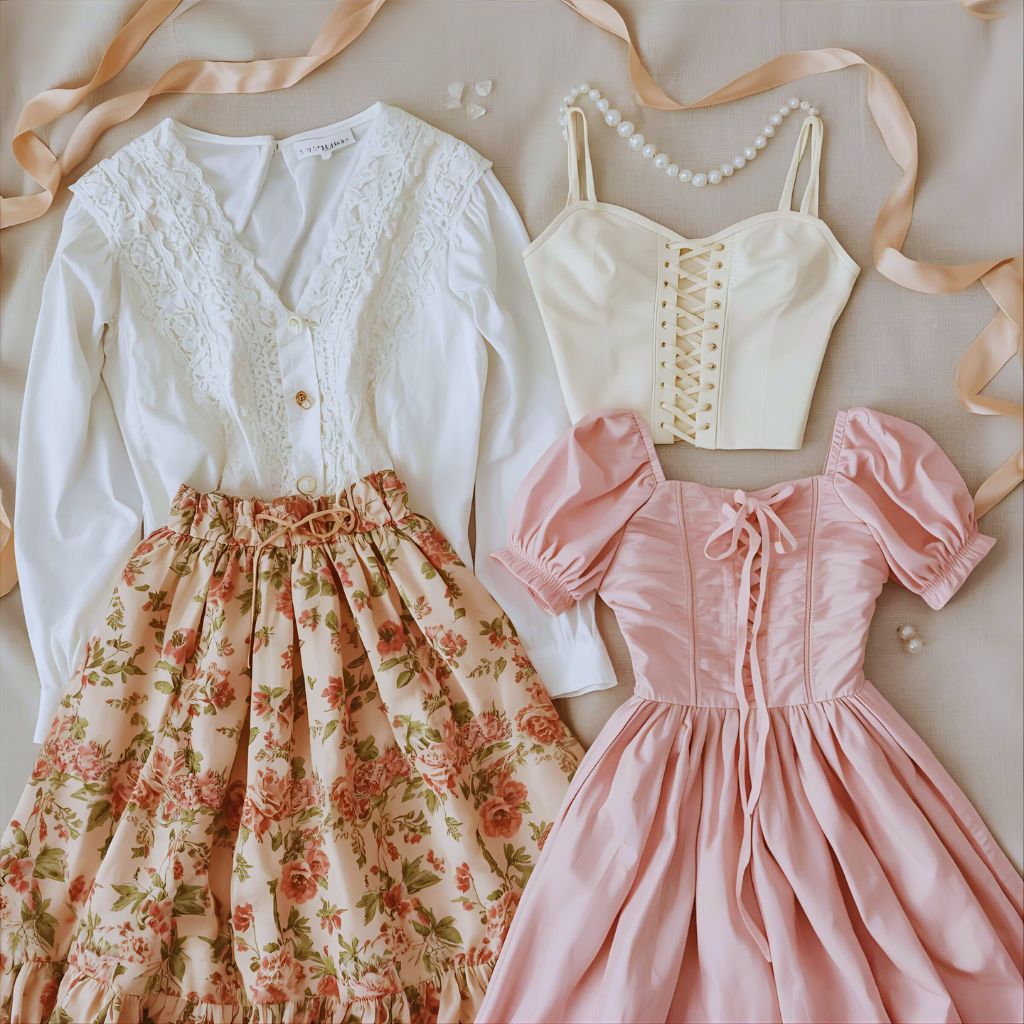
Flat lay of Rococo-style basics including lace tops, floral skirt, and puff-sleeve dress in pastel colors.
“Begin your Rococo wardrobe with timeless basics — lace, ruffles, and soft pastel pieces that form the perfect foundation.”

Before investing in statement pieces, build your foundation with affordable staples:

  • White or cream lace blouses
  • Corset-style tops (look for stretch or tie-backs for comfort)
  • Midi or maxi skirts with ruffles or floral prints
  • Puff-sleeve dresses in pastel tones

You can find these at stores like H&M, Zara, or even thrift shops if you know what to look for.

2. Shop Vintage and Thrift

Vintage clothing rack with lace dresses, floral gowns, and Rococo-inspired pieces in a thrift store.
“Find Rococo treasures in vintage and thrift stores — from lace gowns to puff-sleeve blouses, all for a fraction of retail prices.”

The Rococo aesthetic thrives in vintage stores. Search for:

  • 80s or 90s prom dresses with lace and puff sleeves
  • Old wedding gowns that can be altered or dyed
  • Lace nightgowns (great for layering)
  • Victorian-style blouses with frills and pearl buttons

Thrift stores and online platforms like Depop, Vinted, or Poshmark are treasure troves for Rococo pieces at a fraction of retail prices.

3. DIY and Upcycle

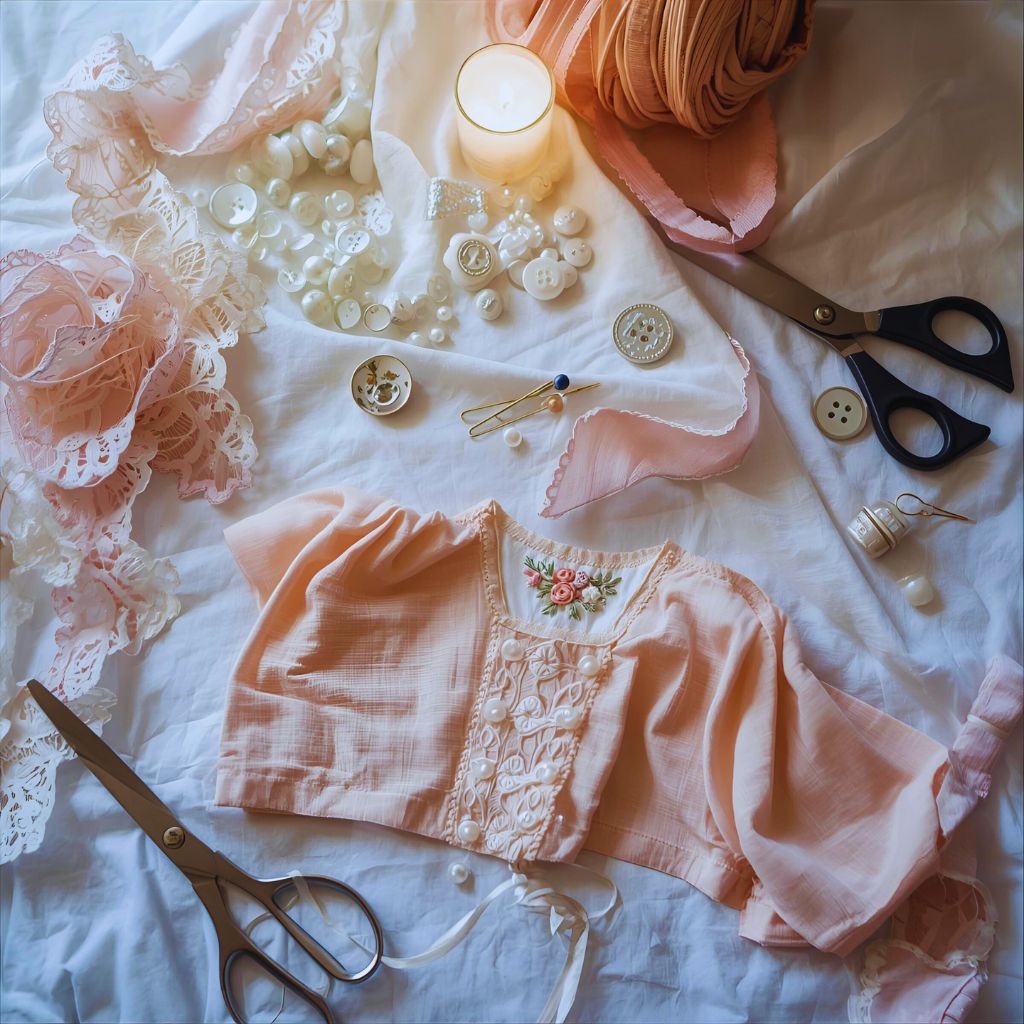
DIY workspace showing lace trims and pearl embellishments being added to pastel clothing.
“Transform everyday pieces into Rococo-inspired fashion with lace, pearls, and a little creative magic.”

If you’re crafty, you can easily transform basic clothes into Rococo masterpieces:

  • Add lace trims or ribbon bows to plain tops.
  • Sew pearl buttons onto a blazer or cardigan.
  • Use fabric paint or embroidery to create delicate floral patterns.
  • Turn a tulle skirt into a dreamy Rococo-inspired gown with just a few embellishments.

A touch of creativity can turn any simple piece into something luxurious and one-of-a-kind.

4. Focus on Accessories

Rococo-inspired accessories including pearls, lace gloves, floral hairpins, and a vintage handbag.
“Complete your Rococo look with delicate accessories — pearls, lace, and floral touches that whisper luxury.”

Rococo is all about the details. Accessories complete the fantasy — and they’re often the easiest to find affordably.

Look for:

  • Pearl necklaces and chokers
  • Cameo brooches or vintage lockets
  • Silk ribbons for your hair or waist
  • Lace gloves, delicate stockings, or floral hairpins
  • Vintage-inspired handbags with gold or floral accents

Even the simplest dress can look decadent and royal with the right accessories.

5. Mix Modern and Historical

Outfit flat lay featuring floral corset top, high-waisted jeans, and baroque-inspired jewelry.
“Blend history with modernity — pair Rococo details with contemporary silhouettes for timeless style.”

To avoid looking like you’re in a costume, balance vintage flair with modern touches:

  • Pair a Rococo-style blouse with high-waisted jeans.
  • Match a floral corset top with a sleek satin skirt.
  • Combine baroque jewelry with a minimal dress.

This fusion keeps your look fashion-forward while retaining that historical charm.

6. Embrace Hair and Makeup

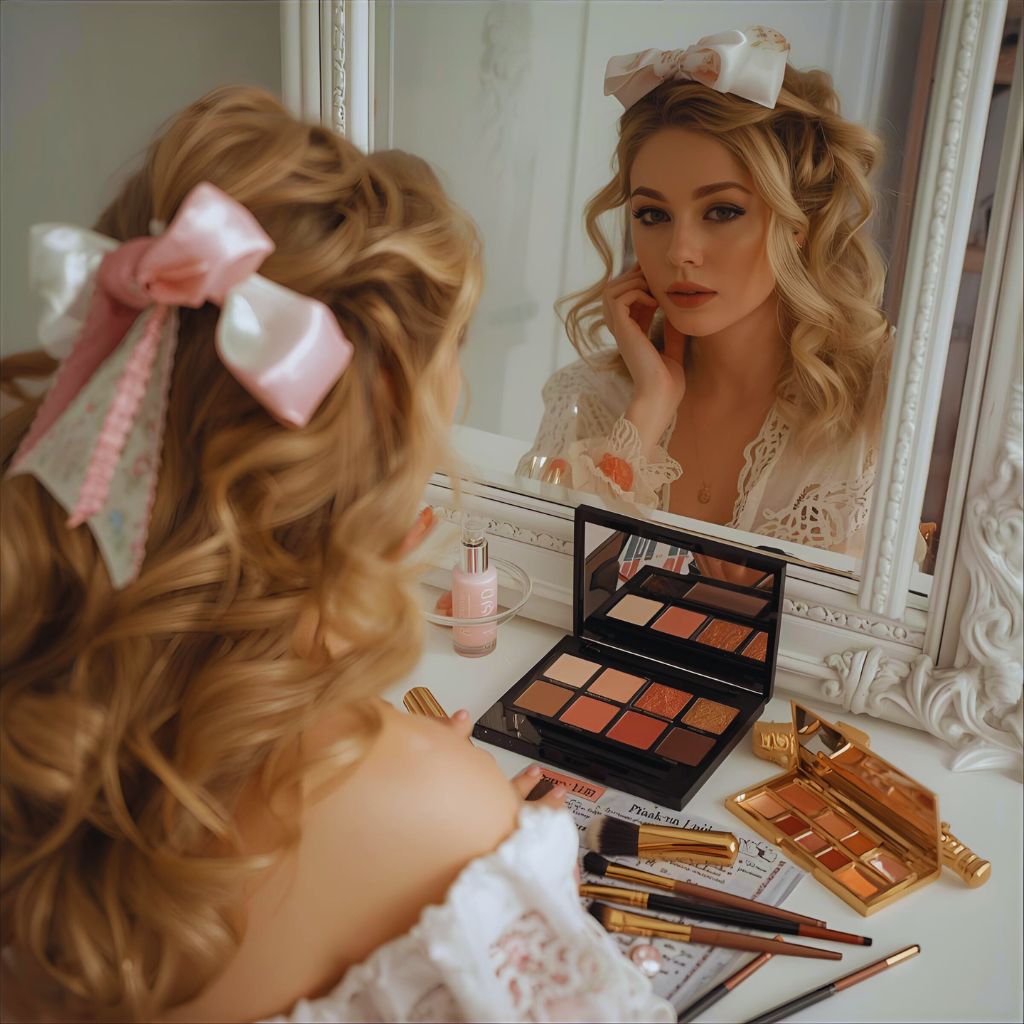
“Channel Rococo beauty with soft curls, rosy blush, and pastel hues — the finishing touch to your dreamy look.”
Romantic makeup setup featuring pink blush, pearl hair accessories, and soft curls tied with a pastel ribbon.

The Rococo look isn’t just about clothes — it’s about the entire presentation. You can easily channel that era’s beauty with modern, wearable techniques:

  • Soft curls or waves tied with pastel ribbons.
  • Rosy blush applied high on the cheeks for that porcelain glow.
  • Glossy lips in shades of pink or peach.
  • Subtle shimmer eyeshadow in gold or champagne tones.

A touch of romantic makeup enhances the delicate and graceful aura of Rococo Revival fashion.

Where to Find Rococo Revival Fashion Online

You can find budget-friendly Rococo pieces across a range of platforms if you know where to look:

  • Etsy – Handmade corsets, lace chokers, vintage-inspired dresses.
  • ThredUp & Depop – Vintage gems and affordable luxury finds.
  • Shein, Romwe, and AliExpress – For budget Rococo-style blouses, accessories, and dresses.
  • H&M, Forever 21, & Zara – Occasionally drop collections inspired by romantic and vintage aesthetics.
  • Local thrift stores or flea markets – The best place to uncover hidden treasures.

Why You’ll Love Rococo Revival

Wearing Rococo Revival fashion is more than just dressing up — it’s about embracing your femininity, creativity, and individuality. Every ruffle, pearl, and bow tells a story. It’s fashion that lets you dream a little, live artfully, and feel extraordinary even on ordinary days.

You don’t need to spend hundreds to look like royalty — with the right eye and a bit of imagination, you can curate your own regal, romantic wardrobe on any budget.

Final Thoughts

The Rococo Revival movement is not just a fashion trend — it’s a reminder that elegance never fades. Whether you’re strolling through a park in a puff-sleeve dress, sipping tea in a lace blouse, or attending an event in a pastel corset gown, this style allows you to feel beautiful, confident, and timeless.

So go ahead — embrace opulence, femininity, and artful living. You don’t need Versailles to feel like a queen — just a little lace, a little imagination, and the courage to express your inner romantic.

Collection of 10 minimalist black-and-white typography wall art prints with motivational quotes arranged on a neutral wall with simple modern décor.

There’s something timeless about black and white — the perfect balance of contrast and calm. When it comes to home décor, especially in minimalist spaces, nothing captures attention more effortlessly than typography wall art.

Clean lines, bold words, and powerful quotes can speak volumes — without saying too much. And that’s exactly why black and white quote art has become a staple in modern minimalist homes.

Whether you’re styling your first apartment, updating your living room, or curating an inspiring workspace, these 10 typography art pieces bring sophistication, motivation, and serenity to any wall.

Why Black & White Typography Art Works So Well

Before diving into the list, let’s talk about why this style has taken over minimalist design feeds everywhere — from Pinterest to Architectural Digest.

  • Timeless Appeal: Black and white never goes out of style. It’s sleek, balanced, and elegant.
  • Versatile Aesthetic: Pairs perfectly with any interior — from Scandinavian simplicity to urban loft vibes.
  • Visual Clarity: Typography stands out beautifully when it’s stripped to the essentials.
  • Emotional Impact: A few carefully chosen words can inspire, calm, or empower — all without clutter.

Minimalism isn’t about emptiness — it’s about intention. And few décor choices are as intentional as typography art that says exactly what you mean.

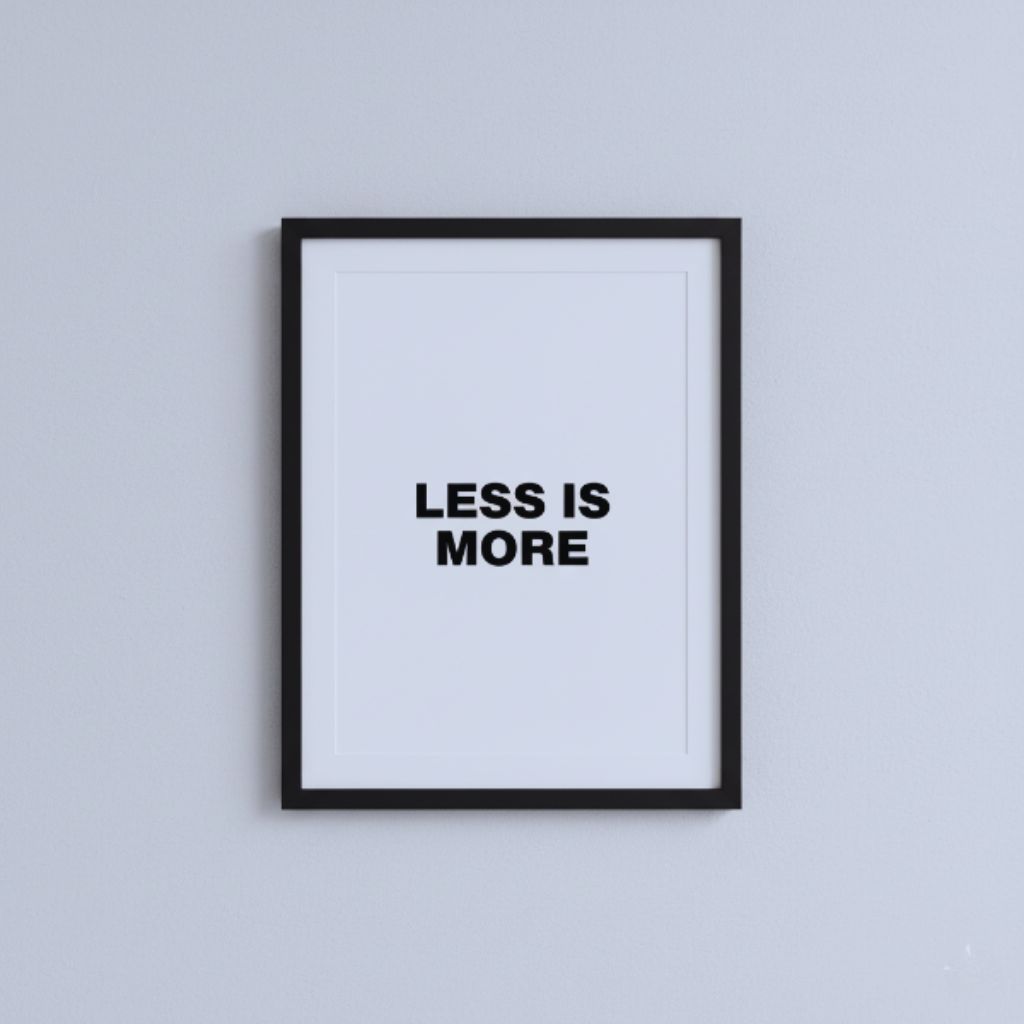
1. “Less Is More” — The Minimalist Manifesto

Minimalist black-and-white wall art print with the quote “Less Is More” in bold font.
“Keep your space clutter-free and intentional with this timeless minimalist mantra — ‘Less Is More.’”

Every minimalist home needs a reminder of its golden rule: Less is More. This iconic phrase defines the entire philosophy of modern minimalism.

Why It Belongs in Your Space:

  • It sets the tone for a clutter-free mindset.
  • Perfect above desks, in hallways, or near entryways.
  • Inspires simplicity and mindfulness every day.

Design Tip: Use sans-serif fonts with lots of white space. The emptier the frame, the stronger the statement.

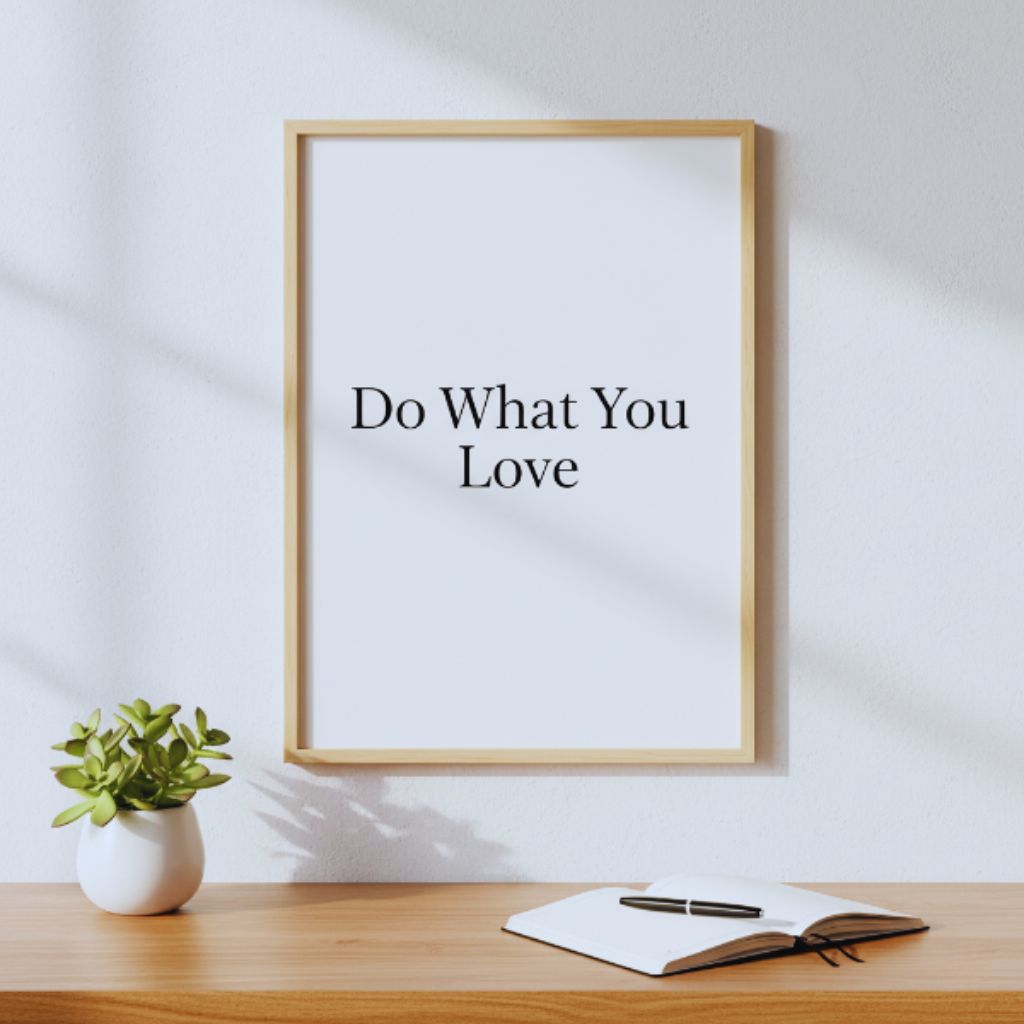
2. “Do What You Love” — The Everyday Motivator

Minimalist wall art print reading “Do What You Love” above a modern desk.
“Motivate your every day with this sleek black-and-white reminder to ‘Do What You Love.’”

A daily boost in black and white form. This typography print works beautifully in offices, studios, or creative corners.

Why It Works:

  • It’s motivational without being loud.
  • A clean, minimal reminder to prioritize passion.
  • Complements modern furniture and neutral walls.

Pair it with: Simple geometric prints or abstract line drawings.

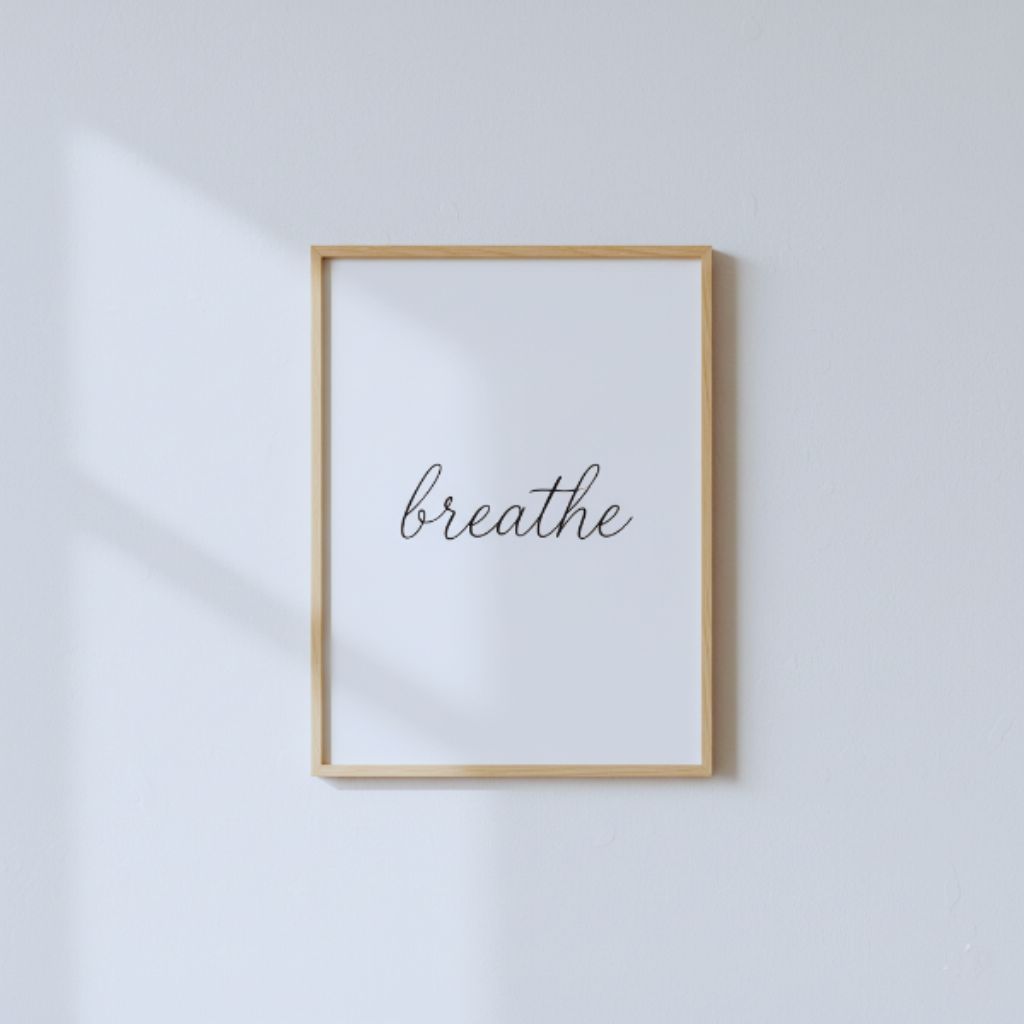
3. “Breathe” — Simplicity in One Word

Minimalist typography wall art with the word “breathe” in cursive font on a white background.
“Add calm and clarity to your space with the peaceful simplicity of ‘breathe.’”

In a world that’s always rushing, this word acts like a pause button.

Why It Belongs in Your Home:

  • Calms the mind instantly.
  • Perfect for bedrooms, bathrooms, or yoga spaces.
  • The simplicity of a single word feels poetic.

Style Tip: Use a lowercase cursive font on a white background — it radiates peace.

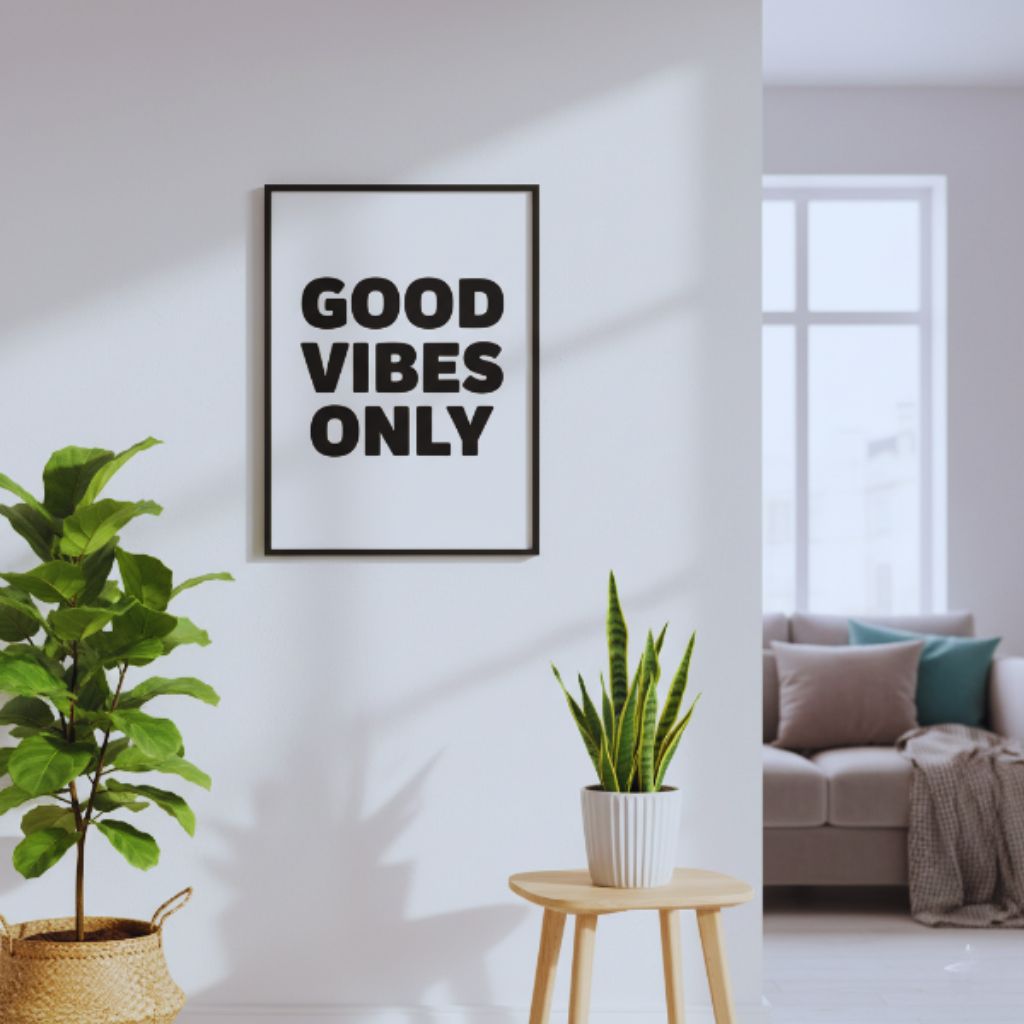
4. “Good Vibes Only” — Positive Energy, Simplified

Black typography wall art with “Good Vibes Only” displayed in a modern living room.
“Invite positivity and warmth into your home with this fun and stylish ‘Good Vibes Only’ print.”

Bring a touch of optimism into your space with this playful, modern quote.

Why It Works:

  • Adds warmth and personality to minimal spaces.
  • Great for entryways or living rooms.
  • Instantly lifts the mood without adding clutter.

Design Tip: Use bold, slightly playful typography — it keeps things light and energetic.

5. “Dream Big” — For the Ambitious Minimalist

Minimalist typography print with the quote “Dream Big” in bold black letters above a desk.
“Fuel your ambition with this elegant minimalist print — ‘Dream Big.’”

Sleek, bold, and purpose-driven — “Dream Big” fits right into your modern workspace or bedroom.

Why It Works:

  • Inspires forward-thinking energy.
  • Blends motivation with elegance.
  • Looks stunning in black frames on white walls.

Pro Styling Tip: Pair with smaller abstract black line drawings for visual harmony.

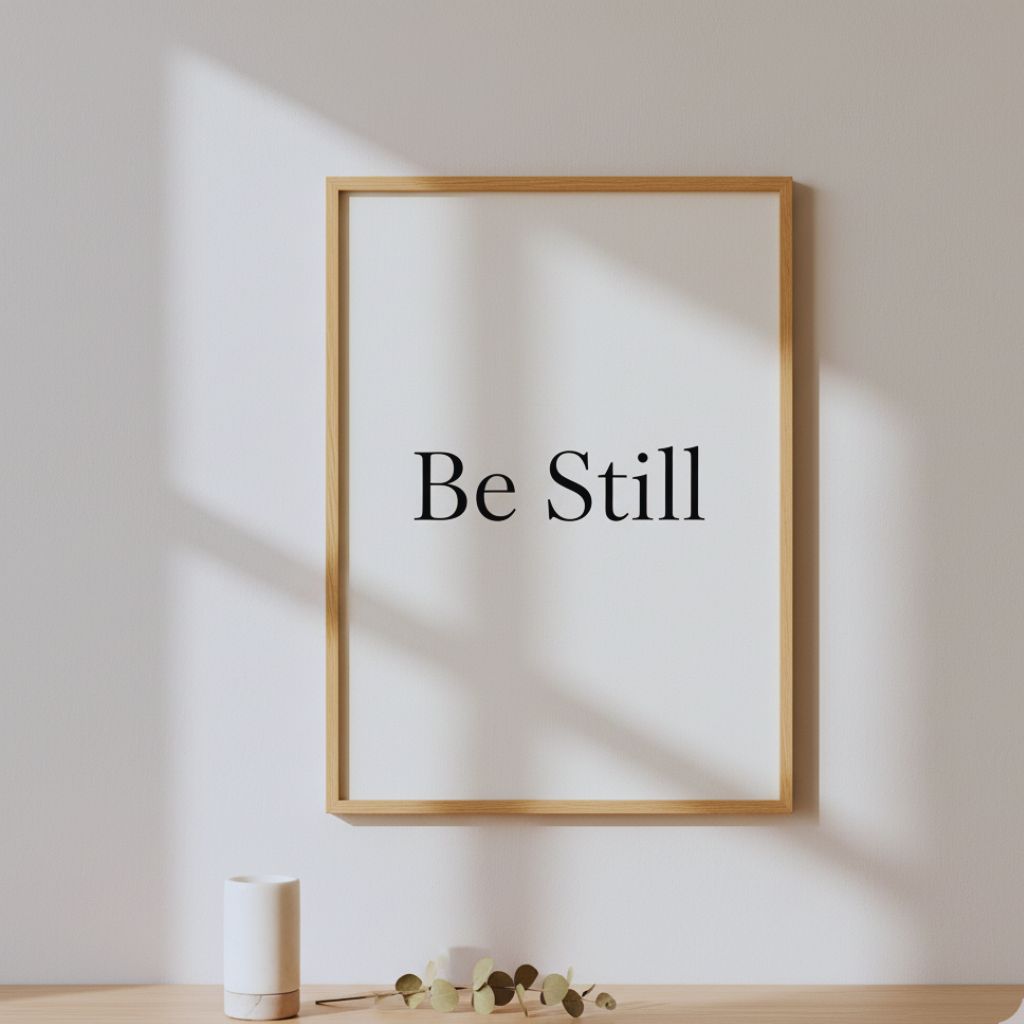
6. “Be Still” — The Quiet Reminder

Minimalist wall art featuring the phrase “Be Still” in elegant serif font on a light background.
“Create a moment of peace in your home with the tranquil reminder — ‘Be Still.’”

Peace doesn’t shout. It whispers.

Why It Belongs in Your Minimalist Home:

  • Encourages mindfulness and presence.
  • Ideal for calm spaces like reading nooks or meditation corners.
  • Subtle, spiritual, and grounding.

Design Idea: Combine serif typography with soft spacing for a tranquil aesthetic.

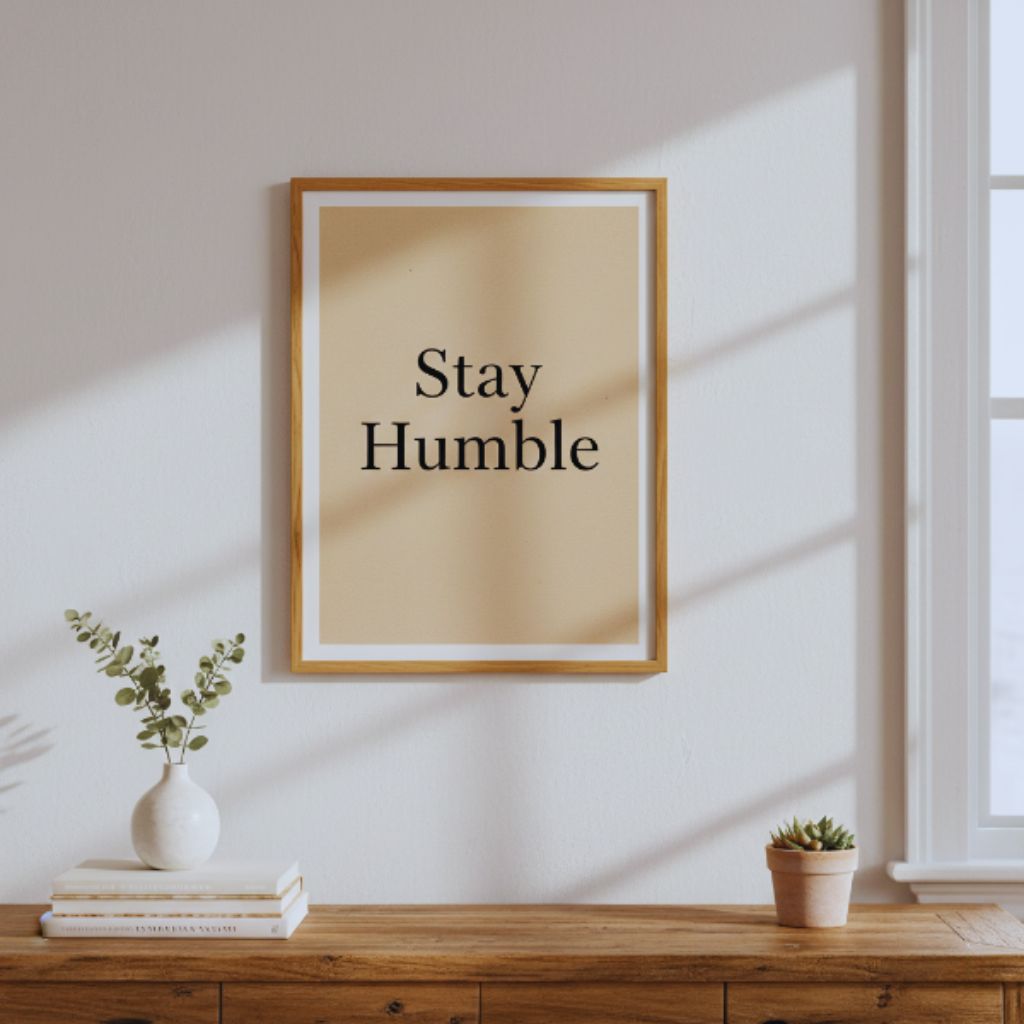
7. “Stay Humble” — Elegant and Grounded

Neutral minimalist poster with “Stay Humble” in black serif font framed in wood.
“Bring grace and gratitude into your space with the gentle reminder — ‘Stay Humble.’”

Minimalism isn’t just about design — it’s a lifestyle. This quote embodies gratitude and grace.

Why It Works:

  • A gentle reminder to stay kind and grounded.
  • Fits beautifully in neutral-toned spaces.
  • Simple but deeply meaningful.

Style It With: Natural wood frames or linen-textured backgrounds.

8. “Make It Happen” — The Goal Setter’s Mantra

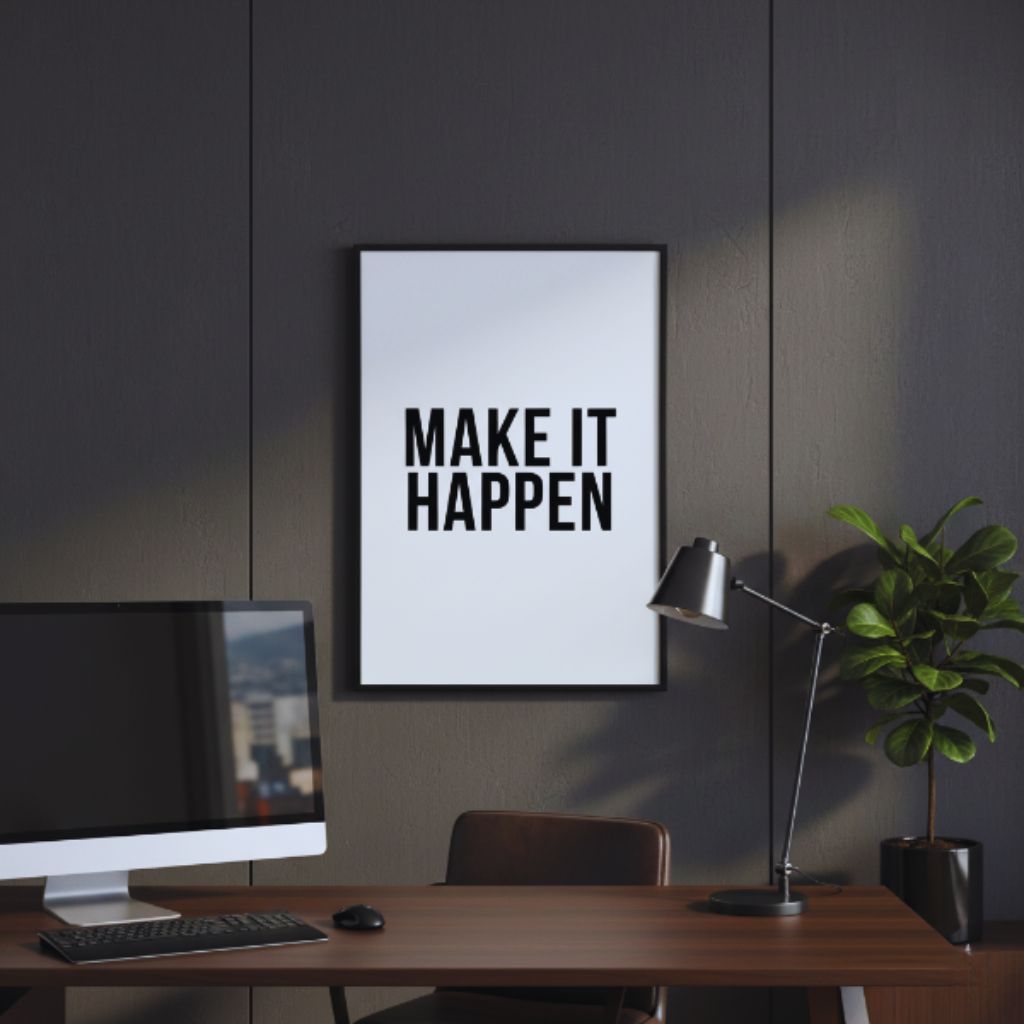
Minimalist wall print with bold uppercase text reading “MAKE IT HAPPEN.”
“Empower your goals with a simple, powerful statement — ‘Make It Happen.’”

For anyone who believes in action over talk, this quote is pure motivation in monochrome.

Why It Works:

  • Inspires productivity without being aggressive.
  • Ideal for workspaces or gyms.
  • Minimal yet powerful visual impact.

Design Tip: Use uppercase bold fonts — it creates instant authority and focus.

9. “You Got This” — Daily Confidence Boost

Minimalist motivational wall art print with “You Got This” in black and white.
“Start every day with confidence and positivity — ‘You Got This.’”

Sometimes, all you need is a gentle nudge. This quote delivers confidence and positivity in clean typography.

Why It Belongs:

  • Encourages self-belief.
  • Perfect for mirrors, offices, or bedroom walls.
  • Friendly, modern, and relatable.

Styling Tip: Frame it with a black border to add contrast to white walls.

10. “Live Simply” — The Core of Minimalism

Minimalist wall art with the phrase “Live Simply” in black text on a white textured background.
“Embrace intentional living with this beautifully minimalist reminder — ‘Live Simply.’”

If your home embraces minimalist values, this quote is your philosophy framed.

Why It Works:

  • Encapsulates the spirit of intentional living.
  • Adds peace and purpose to everyday spaces.
  • A subtle reminder that less truly means more.

Design Tip: Use natural textures (linen, canvas, or matte paper) to complement the theme.

How to Style Black & White Typography Art

Here’s how to make your typography collection look like it belongs in a design magazine:

1. Create a Gallery Wall

Mix quotes of different sizes and fonts for a curated but clean vibe.
Use consistent black, white, or oak frames for harmony.

2. Keep Space Around Each Piece

White space enhances impact. Don’t overcrowd — let every quote breathe.

3. Match Font Personality to the Room

  • Bold Sans Serif: Offices or gyms.
  • Script Fonts: Bedrooms, living rooms, or cozy corners.
  • All Caps Minimal Fonts: Entryways and modern lofts.

4. Play with Placement

Lean smaller frames on shelves, or stack multiple prints in vertical alignment for a chic, editorial look.

5. Add Texture

Combine typography with linen canvases, matte paper, or floating glass frames to add depth without breaking the minimalist flow.

Why Minimalist Quote Art Never Gets Old

Because minimalism is more than a trend — it’s a state of mind.

Black and white typography reminds us of clarity, balance, and focus.
It’s proof that words alone can create atmosphere, emotion, and identity.

When you decorate with monochrome quotes, you’re not just filling wall space —
you’re filling it with meaning, intention, and calm confidence.

Final Thoughts

Your home should inspire you — quietly, beautifully, and authentically.

These 10 black and white quote prints do exactly that.
They’re modern yet timeless, artistic yet functional, and perfectly suited for anyone who believes that simplicity is the ultimate sophistication.

So, next time you want to elevate your décor, skip the clutter and hang words that matter.
After all, the right typography doesn’t just decorate walls — it defines spaces.

The Unexpected Mental Health Benefits of Adult Coloring: 5 Free Printables Inside

Mental Health Benefits of Adult Coloring- In a world where screens never sleep and stress seems to be our constant companion, finding peace has become a luxury. Yet, sometimes the simplest tools can lead to the deepest calm — and one of them involves nothing more than paper, color pencils, and imagination.

Welcome to the world of adult coloring — a creative revolution that’s quietly transforming the way adults handle anxiety, stress, and burnout. It’s not just about nostalgia; it’s about neuroscience, mindfulness, and a powerful mental reset.

Let’s dive into the unexpected mental health benefits of adult coloring, and discover how this simple act of creativity can become your daily dose of calm — plus, stick around for 5 free printable designs to help you begin today.

1. Coloring Reconnects You With the Present Moment

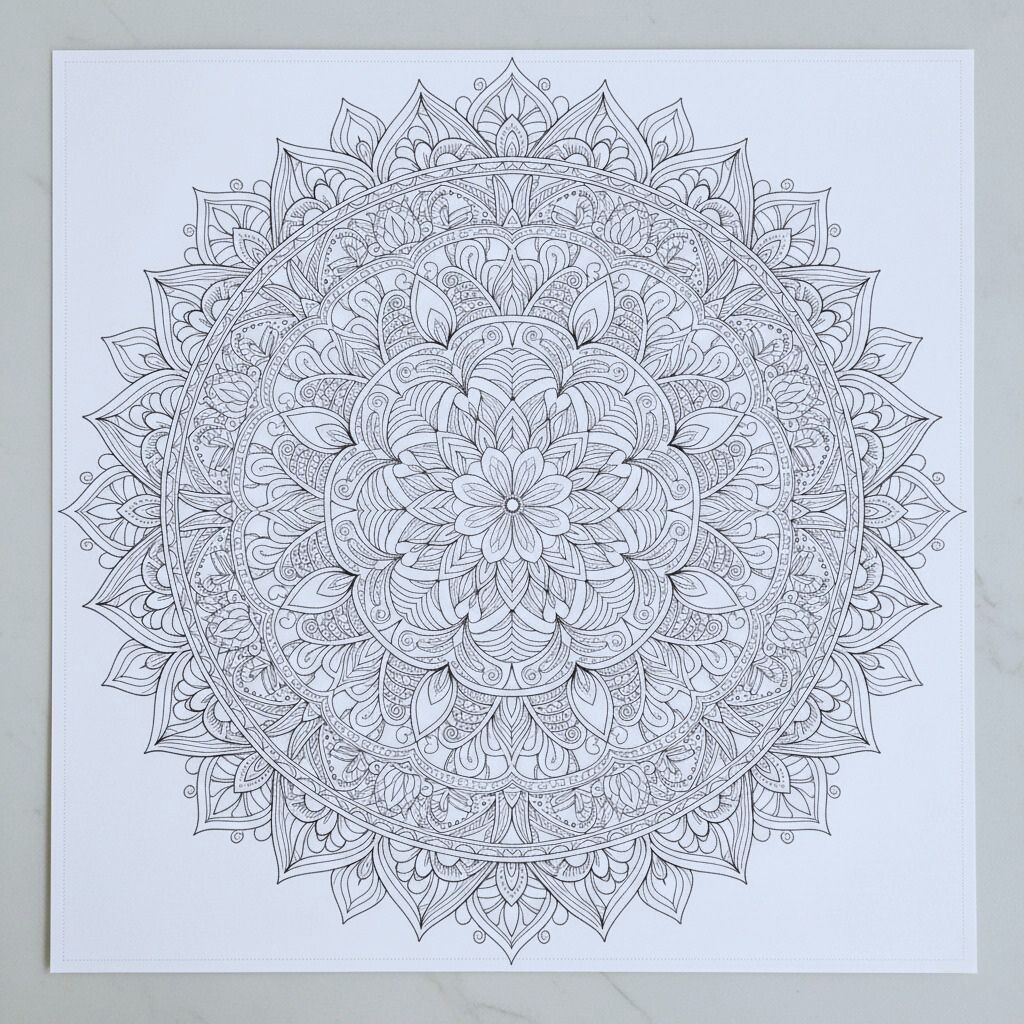
Black and white mandala adult coloring page for mindfulness and relaxation
Find your calm in every circle — start your mindful journey with this mandala coloring page.

When was the last time you focused on something without checking your phone?

Adult coloring offers that rare opportunity to be fully present. The rhythmic motion of shading, blending, and filling in lines creates a meditative rhythm — one that anchors your mind in the now.

Psychologists say this gentle concentration mirrors mindfulness meditation — your attention drifts to color, form, and texture, helping silence mental noise.

Benefits at a Glance:

  • Encourages mindful focus and mental grounding.
  • Helps interrupt racing thoughts and anxiety loops.
  • Reduces overthinking by keeping your hands busy and your mind engaged.

So the next time your mind feels chaotic, grab your coloring pencils — your stress won’t stand a chance.

2. Coloring Lowers Anxiety and Activates Calm Brain Pathways

Botanical adult coloring page with flowers and leaves for stress relief
Breathe in nature, color out stress. Relax with this botanical-inspired printable.

There’s a reason therapists are recommending coloring books for adults more than ever — because coloring directly affects your nervous system.

When you color, your brain releases dopamine, a feel-good neurotransmitter that enhances focus, reduces stress, and triggers calm. It’s similar to the relaxation response you get from yoga or meditation.

A study published in the journal Art Therapy found that just 20 minutes of coloring mandalas can significantly lower anxiety levels.

What Happens in Your Brain:

  • Amygdala activity decreases, reducing fear and tension.
  • Cortisol levels drop, easing physical symptoms of stress.
  • Frontal lobe engagement boosts focus and decision-making.

In other words — coloring is scientifically calming. It’s mental yoga for your mind.

3. Coloring Boosts Creativity and Self-Expression

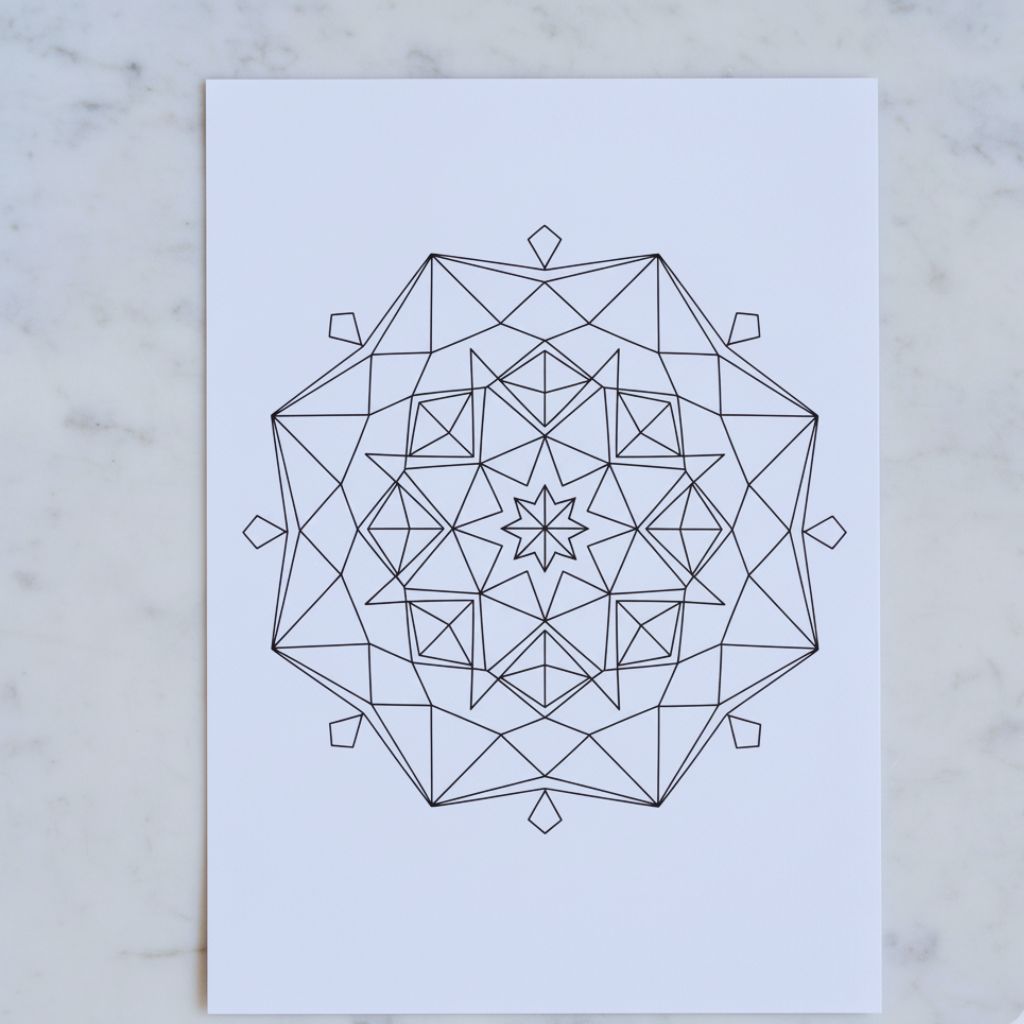
Geometric adult coloring page for mindfulness and mental clarity
Stay balanced with mindful geometry — a perfect pattern for focus and calm.

Somewhere between childhood and adulthood, many of us stopped creating — we stopped drawing, doodling, and coloring because we thought creativity was “for kids.”

But here’s the truth: creative play isn’t childish — it’s healing.

Coloring reawakens that playful side of you that’s often buried under responsibilities. It’s a safe space to express emotion without words — to choose colors that reflect your mood, your energy, or your dreams.

Try This Exercise:

Pick a coloring sheet and let your intuition guide your color choices — no rules, no perfection. Notice how each shade changes your energy. That’s color therapy in action.

Color psychology suggests that different hues influence emotion:

  • Blue → Calm, focus, and peace
  • Green → Balance and growth
  • Yellow → Happiness and clarity
  • Red → Strength and motivation
  • Purple → Creativity and imagination

Through color, you’re not just making art — you’re expressing your inner world.

4. Coloring Helps with Depression and Emotional Healing

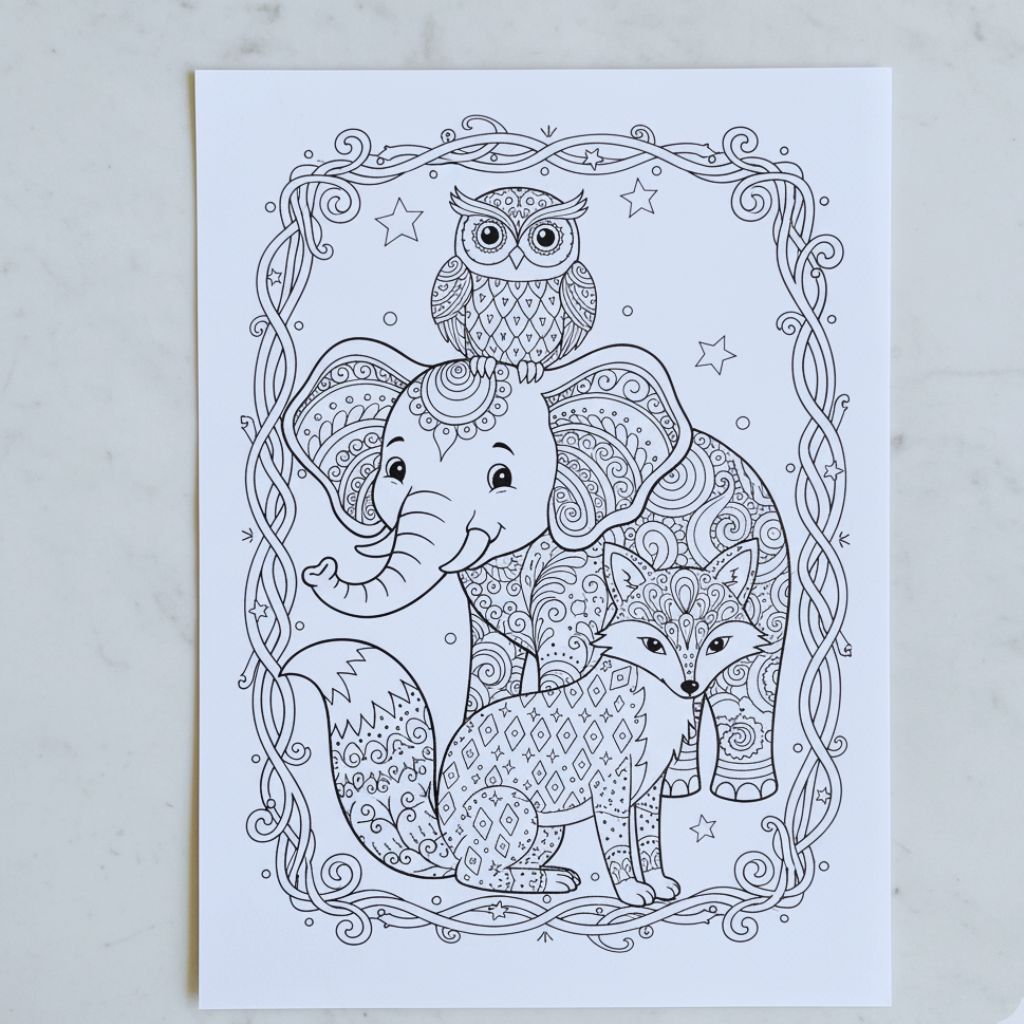
Whimsical animal adult coloring page with detailed line art
Let your inner child play again — color these whimsical creatures your own way.

The repetitive, structured patterns in adult coloring books can feel comforting for people experiencing depression or emotional overwhelm.

Coloring provides a sense of control and accomplishment, even in small doses. Each completed page becomes a gentle reminder: you can finish what you start.

That feeling matters deeply when you’re struggling.

Emotional Benefits of Coloring:

  • Encourages self-soothing and emotional regulation.
  • Offers a break from negative thoughts.
  • Provides a visual symbol of progress and peace.
  • Builds confidence through small creative wins.

Many therapists now incorporate art-based coping tools like coloring for trauma recovery, because it bypasses logic and lets emotions flow safely.

Coloring becomes more than art — it becomes therapy through color and rhythm.

5. Coloring Improves Focus and Memory

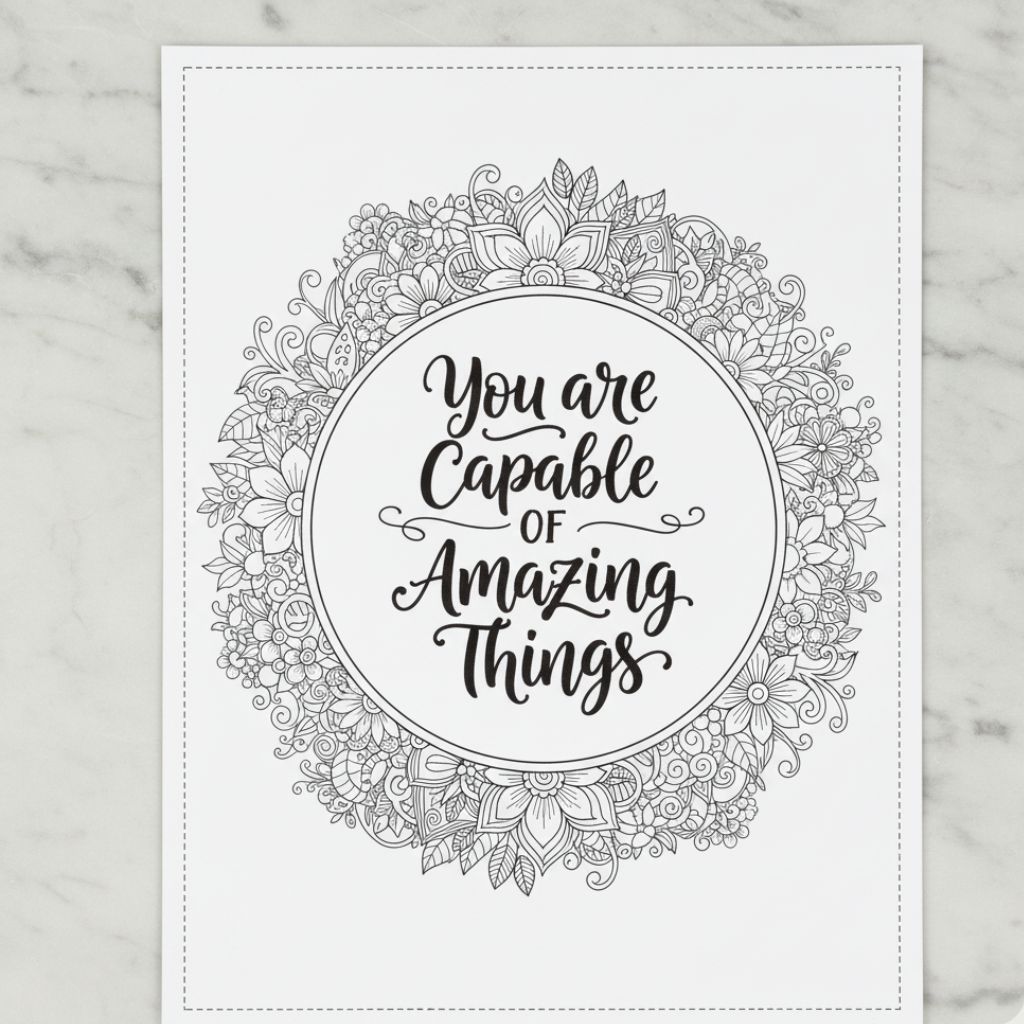
Positive affirmation adult coloring page with motivational quote
Color your affirmations — because positive thoughts deserve beautiful shades.

Believe it or not, coloring isn’t just relaxing — it’s also mentally sharpening.

When you color, your brain’s frontal lobe activates — the part responsible for planning, problem-solving, and concentration. The act of selecting colors and staying within boundaries strengthens your attention span and fine motor skills.

Bonus Cognitive Benefits:

  • Enhances visual processing and hand-eye coordination.
  • Trains your brain to sustain attention longer.
  • May help improve memory recall through pattern recognition.

Many people report feeling more focused and productive after a short coloring break — it’s the perfect mid-day reset when your brain needs a breather but not a nap.

Final Thoughts: Coloring Is More Than Just Art

In a world chasing perfection, coloring reminds us that beauty lies in the process — not the result.

It’s not about staying within the lines; it’s about finding your calm within the chaos.

Whether you’re managing stress, healing emotionally, or simply craving stillness, adult coloring offers a gentle, beautiful way to care for your mental health.

So go ahead — pick a color, fill a shape, breathe deeper.
Because sometimes, the path to healing begins with a single stroke of color.