Glowing woman with dewy skin sitting at a vanity with skincare products and gua sha tool in a soft pastel bedroom aesthetic.

The “Soft Girl” aesthetic is more than just a viral trend; it is a philosophy of self-care that prioritizes a radiant, dewy, and effortless appearance. Unlike heavy “insta-glam” makeup that masks the skin, the soft girl beauty routine focuses on enhancing your natural features through meticulous skincare layering, deep hydration, and restorative habits.

When people say this routine “changes your face,” they aren’t talking about surgery. They are talking about the visible transformation that happens when your skin barrier is healthy, your lymphatic system is drained, and your cells are deeply nourished.

Here is the definitive guide to achieving that ethereal, lit-from-within glow through a dedicated holistic beauty approach.

Phase 1: The Art of Skincare Layering

Flat lay of skincare products arranged in layering order including oil cleanser, toner, serums, and moisturizer on a soft pastel background.
The secret to glass skin? Layer your skincare from thinnest to thickest for maximum glow.

The foundation of the soft girl look is skin that looks like glass. To achieve this, you must master the sequence of your products. The rule is simple: layer from thinnest to thickest consistency to ensure maximum product absorption.

1. The Double Cleanse (The Non-Negotiable)

  • Step A: Use an oil-based cleanser or balm to dissolve SPF, makeup, and sebum.
  • Step B: Follow with a gentle, pH-balanced water-based cleanser.
  • Why it works: It prevents “congested skin” and ensures your expensive serums aren’t sitting on top of a layer of dirt.

2. Hydrating Toners and Essences

  • Instead of harsh astringents, use hydrating toners packed with rose water or rice ferment.
  • Pro Tip: Apply 3 to 7 layers of toner (the “7-Skin Method”) for an instant plumping effect.

3. Targeted Serums (The Transformers)

  • Vitamin C: For morning brightness and protection against environmental stressors.
  • Niacinamide: To minimize pores and regulate oil production.
  • Hyaluronic Acid: The gold standard for moisture retention. Always apply this to damp skin to avoid drawing moisture out of your face.

4. Barrier Repair Moisturizer

  • Look for ingredients like ceramides, fatty acids, and squalane.
  • A healthy skin barrier is what gives you that “soft” texture and prevents redness or irritation.

Phase 2: The Hydration Architecture

Aesthetic setup with water bottle and lemon, avocado and walnuts, humidifier misting, and face spray on a soft pastel background.
Glowing skin starts with hydration—inside and out.

True hydration isn’t just about what you put on your face; it’s about how your body manages water. For the soft girl aesthetic, we want “bouncy” skin that reflects light.

Internal Hydration

  • The 3-Liter Rule: Drinking enough water is the cheapest beauty treatment in existence.
  • Electrolytes: Add a pinch of sea salt or a lemon slice to your water. Pure water can sometimes pass through you; electrolytes help it actually enter your cells.
  • Omega-3s: Incorporating healthy fats (avocados, walnuts, salmon) creates a natural oil seal for your skin from the inside out.

External Humidity

  • The Humidifier Hack: If you live in a dry climate or use air conditioning, a humidifier is essential. It prevents trans-epidermal water loss while you sleep.
  • Face Mists: Keep a thermal water spray at your desk. A quick spritz during the day keeps your dewy finish intact without ruining your makeup.

Phase 3: The Sleep-Skin Connection

Woman resting on a silk pillowcase in a softly lit bedroom with skincare products on the nightstand.
Your skin repairs while you sleep—make your nighttime routine work harder.

They call it beauty sleep for a reason. During the REM cycle, your body’s growth hormones kick in, repairing tissue and producing new collagen.

1. The Silk Pillowcase Advantage

  • Cotton absorbs moisture and creates friction, leading to “sleep lines” and frizzy hair.
  • Silk or Satin: These fabrics allow your face to glide, preserving your skincare products on your skin rather than your pillow.

2. The Overnight Repair Window

  • Between 10 PM and 2 AM, skin cell turnover is at its peak.
  • Using a sleeping mask or a thicker “slugging” layer of petrolatum-based ointment can lock in active ingredients and transform a tired complexion by morning.

3. Elevation for Drainage

  • Sleeping slightly elevated on two pillows can prevent fluid from pooling under your eyes.
  • This simple shift drastically reduces morning puffiness and dark circles.

Phase 4: Consistency and the “Compound Effect”
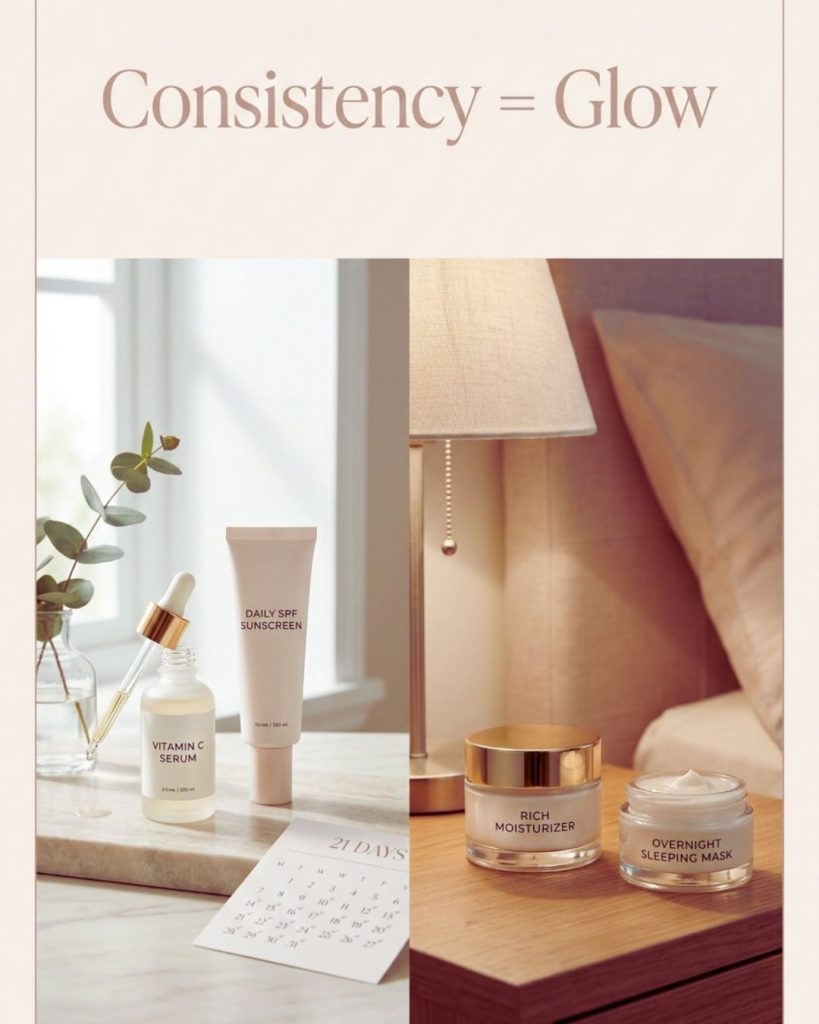
Split image of morning vitamin C and SPF routine beside nighttime moisturizer and sleeping mask in a soft aesthetic setting.
Great skin isn’t about one miracle product—it’s about what you do every single day.

The biggest mistake in beauty routines is the “hero product” myth. No single cream will change your face overnight. It is the consistency routine that yields results.

The 21-Day Rule

  • Skin cells take about 28 days to renew.
  • Commit to your skincare steps for at least three weeks before deciding if a product “works.”
  • Consistency is the bridge between a “good skin day” and a “good skin life.”

Morning vs. Evening Discipline

  • Morning: Focus on Antioxidant Protection and high-SPF sun protection.
  • Evening: Focus on Cellular Repair and deep nourishment.
  • Never skip your evening routine, no matter how tired you are. The pollutants of the day are the primary cause of premature aging.

Phase 5: Sculpting the Soft Girl Features

Close-up of a woman using a gua sha tool with glowing skin, fluffy brows, and natural lashes in soft lighting.
Sculpt your features naturally with daily facial massage and soft grooming rituals.

To “change your face,” you must address the underlying structure. Soft girl beauty is about soft contours and a relaxed expression.

1. Manual Lymphatic Drainage (Gua Sha)

  • Using a Gua Sha tool or even your fingers can move stagnant lymph fluid.
  • Focus on the jawline, cheekbones, and brow bone.
  • Result: A more snatched, “sculpted” look without the need for heavy contour makeup.

2. The Power of Facial Massage

  • Massaging your face for 2 minutes during your oil cleanse increases blood flow.
  • Increased circulation brings fresh oxygen to the skin, creating a natural, healthy rosy flush.

3. Brow and Lash Care

  • The soft girl look relies on “fluffy” brows and long, natural lashes.
  • Use a growth serum or castor oil nightly. Well-groomed, full brows frame the face and provide a youthful, “soft” lift.

The Soft Girl Mindset: Stress and Skin

You cannot have “soft” skin if your body is in a “hard” state of stress. Cortisol, the stress hormone, breaks down collagen and triggers inflammatory conditions like acne and eczema.

Mindful Beauty

  • Turn your skincare routine into a meditative ritual.
  • Light a candle, play lo-fi music, and focus on the sensation of the products on your skin.
  • Lowering your stress levels is a form of anti-aging that no cream can replicate.

Summary of the Soft Girl Formula

To truly transform your complexion, follow this checklist daily:

CategoryEssential Action
CleansingDouble cleanse every night to remove environmental pollutants.
LayeringApply products from watery to creamy; never skip SPF 30+.
MoistureDrink 2-3L of water and use a humidifier at night.
RecoveryAim for 7-9 hours of sleep on a silk pillowcase.
MovementPerform 5 minutes of facial massage or Gua Sha daily.

Final Thoughts: The Journey to Radiance

The soft girl routine is an investment in yourself. It is the rejection of the “hustle” in favor of a slower, more intentional way of living and grooming. When you treat your face with kindness and provide it with the hydration and nutrients it craves, it will reward you with a glow that transcends makeup.

Changing your face isn’t about changing who you are; it’s about revealing the most vibrant, hydrated, and rested version of yourself.
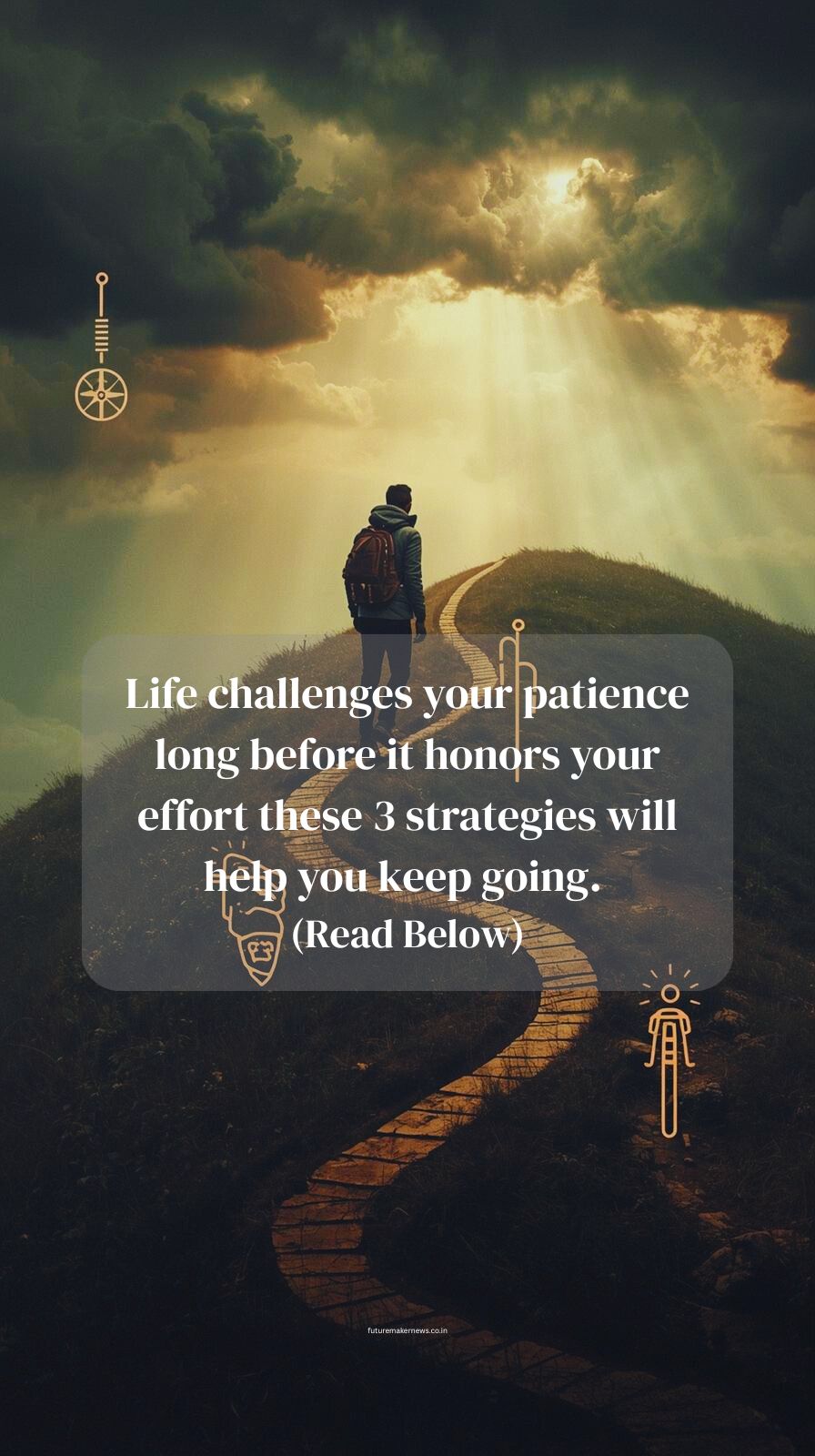

Motivational illustration of a person walking alone on a long road toward light, symbolizing patience, consistency, and effort before success.

Life has a frustrating pattern: it demands patience long before it delivers results.
Effort comes first. Silence follows. Recognition comes last—if you don’t quit in between.

Most people don’t fail because they lack talent or discipline.
They fail because the waiting breaks them.

If you’re doing the work and still seeing no visible progress, these three mindset strategies will help you stay grounded, consistent, and mentally strong until the reward arrives.

1. Detach From the Outcome and Commit to the Process

One of the fastest ways to lose patience is obsessing over timelines.

When you constantly ask “Is this working yet?” you drain energy from the very actions that create progress. Growth doesn’t happen in the result—it happens in repetition.

Shift your focus from counting days to showing up well today.
The process builds skill, confidence, and resilience long before it produces external proof.

When you detach from outcomes, patience stops feeling like suffering and starts feeling like mastery.

2. Reframe Waiting as Training, Not Punishment

Delays feel painful because we interpret them as rejection or failure.

But waiting is rarely a denial—it’s preparation.

Every period of uncertainty strengthens something internal:
your discipline, emotional control, faith in yourself, and ability to move forward without validation.

Athletes don’t call resistance useless—they call it training.
Life works the same way. The delay is shaping the version of you who can actually handle what’s coming next.

When you see waiting as training, impatience turns into purpose.

3. Stay Consistent in Silence

Some of the most important work you’ll ever do will happen with no applause, no encouragement, and no witnesses.

This is where most people stop—but it’s also where momentum quietly builds.

Consistency in silence creates credibility.
It turns patience into proof.

If you can keep showing up when no one is watching, you won’t need to chase recognition later—it will arrive naturally.

Final Thought

Life always tests patience before it honors effort.
That test is the filter.

The reward doesn’t go to the loudest, fastest, or most impatient—it goes to those who keep moving forward when progress feels invisible.

Stay with the process.
The results are catching up.

Flat lay of notepad titled “Boundaries = Peace” with coffee and pen on a calm minimalist desk setup.

Do you ever say “yes” when you really want to say “no”?
Do you feel exhausted from trying to please everyone around you — at work, at home, or in friendships?

If so, you’re not alone.

Many people struggle with setting healthy boundaries because they fear being seen as selfish, rude, or unkind. But here’s the truth — boundaries are not walls; they’re doors. They don’t push people away; they teach others how to treat you with respect.

And the best part? You can set firm, healthy boundaries without feeling guilty — simply by learning the right words to say.

In this post, we’ll explore why boundaries matter, how to set them confidently, and 5 empowering phrases you can start using today to protect your peace and self-worth.

Let’s dive in.

Why Setting Boundaries Is So Important

Boundaries are like emotional fences — they define where your responsibilities end and someone else’s begin. They help you stay balanced, respected, and mentally healthy.

Here’s why setting boundaries is essential for your well-being:

  • They protect your energy: Without boundaries, you end up drained and resentful.
  • They improve relationships: People respect you more when they know your limits.
  • They reduce stress: Boundaries remove confusion about what’s acceptable and what’s not.
  • They build confidence: Saying no when necessary strengthens your sense of self.

When you learn to set boundaries with kindness and clarity, you create relationships based on mutual respect, not obligation.

Why You Feel Guilty for Setting Boundaries

Let’s be honest — guilt is the number one reason people avoid setting boundaries.

You might think:

  • “What if they get upset?”
  • “I don’t want to disappoint anyone.”
  • “It’s easier to just say yes.”

That guilt often comes from people-pleasing habits you developed to keep peace or gain approval. But the truth is, saying yes when your heart says no only builds silent resentment — and resentment poisons relationships.

Remember this powerful truth:

Saying no to others is often saying yes to yourself.

Healthy boundaries aren’t about control or selfishness — they’re about self-respect and emotional safety.

How to Set Boundaries Without Feeling Guilty

Setting boundaries doesn’t mean being harsh or cold. It means being clear, kind, and consistent. Here’s how to do it with grace:

  1. Know your limits.
    Ask yourself what drains your energy or makes you uncomfortable. That’s where boundaries are needed.
  2. Communicate early and honestly.
    Don’t wait until you’re frustrated. Use calm, direct language to express your needs.
  3. Use “I” statements.
    Focus on how you feel rather than blaming others. (For example: “I need time to recharge” instead of “You always expect too much.”)
  4. Stay consistent.
    People might test your boundaries. Stay firm and don’t over-explain.
  5. Replace guilt with gratitude.
    Instead of feeling bad for saying no, thank yourself for taking care of your mental health.

Now, let’s get to the most practical part — the five empowering phrases you can start using today.

5 Phrases to Start Using Today (and How to Use Them)

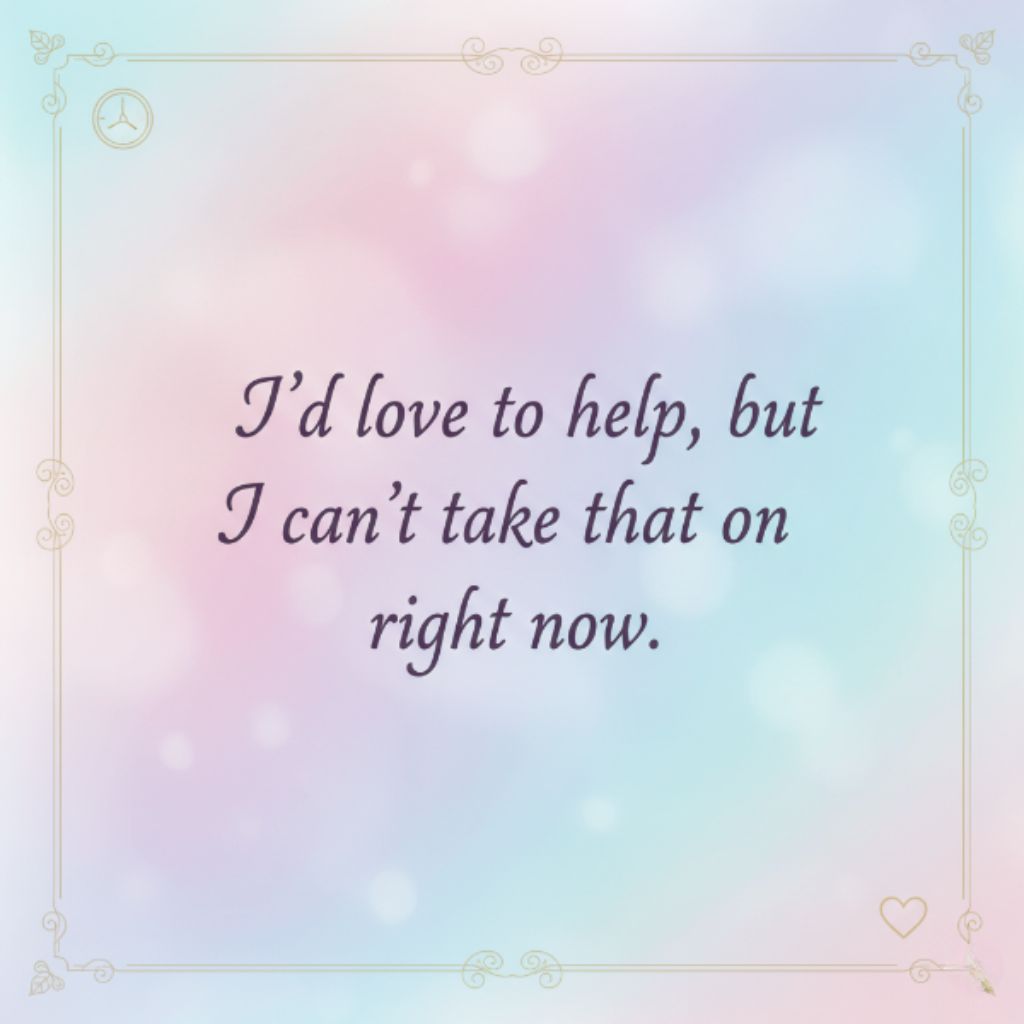
1. “I’d love to help, but I can’t take that on right now.”

Quote graphic reading “I’d love to help, but I can’t take that on right now” on pastel background with clock and heart icons.
Polite. Clear. Guilt-free. This phrase helps you say no with kindness and confidence.

This is a gentle and polite way to decline without overexplaining. It shows empathy, but also honors your limits.

Why it works:

  • It keeps your tone warm and respectful.
  • It signals that your time and energy are valuable.
  • It prevents you from saying yes out of guilt.

Try this when:

  • A coworker asks you to stay late again.
  • A friend asks for a favor when you’re already overwhelmed.

2. “That doesn’t work for me right now.”

Minimalist desk scene with closed laptop, cup of tea, and sticky note reading “That doesn’t work for me right now” in elegant handwriting.
You don’t owe long explanations. Sometimes the most powerful boundary is a calm, simple “That doesn’t work for me right now.”

This phrase is simple, neutral, and assertive. It doesn’t invite debate or justification.

Why it works:

  • It sets a boundary without sounding defensive.
  • It keeps the focus on your needs, not excuses.
  • It’s a go-to phrase for both personal and professional settings.

Try this when:

  • You’re invited to an event you don’t want to attend.
  • Someone pushes you to do something you’re uncomfortable with.

3. “I need some time to think about that.”

Notebook with quote “I need some time to think about that” written neatly beside a pen.
You don’t owe anyone an instant answer. Take your time — your peace matters.

This is perfect for those moments when you feel pressured to say yes immediately. It creates space for decision-making.

Why it works:

  • It buys you time to evaluate whether you truly want to commit.
  • It helps you avoid impulsive “yes” responses.
  • It teaches others that your time is valuable.

Try this when:

  • A boss, friend, or family member asks for a favor on the spot.
  • You’re unsure if you can meet someone’s request.

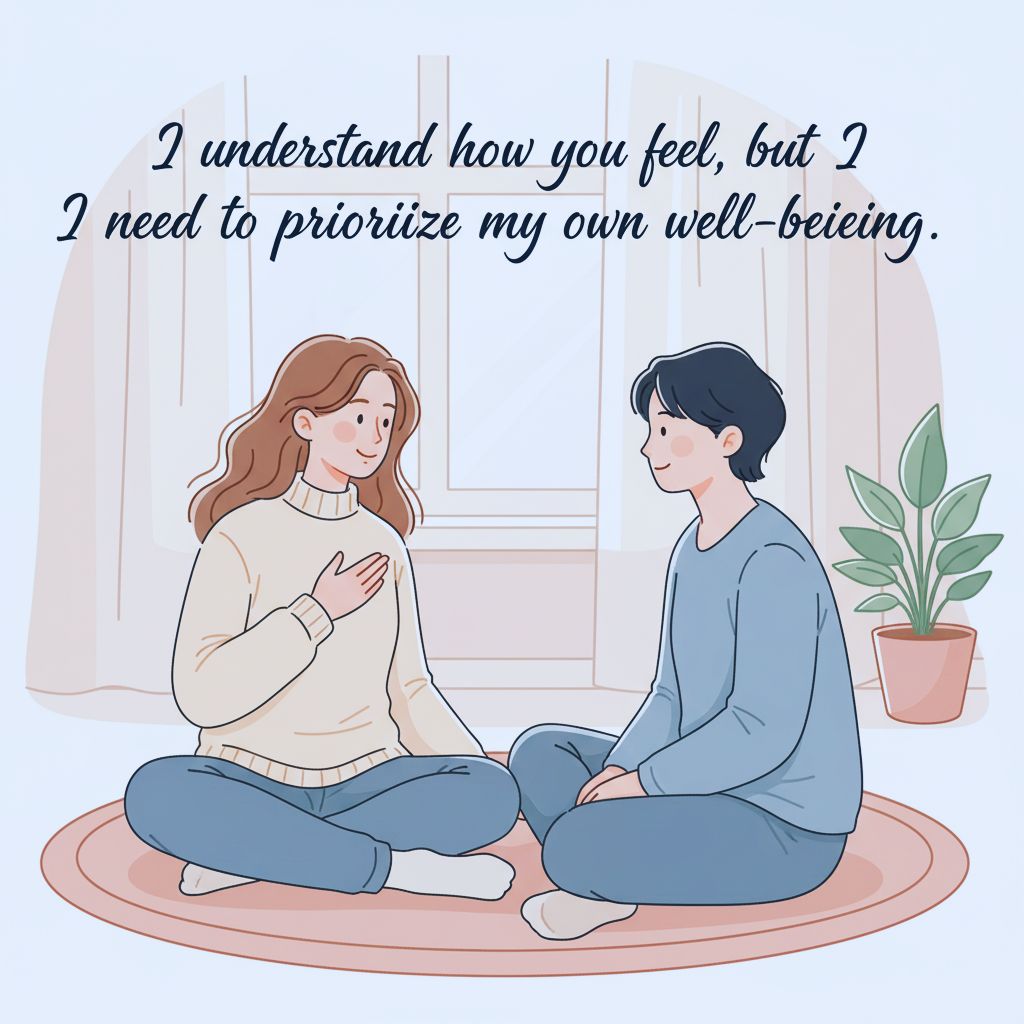
4. “I understand how you feel, but I need to prioritize my own well-being.”

Minimalist illustration of calm conversation with text overlay “I understand how you feel, but I need to prioritize my own well-being.”
Empathy and boundaries can coexist. This line keeps your heart open and your energy protected.

This phrase blends empathy with firmness. It acknowledges others’ feelings without sacrificing your own.

Why it works:

  • It shows compassion while asserting boundaries.
  • It teaches emotional maturity and self-respect.
  • It’s ideal for sensitive or emotional conversations.

Try this when:

  • Someone guilt-trips you for saying no.
  • You need to protect your mental health from toxic demands.

5. “No, thank you.” (Period.)

Minimalist quote graphic that reads “No, thank you.” on neutral beige background.
Short. Polite. Powerful. The most freeing phrase you’ll ever use.

Sometimes, the most powerful boundary is the simplest one. You don’t owe anyone an explanation for protecting your peace.

Why it works:

  • It’s short, polite, and final.
  • It reinforces that you don’t have to justify your decisions.
  • It empowers you to take control of your choices.

Try this when:

  • Someone repeatedly pushes your limits.
  • You’re asked to do something that doesn’t align with your values.

The Emotional Shift: From Guilt to Self-Respect

Once you start using these phrases, you may feel a little uncomfortable at first — and that’s normal. Growth often feels awkward before it feels empowering.

But here’s what happens over time:

  • People begin respecting your boundaries.
  • You gain more energy and emotional clarity.
  • You stop over-explaining or apologizing for your needs.
  • You feel free, calm, and confident instead of guilty or anxious.

Each “no” you say with self-respect creates space for more meaningful yeses — yes to rest, joy, creativity, and peace.

Tips to Strengthen Your Boundaries Over Time

  1. Practice in low-stakes situations.
    Try setting small boundaries first (like declining a minor request). Build up your confidence gradually.
  2. Don’t apologize for saying no.
    You don’t need to say, “I’m sorry, but…” Replace apology with appreciation (“Thanks for understanding”).
  3. Surround yourself with boundary-respecting people.
    Healthy people respect healthy boundaries — and set their own, too.
  4. Remember your “why.”
    Boundaries aren’t selfish — they’re self-care in action. They protect your time, energy, and emotional peace.

Final Thoughts: You Deserve Peace Without Guilt

Setting boundaries doesn’t make you difficult — it makes you authentic. It’s how you teach the world how to treat you.

The more you practice using these boundary-setting phrases, the easier it becomes to protect your energy without overthinking or feeling guilty.

So next time someone asks for more than you can give, take a deep breath and remind yourself:

“My peace matters. My needs matter. My boundaries matter.”

Because when you respect your limits, you create a life filled with balance, confidence, and genuine connection — the kind of life you truly deserve.

“Flat lay of self-care items including journal, tea, candle, and affirmations promoting mindfulness and calm living.”

Let’s be real — in a world that glorifies being “busy,” burnout has quietly become the new normal. We push ourselves endlessly, check off to-do lists like robots, and call it productivity. But here’s the truth: you can’t pour from an empty cup.

Self-care isn’t about bubble baths or candles (though they’re lovely). It’s about building a lifestyle that protects your energy, honors your limits, and keeps you thriving — not just surviving.

If you’ve been feeling mentally drained, emotionally numb, or physically exhausted, it’s time for a reset. And not by adding more tasks to your plate, but by stopping certain habits that quietly drain you every single day.

This is your Anti-Burnout Self-Care Checklist — 5 powerful things to stop doing today so you can reclaim your balance, clarity, and peace of mind.

Why Burnout Happens — and Why “Self-Care” Isn’t Always the Answer

Burnout doesn’t happen overnight. It builds quietly — from sleepless nights, skipped meals, ignored emotions, and endless “yeses.” Eventually, your body and mind wave a white flag.

The issue isn’t that we don’t care for ourselves — it’s that we often do the wrong kind of self-care. We focus on surface-level fixes instead of addressing the habits that caused burnout in the first place.

The real secret to an anti-burnout lifestyle isn’t doing more; it’s doing less of what drains you.

So let’s get to it — the 5 things you should stop doing today if you’re serious about breaking the burnout cycle.

1. Stop Saying “Yes” When You Mean “No”

The fastest way to burnout? Overcommitting.
Whether it’s work requests, family favors, or social plans, every “yes” takes a piece of your time, energy, and peace.

When you constantly agree to things you don’t want to do, you end up living for other people’s expectations instead of your own priorities.

Why It Drains You:

  • You spread yourself too thin.
  • You feel resentment and guilt.
  • You lose control over your schedule — and your sanity.

What To Do Instead:
Start practicing the art of polite refusal. You don’t need to justify or overexplain. A simple:

  • “I’d love to, but I’m not available right now.”
  • “That’s not something I can take on.”
    works beautifully.

Protecting your boundaries is the foundation of real self-care. Every time you say “no” to what drains you, you’re saying “yes” to your peace.

2. Stop Checking Your Phone First Thing in the Morning

“Phone on nightstand next to water glass and journal, representing a tech-free morning.”
“Start your day with presence, not notifications.”

You wake up, grab your phone, and suddenly — you’re scrolling, comparing, reacting. Within minutes, your brain is flooded with notifications, news, and other people’s lives.

That’s not connection — that’s mental chaos before your day even begins.

Why It Drains You:

  • You start your day on reactive mode instead of intentional mode.
  • It spikes stress and anxiety levels.
  • You lose focus before you’ve even had your coffee.

What To Do Instead:

  • Keep your phone out of reach when you sleep.
  • Replace morning scrolling with five mindful minutes — stretch, hydrate, breathe, or journal.
  • Set a tech boundary: no screens for the first 30 minutes after waking.

This one habit alone can dramatically improve your energy, focus, and mental clarity. Start your day with your own mind, not the world’s noise.

3. Stop Glorifying “Being Busy”

“Minimal workspace with tea and closed laptop representing work-life balance.”
“Busy isn’t the goal — balanced is.”

Let’s kill the myth: being busy ≠ being productive.

So many people wear exhaustion like a badge of honor — bragging about packed schedules, late nights, and zero breaks. But here’s the truth: rest is productive.

If you constantly chase busyness, you never give your brain the stillness it needs to recharge. Eventually, you burn out — physically, mentally, emotionally.

Why It Drains You:

  • You confuse motion for progress.
  • You lose sight of what really matters.
  • You normalize exhaustion instead of balance.

What To Do Instead:

  • Redefine success. Ask yourself: “Does this bring peace or pressure?”
  • Schedule rest like a meeting — make it non-negotiable.
  • Prioritize deep work over shallow multitasking.

The goal isn’t to do everything. The goal is to do the right things with calm, clarity, and presence.

Remember: busy is a habit, not a badge.

4. Stop Ignoring Your Body’s Signals

“Woman stretching on yoga mat by window, symbolizing mindfulness and body care.”
“Listen when your body whispers — before it has to scream.”

Your body speaks — the question is, are you listening?

Headaches, fatigue, irritability, brain fog — these aren’t random. They’re messages from your body saying, “Slow down. Take care of me.”

Ignoring them in the name of productivity is like ignoring your car’s warning light until it breaks down.

Why It Drains You:

  • Chronic stress becomes your “normal.”
  • Small issues (like tension or fatigue) snowball into bigger problems.
  • You disconnect from your own needs.

What To Do Instead:

  • Pause and scan your body throughout the day. Are your shoulders tight? Are you clenching your jaw?
  • Take short breaks — stretch, breathe, hydrate, move.
  • Prioritize sleep and nutrition like your career depends on it (because it does).

Your body is your longest home. Treat it like the sacred space it is. Self-care begins with listening.

5. Stop Comparing Yourself to Others

“Person smiling in mirror surrounded by positive affirmation notes.”
“Comparison steals joy — celebrate your own progress.”

Comparison is the silent killer of joy.

In the age of social media, it’s easy to fall into the trap of feeling behind — someone always seems to have a better job, body, or life. But remember: you’re seeing their highlight reel, not their behind-the-scenes.

Why It Drains You:

  • It breeds insecurity and self-doubt.
  • You measure your worth by someone else’s journey.
  • You lose sight of your own progress.

What To Do Instead:

  • Practice gratitude daily. Focus on what’s going right in your life.
  • Curate your social feed — unfollow accounts that trigger comparison.
  • Celebrate your small wins. Progress is personal, not a race.

You are on your own timeline — and it’s unfolding exactly as it should.

The Burnout Antidote: Doing Less, Living More

Burnout recovery isn’t about a weeklong vacation or a fancy spa day. It’s about everyday micro-choices that protect your peace.

When you stop overcommitting, unplug in the morning, release the busyness trap, listen to your body, and let go of comparison — something beautiful happens: your energy returns.

You feel lighter, calmer, and more aligned with your true self.

Self-care isn’t indulgence — it’s maintenance. It’s the foundation for your creativity, relationships, and success.

So today, instead of adding more to your to-do list, start by removing the things that drain you. That’s how you create space for balance, joy, and renewal.

Quick Recap — Your Anti-Burnout Checklist

Here’s your reminder list of what to stop doing today to reclaim your energy and peace:

  1. Saying “yes” when you mean “no.”
  2. Checking your phone first thing in the morning.
  3. Glorifying being busy.
  4. Ignoring your body’s signals.
  5. Comparing yourself to others.

Replace these with mindful habits that nurture you daily: boundaries, gratitude, rest, presence, and self-awareness.

The Bottom Line

Burnout isn’t a badge of honor — it’s a signal.
Your mind and body aren’t asking for more hustle — they’re asking for healing.

When you stop chasing unrealistic standards and start honoring your needs, you’ll realize that peace isn’t found in doing more; it’s found in doing less — with intention.

This is your permission slip to slow down, breathe deeply, and protect your energy unapologetically.
Because the world doesn’t need a burned-out version of you — it needs a balanced, alive, and fully present you.

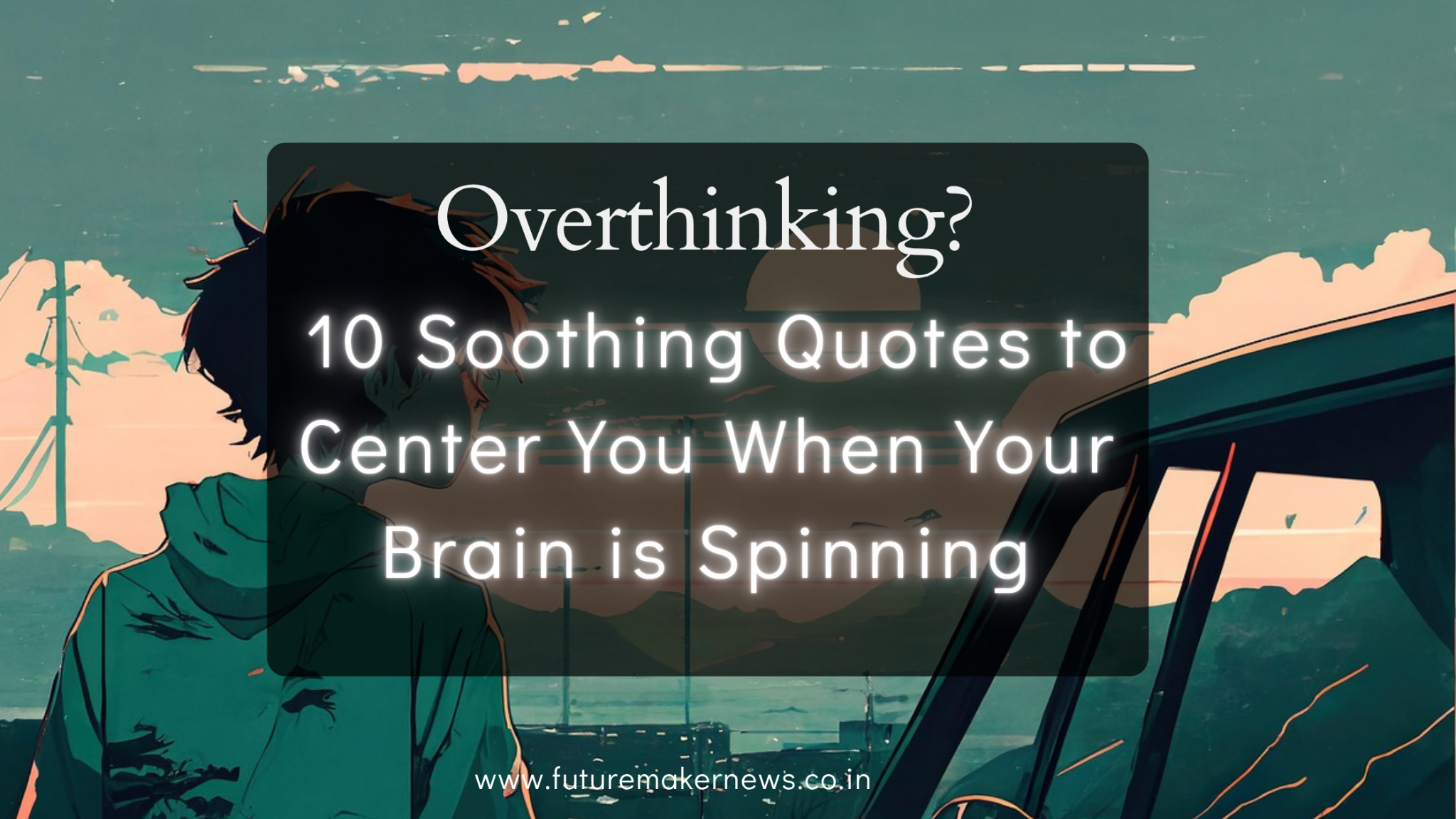
Illustration of a person standing near a car at sunset with text “Overthinking? 10 Soothing Quotes to Center You When Your Brain is Spinning.”

You recognize the sensation.
It’s late at night, the house is still, and yet your mind is as awake as it is wired — racing marathons through what happened or what may never occur. The “what-ifs,” the “should-haves,” the whole mental merry-go-round just refuses to slow down.

I’ve lost count of how many times I’ve been there.
Lying in bed, gazing up at the ceiling, replaying arguments that ended hours before. My body is tired, but my mind? They’re hosting an all-night conference.

What I’ve picked up on over the years is that there are times when you don’t need to struggle against your thoughts — you just need to find a pause long enough to catch your breath.
And of all the gentle ways to do that, one of them is through words. Not forced mantras or affirmations, but simple, earthy truths that remind you to return to now.

And so here are ten quotations that serve as soft brakes — little anchors to calm your frantic thoughts, reboot your brain from fear, and silence that inner critic that never seems to sleep.

The Anchor: 10 Quotes to Silence Your Inner Critic

“You must live in the present, launch yourself on every wave, find your eternity in each moment.”

— Henry David Thoreau

Each time I read this, it is like taking a deep breath.
You don’t have to manage tomorrow or repair yesterday. Just take this one wave. That’s how to immediately bring yourself back to earth — by returning to where your feet are.

“I’ve had a lot of worries in my life, most of which never happened.”

— Mark Twain

This one hurts because it’s true.
We construct whole catastrophe films in our minds, and 99% of them never make it to the cinema of real life. Take this to heart when you find yourself spiraling — it’s how you end the mental carousel before it spins around again.

“Feelings come and go like clouds in a windy sky. Conscious breathing is my anchor.”

— Thích Nhất Hạnh

When I feel the anxiety start to rise, I return to my breath.
It’s not about fleeing the storm; it’s about knowing you’re the sky, not the cloud. Take a few deep inhales, and you’ll sense it — that quiet calm that starts to settle my racing mind.

“You are not your mind.”

— Eckhart Tolle

This quote revolutionized my life.
There’s a point when you catch your thoughts instead of being overwhelmed by them — and all of a sudden, you’re liberated. This is the most peaceful means of silencing the inner critic: by understanding it’s not really you speaking.

“The most difficult thing is the decision to act; the rest is merely tenacity.”

— Amelia Earhart

Excessive thinking usually masquerades as preparation.
But occasionally the best exit from fretting is through action — one tiny, gentle step in a new direction. That’s the easy mental adjustment for fretting: doing instead of cogitating endlessly.

“Attachment is the root of suffering.”

— Buddha

Each time I cling too hard — to schedules, to people, to results — my worries constrict along with them.
When I release my hold, peace returns. This is the most authentic way to restore brain from fear — by letting go of what you can’t control.

“Do not be satisfied with the stories that come before you. Unfold your own myth.”

— Rumi

Rumi reminds me always to be kind to myself.
It’s fine that you’re still learning to live slower, softer. Self-kindness isn’t excess — it’s the source of strength. That’s how to ground yourself in an instant when life gets too loud.

“You gain strength, courage, and confidence by every experience in which you really stop to look fear in the face.”

— Eleanor Roosevelt

At times, I reread this on the days my fear is louder than logic.
Every time you decide to breathe through it rather than fleeing, you deepen your roots. That’s how you end the mental merry-go-round — not by sidestepping fear, but by acquainting yourself with it.

“If you can’t feed a hundred people, feed just one.”

— Mother Teresa

When the world gets too big, begin small.
Send a text, water a plant, breathe once. Small, actual things ground you back to earth. They soothe my frantic thoughts quicker than any elaborate scheme ever could.

“When I let go of what I am, I become what I might be.”

— Lao Tzu

This one is like a slow breath.
It’s a reminder that peace doesn’t come from control — it comes from surrender. The next time your brain won’t stop listing what-ifs, quiet the inner critic by whispering: “I’m allowed to let go.”

How to Use These Anchors

Here’s something simple I started doing last year:
I stuck my favorite quote on a Post-it note and placed it on my computer. Whenever my mind begins to spin, I look at it — a little reminder to switch channels.

That’s basically the idea. You’re not shutting off your thoughts. You’re simply redirecting them gently — like turning down the volume when a song turns too loud.
It’s an easy mind flip for anxiety: rather than “How do I prevent thinking?” try “What thought do I wish to water?”

You may even take a photo of one quote and set it as your phone background, or begin your day by reading one aloud. It’s amazing how some real-word sentences can flip your entire mood.

Your Mind Deserves Quiet

Serene night landscape with a full moon reflecting over a calm lake and palm trees in the distance.
The night doesn’t overthink. It just reflects.

Overthinking is not a weakness; it’s simply your brain attempting a little too hard to guard you.
You may thank it — and then instruct it to rest.

Even if all feels knotted up and noisy, keep in mind: you always possess an anchor. A break. A breath. A passage that waits quietly for you to return to it.

So, take a deep breath.
Which one of these quotes spoke to you most today?
Share it in the comments — because your words might be the anchor someone else needs tonight.

Self-care rituals banner with pink flower and text "7 Ways to Refresh Mind, Body & Home This Month".

Have you ever hit that weird point in the month where everything feels… heavy? Like your brain’s buffering, your body’s dragging, and even your living room looks tired? Yeah—me too. It’s usually that seasonal in-between where the weather’s changing but my energy hasn’t caught up yet.

Here’s the thing: you don’t need a spa weekend, a six-hour break from your inbox, or a shopping cart full of fancy “self-care” products to reset. Nope. These 7 simple Seasonal Self-Care Rituals take 15 minutes or less, don’t require a big budget, and—spoiler alert—the 7th one is the real game-changer because it shifts your mindset (not just your routine).

So if your mind feels stale, your body feels sluggish, and your home feels… meh—let’s fix that.

Recharge the Body: Starting with Cozy Bath Habits

Hands relaxing in a cozy bath with candles and essential oils, perfect for seasonal self-care rituals.
Unwind with cozy bath

Baths aren’t just about being clean—they’re about reclaiming your body from the chaos of the day. The secret is making them cozy, not complicated.

  1. Temperature sweet spot: Aim for warm—not scalding. About 100°F (38°C) is perfect. Just warm enough to soften your muscles but not so hot you emerge looking like a tomato.
  2. Lights down, mood up: Swap bright bathroom lights for a candle (or heck, the flashlight on your phone in a glass jar). Instant spa vibes.
  3. DIY scrub hack: Mix a spoonful of sugar or coffee grounds with olive oil. Boom—you’ve got an exfoliating scrub that costs pennies and smells way better than store-bought.

And if you’re wondering what scents or oils to toss into your bath water, I’ve already got you covered in my old guide: Healing Scents: DIY Aromatherapy. Trust me—you’ll never look at lavender or peppermint the same way again.


Recharge the Mind: The Power of Candle Journaling Routine

This one sounds fancy, but it’s really just journaling with better lighting and intention.

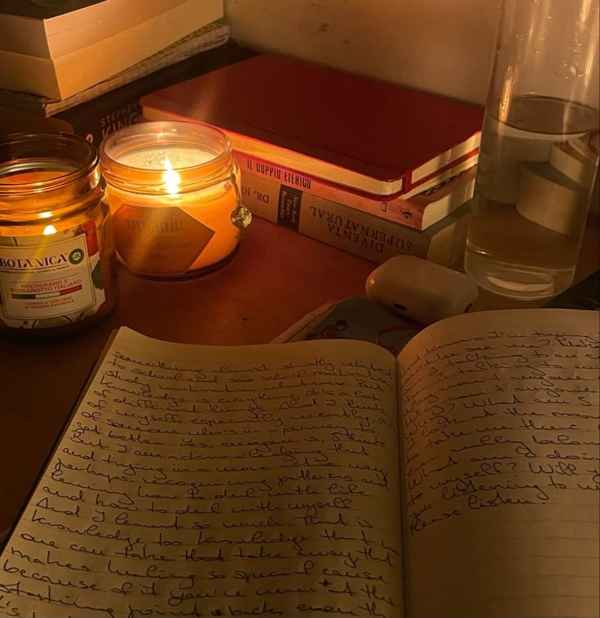
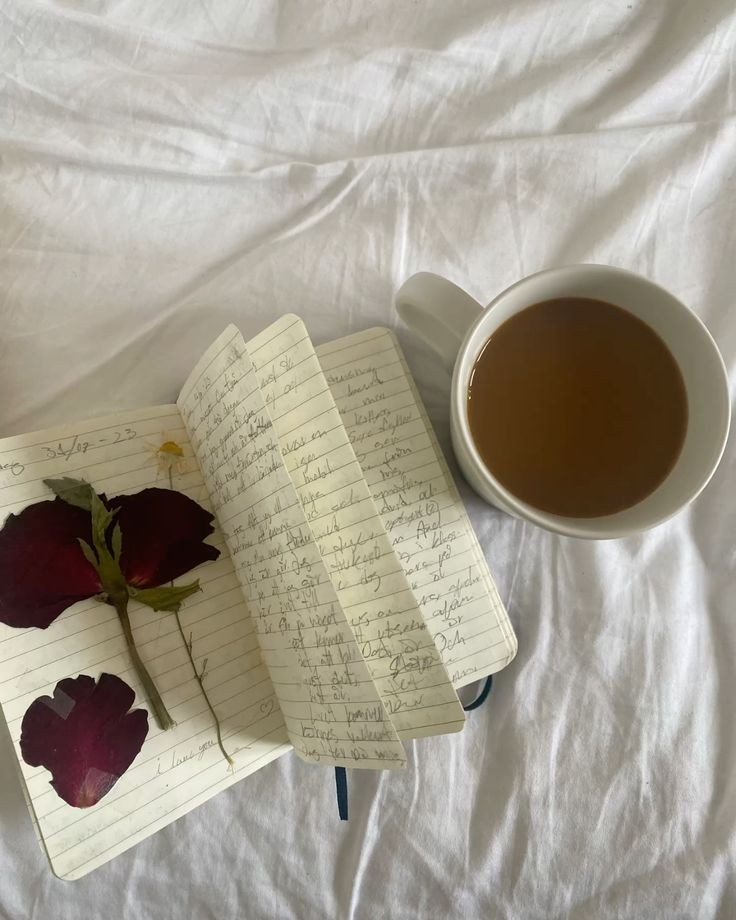
Open journal with candlelight and books in a cozy setup.
Late-night journaling with candles—turning thoughts into calm.

Here’s how to create a Candle Journaling Routine that doesn’t feel like homework:

  1. Light a candle – any candle. Scented, unscented, even that half-burned one in your kitchen drawer.
  2. Set a timer – five to ten minutes max. The candle’s flame acts as your focus point and your built-in clock.
  3. Write freely – no pressure. Try prompts like “What’s one thing I need to let go of today?” or “What made me smile this week?”
  4. End when the flame reminds you – blow it out, take a deep breath, and let that be the signal that the moment is complete.

The candle keeps you grounded. Instead of getting lost in endless “dear diary” rambling, you’re giving your brain a short, sensory window to declutter.


Recharge the Home: Creating a Seasonal Sanctuary

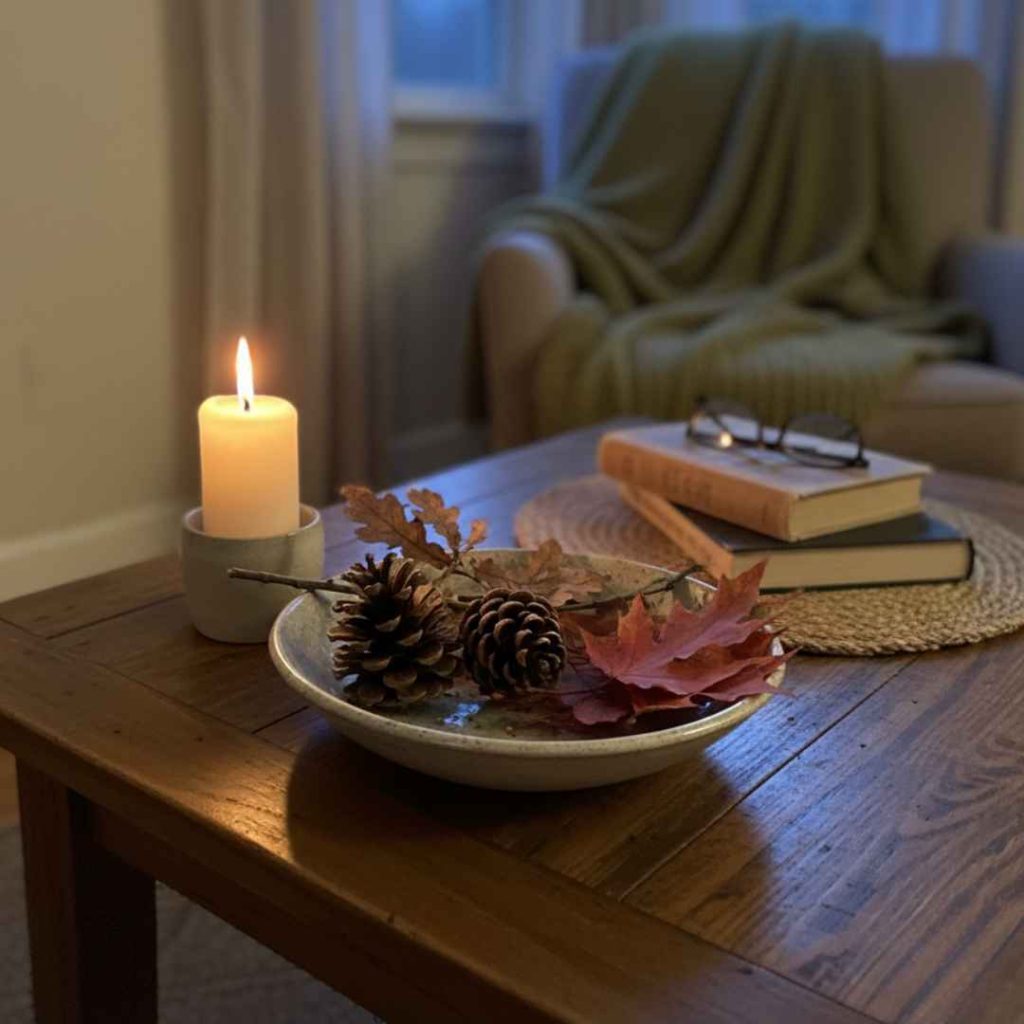
A cozy fall home scene with a lit candle, pinecones, and autumn leaves on a wooden coffee table beside books and a blanket-covered chair.
Creating a seasonal sanctuary

Your environment affects your energy way more than you think. But don’t panic—I’m not about to tell you to overhaul your entire house. This is about small, seasonal tweaks that spark a Mindset Shift for Refreshment.

  • Declutter one corner: Seriously—just one. The nightstand, the coffee table, or even the shoe pile near your door. That tiny shift ripples into calm.
  • The Cozy Candle Rule: Keep one candle (just one!) in the space you use most at night. When it’s lit, that’s your signal the day is winding down.
  • Bring in nature: Grab a pinecone, a few branches, or even fallen leaves on your next walk. Put them in a bowl on your counter or shelf. It’s free décor and it ties your home to the season outside.

Your home doesn’t need a Pinterest makeover—it just needs a touch of intention.


The Mindset Shift for Refreshment (The Grand Finale)

Example: A cozy journal with self worth journal prompts written inside.

Okay—this is the 7th ritual, and honestly, it’s the one that will change everything.

Here’s the deal: schedule rest before you need it. We’re so used to waiting until we’re burned out to crash, but what if you built little breaks into your week like appointments you can’t cancel?

Here’s a mindset prompt to try right now (yep, grab a pen—or your phone’s notes app):

“What’s one thing I can give myself permission to stop doing this week?”

It could be something small—like answering work emails after 7 PM, or folding laundry the same day it comes out of the dryer (you know who you are). The point is: intentional rest keeps you from spiraling into exhaustion later.


Wrapping It Up (And Passing It On)

So there you have it: 7 quick, affordable Seasonal Self-Care Rituals that refresh your body, mind, and home without stealing your whole weekend.

Remember: it’s not about perfection—it’s about creating little pockets of care that make life feel lighter.

Now I want to hear from you: Which ritual are you going to try first? Drop a comment and let’s compare notes (your ideas might inspire someone else, too).

And if you have a friend who’s been running on empty lately—send them this post. Sometimes the best gift isn’t flowers or chocolate—it’s a nudge toward giving themselves a break.

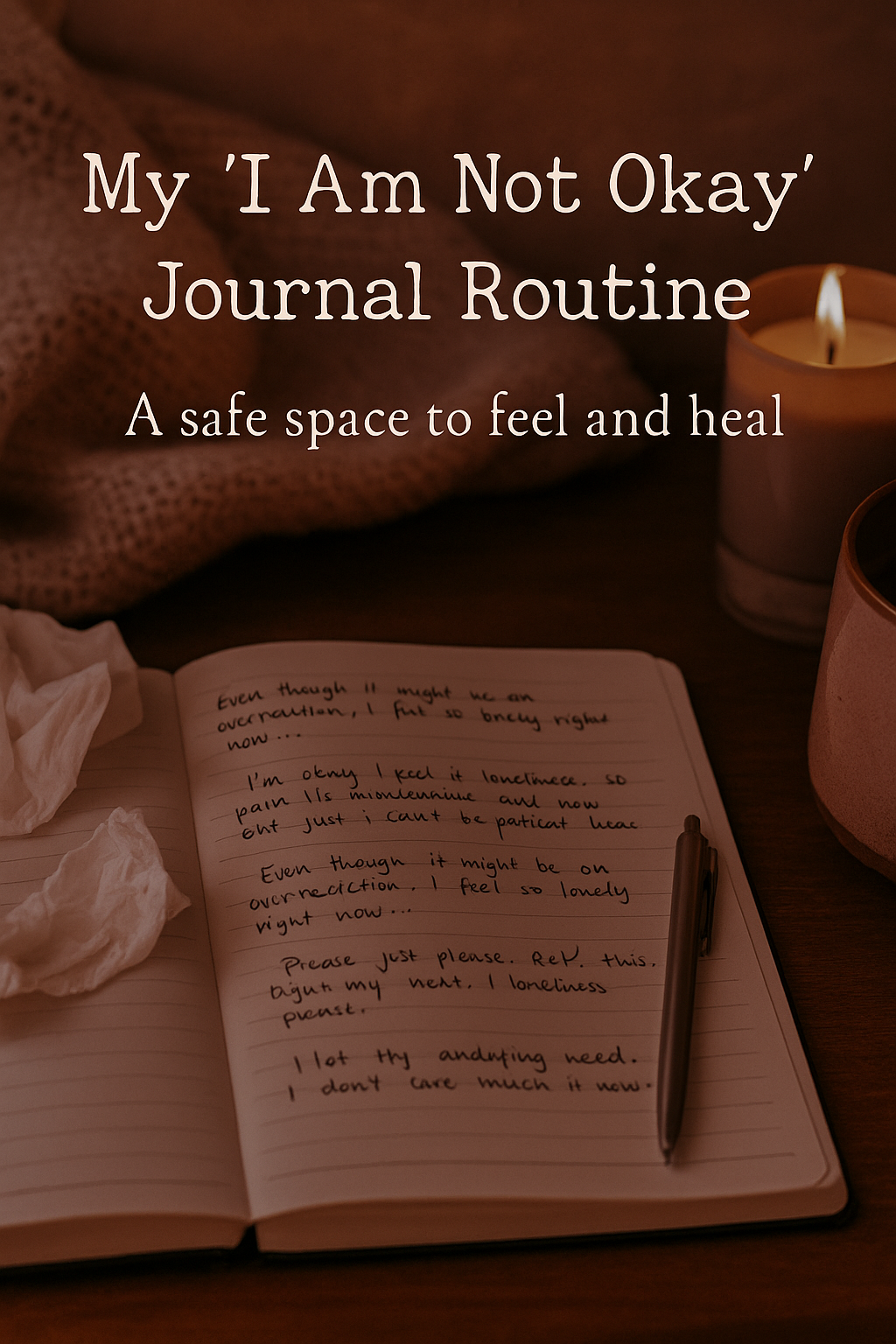
A moody, cozy flat-lay featuring an open journal with handwritten emotional notes, soft tissues, a flickering candle, and a warm drink on a blanket. The scene is bathed in dim lighting with dusty rose and beige tones, evoking a sense of late-night emotional healing and self-reflection.

A Safe Space to Feel and Heal

Why I Created This Ritual

Some nights, the weight of everything hits at once — anxiety that lingers, unresolved conversations, self-doubt, or just the feeling of being overwhelmed. I realized I needed a routine that didn’t force positivity, but allowed me to just be — in all of my emotions, without shame.

This isn’t a productivity hack or a gratitude list. This is my space to fall apart — safely.

Setting the Mood

I dim all the lights in my room, leaving only warm bedside lighting or candlelight. A softly burning candle adds calm. I wrap myself in a cozy blanket and make a cup of warm tea. Tissues are nearby — because some nights bring tears, and that’s okay. I also silence and put away my phone. This space is just for me.

What I Write (and Don’t Write)

There are no rules in this journal. I don’t aim to “solve” anything. I let my thoughts spill out — angry, confused, broken, hopeful. Some nights, it’s full paragraphs of pain. Others, just single words or a page that says “I don’t know what I feel. I just feel heavy.”

And that’s enough.

How I End the Routine

I always close with a grounding sentence to hold myself through the night:

  • This moment will pass.
  • You don’t need to fix yourself to be worthy of rest.
  • It’s okay not to be okay.

It’s like tucking my heart in for the night.

What This Routine Has Taught Me

That vulnerability is not weakness — it’s the beginning of healing. That emotional journaling can be a safe outlet when you don’t feel safe elsewhere. That we don’t always need solutions — we need self-compassion.

This journal is not about perfection. It’s about presence.

You are still here. You are still trying. That’s more than enough.

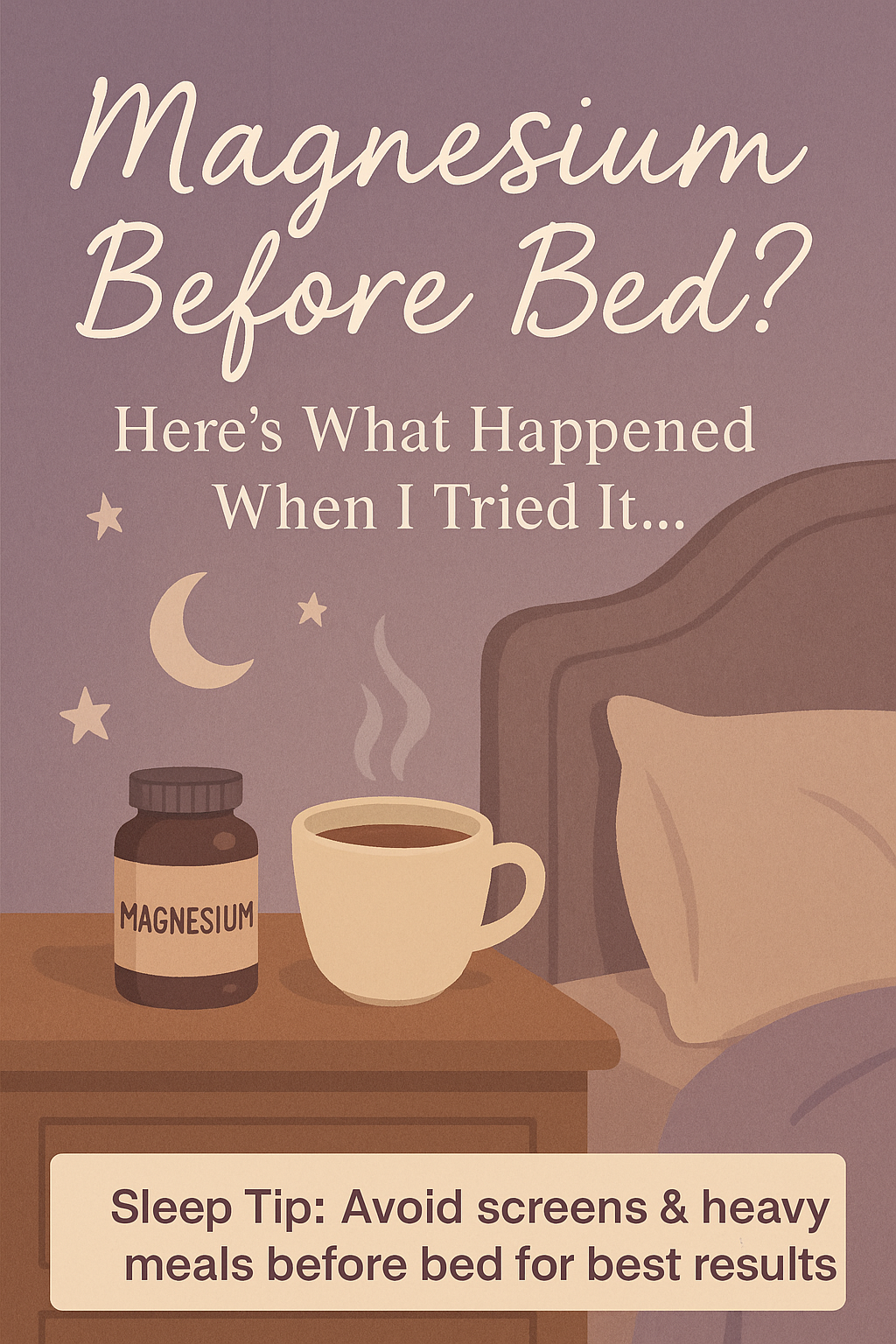
Magnesium Before Bed? Here’s What Happened

Magnesium Before Bed? Here’s What Happened When I Tried It…

I’ve always struggled with winding down at night. My mind would race, my muscles felt tense, and falling asleep took longer than I’d like to admit. After reading about magnesium’s calming effects on the body, I decided to give it a try for one full week — just one capsule or powder mixed in warm water, about 30 minutes before bed.

What happened truly surprised me.

Night 1–2: Subtle Shifts

I didn’t expect anything magical, but by the second night, I noticed I wasn’t tossing and turning as much. My muscles — especially my shoulders and legs — felt looser. It was as if my body gave a little sigh of relief. No drowsiness, just a subtle calm.

By Night 3–4: Deeper Sleep, Fewer Wake-Ups

This was the real game-changer. I usually wake up at least once or twice at night. But with magnesium, I slept through the night more consistently. I also didn’t wake up feeling groggy — I felt clear-headed and genuinely rested.

Night 5–7: Better Mornings, Less Anxiety

The biggest surprise was how it affected my mornings. I woke up without the usual tension or mental fog. Even my mood improved — less morning anxiety and a calmer start to the day. Magnesium didn’t just help me sleep — it helped me recover overnight.

Why Magnesium Helped Me: A Quick Science Note

Magnesium plays a vital role in regulating neurotransmitters and calming the nervous system. It also helps the body produce melatonin naturally — the hormone responsible for sleep. When taken at night, it promotes muscle relaxation and makes it easier for the brain to enter a restful state.

My Final Thoughts

Magnesium is now a permanent part of my nighttime routine — right next to my journal and herbal tea. It’s not a sedative. It doesn’t knock you out. But it creates the conditions for deep, healing rest. And in today’s overstimulated world, that’s priceless.

Would I recommend it? Absolutely — especially if you:

  • Struggle to fall asleep
  • Wake up often in the middle of the night
  • Feel sore or tense at bedtime
  • Want to support a more relaxed nervous system naturally

Sometimes, the smallest rituals bring the biggest shifts.

Magnesium at night might be your new go-to too.

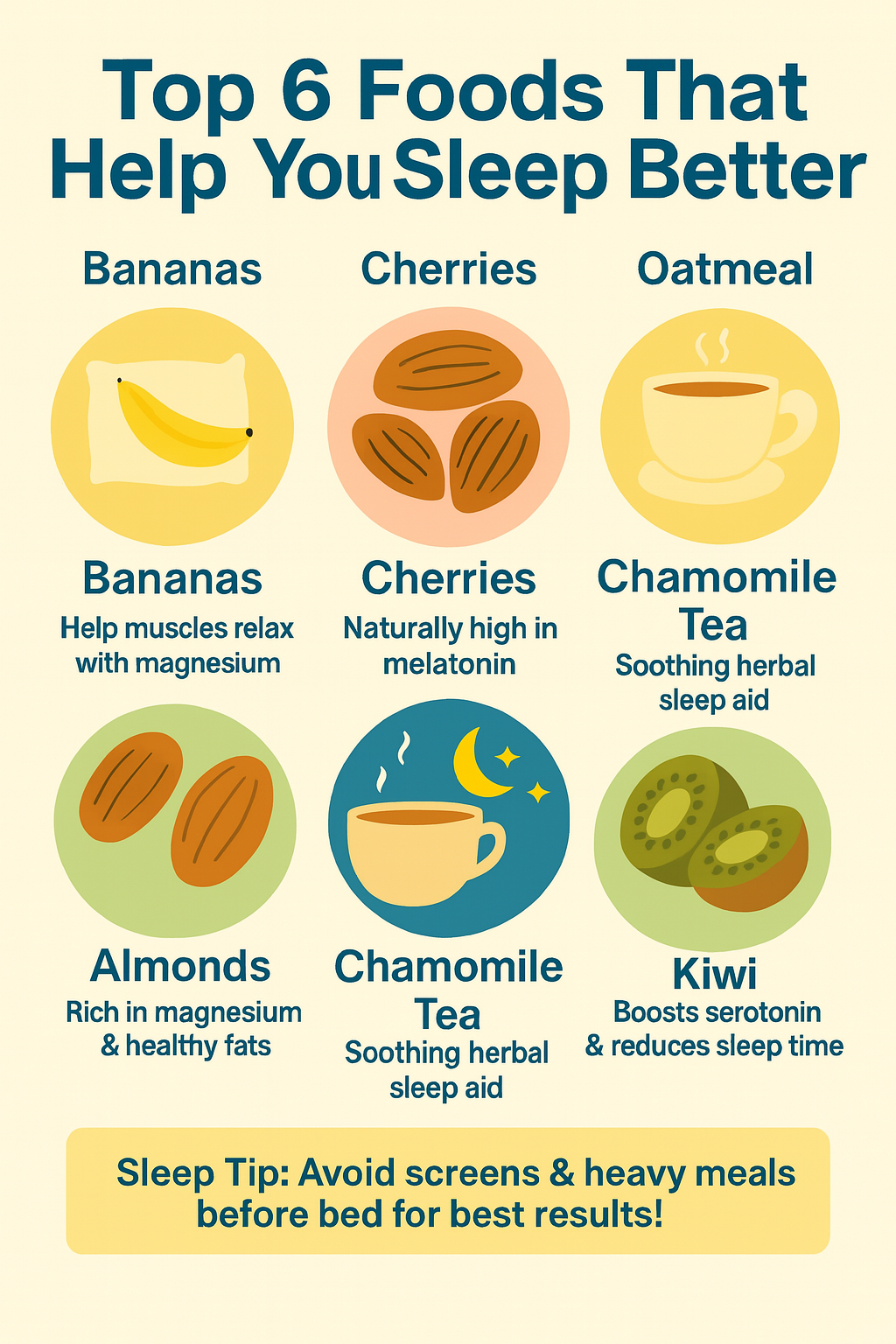
Top 6 Foods That Help You Sleep Better

Top 6 Foods That Help You Sleep Better

1. Bananas

Bananas are rich in magnesium and potassium, which help relax muscles and nerves. They also support melatonin production for improved sleep quality.

2. Cherries

Cherries, especially tart cherries, are a natural source of melatonin, the hormone that regulates sleep cycles. Consuming cherries or cherry juice can help you fall asleep faster and stay asleep longer.

3. Oatmeal

Oatmeal contains complex carbohydrates that promote serotonin release, a calming neurotransmitter. It also has melatonin-supporting nutrients like vitamin B6 and magnesium.

4. Almonds

Almonds are packed with magnesium, healthy fats, and protein—all of which contribute to better sleep by calming the nervous system and regulating blood sugar levels through the night.

5. Chamomile Tea

Chamomile tea is known for its relaxing and mildly sedative properties. It contains apigenin, an antioxidant that binds to receptors in the brain to promote sleepiness and reduce insomnia.

6. Kiwi

Kiwi is high in antioxidants and serotonin, which help improve sleep onset and duration. Eating kiwi an hour before bed may reduce the time it takes to fall asleep and enhance sleep efficiency.

Sleep Tip: Avoid screens & heavy meals before bed for best results!

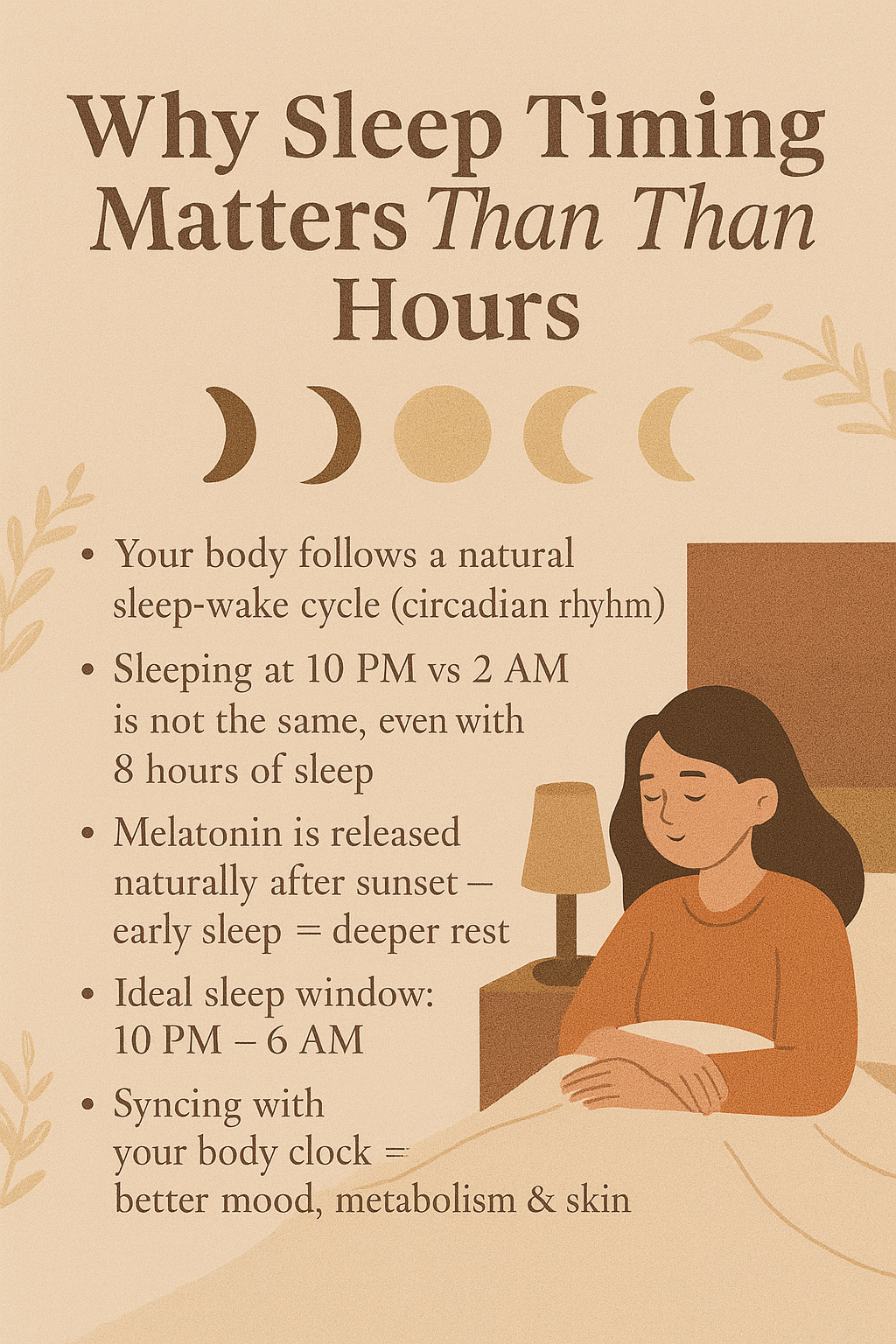
Why Sleep Timing Matters More Than Hours

Why Sleep Timing Matters More Than Just the Number of Hours You Sleep

We often hear that getting eight hours of sleep is essential—but what’s rarely talked about is when you sleep. Timing plays a major role in how restorative your sleep truly is. Sleeping at the right time, in sync with your body’s natural rhythm, can dramatically improve your mental and physical well-being.

Your Body Follows a Natural Sleep-Wake Cycle

This internal clock is known as the circadian rhythm, and it controls your energy levels, alertness, hormone production, and sleep patterns over a 24-hour period. It responds to natural cues like sunlight and darkness, telling your body when to feel awake and when to rest. Ignoring this rhythm—like staying up late and waking up late—can disrupt everything from mood to metabolism.

Sleeping at 10 PM vs 2 AM Is Not the Same

Even if you clock in eight hours of sleep, the results can vary drastically based on when those hours occur. Sleeping from 2 AM to 10 AM might leave you feeling foggy, irritable, or emotionally off. In contrast, going to bed by 10 PM allows your body to align with its natural hormonal cycles, helping you feel more refreshed and mentally clear.

Melatonin Peaks After Sunset

Melatonin is a hormone released by your brain to signal that it’s time to wind down. This release starts naturally around 9 to 10 PM, as darkness falls. When you sleep in alignment with this natural process, you’re more likely to fall asleep quickly, stay asleep, and enter deep sleep cycles. Delaying bedtime past midnight can blunt melatonin production, making your sleep feel lighter and less effective.

The Ideal Sleep Window: 10 PM – 6 AM

While everyone’s sleep needs are slightly different, the 10 PM to 6 AM window is considered ideal for most adults. This is when your body naturally undergoes critical processes such as tissue repair, immune regulation, and memory consolidation. Sleeping during this time ensures you’re not just resting—but truly recovering.

Syncing with Your Body Clock Has Real Benefits

When your sleep aligns with your natural circadian rhythm, you may notice a boost in:

  • Morning alertness and energy
  • Emotional stability and lower stress
  • Digestive efficiency and metabolism
  • Skin clarity and cellular repair
  • Immune strength and hormonal balance

Final Thought: Quality Sleep Starts with the Clock

The next time you think about getting “enough” sleep, ask yourself when that sleep is happening. Prioritizing earlier bedtimes in line with your circadian rhythm can have a profound effect on your overall health—one that lasts far beyond the morning alarm.