
 By Frank Lucasale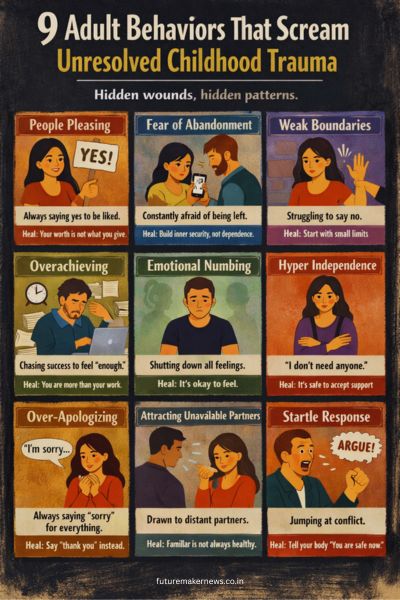
Many adults carry emotional wounds from childhood they never chose—and were never taught how to heal.
What looks like:
- Strength
- Independence
- Perfectionism
- “Personality quirks”
is often something deeper: survival strategies that once protected you.
These behaviors are not flaws. They are adaptations. Below are nine common adult patterns often linked to unresolved childhood trauma—and what healing can gently look like.
1. People-Pleasing at All Costs
Example:
Saying yes while breaking inside. Avoiding conflict even when it hurts.
This often develops when love or safety felt conditional in childhood.
Healing direction:
Your worth is not earn through sacrifice. Practice choosing yourself in small, safe ways.
2. Fear of Abandonment
Example:
Constantly monitoring a partner’s mood. Feeling anxious they might leave at any moment.
This can stem from early experiences of inconsistency or emotional loss.
Healing direction:
Build internal safety. Other people’s emotions are not proof of your value.
3. Difficulty Setting Boundaries
Example:
Feeling guilty for saying no. Overexplaining basic needs.
When boundaries were ignored or punished early on, asserting them later can feel unsafe.
Healing direction:
Start small. Set one boundary and honor it—without justification.
4. Overachieving to Cope
Example:
Nothing ever feels “enough,” no matter how much you accomplish.
Achievement becomes a substitute for worth when love was tied to performance.
Healing direction:
Redefine success as balance, rest, and self-respect—not constant output.
5. Emotional Numbing
Example:
Staying “strong” by disconnecting from feelings.
This often forms when emotions were dismissed or overwhelming in childhood.
Healing direction:
Notice emotions without judging them. Feeling does not equal weakness.
6. Hyper-Independence
Example:
“I don’t need anyone” becomes emotional armor.
This can develop when relying on others once led to disappointment or pain.
Healing direction:
Let safe people support you—slowly and on your terms.
7. Over-Apologizing
Example:
Saying sorry before speaking. Feeling like a burden for existing.
This often forms when you were made to feel “too much” or responsible for others’ emotions.
Healing direction:
Replace “sorry” with “thank you.” Shift from shame to presence.
8. Attracting Emotionally Unavailable Partners
Example:
Being drawn to people who cannot fully show up.
Familiar patterns feel safer than healthy ones—even when they hurt.
Healing direction:
Remember: familiar does not mean safe or nourishing.
9. Heightened Startle Response to Conflict
Example:
Raised voices trigger anxiety or panic.
When conflict once meant danger, the body remembers—even years later.
Healing direction:
Ground yourself in the present. Gently remind your body that you are safe now.
Final Thoughts: These Are Not Flaws—They Are Armor
Unresolved childhood trauma is not your fault.
These behaviors are not character defects.
They are protective systems you built when you had no other choice.
Healing doesn’t mean erasing them—it means learning that you no longer have to live in survival mode.
And that learning can be slow, compassionate, and deeply freeing.