Life has a frustrating pattern: it demands patience long before it delivers results. Effort comes first. Silence follows. Recognition comes last—if you don’t quit in between.
Most people don’t fail because they lack talent or discipline. They fail because the waiting breaks them.
If you’re doing the work and still seeing no visible progress, these three mindset strategies will help you stay grounded, consistent, and mentally strong until the reward arrives.
1. Detach From the Outcome and Commit to the Process
One of the fastest ways to lose patience is obsessing over timelines.
When you constantly ask “Is this working yet?” you drain energy from the very actions that create progress. Growth doesn’t happen in the result—it happens in repetition.
Shift your focus from counting days to showing up well today. The process builds skill, confidence, and resilience long before it produces external proof.
When you detach from outcomes, patience stops feeling like suffering and starts feeling like mastery.
2. Reframe Waiting as Training, Not Punishment
Delays feel painful because we interpret them as rejection or failure.
But waiting is rarely a denial—it’s preparation.
Every period of uncertainty strengthens something internal: your discipline, emotional control, faith in yourself, and ability to move forward without validation.
Athletes don’t call resistance useless—they call it training. Life works the same way. The delay is shaping the version of you who can actually handle what’s coming next.
When you see waiting as training, impatience turns into purpose.
3. Stay Consistent in Silence
Some of the most important work you’ll ever do will happen with no applause, no encouragement, and no witnesses.
This is where most people stop—but it’s also where momentum quietly builds.
Consistency in silence creates credibility. It turns patience into proof.
If you can keep showing up when no one is watching, you won’t need to chase recognition later—it will arrive naturally.
Final Thought
Life always tests patience before it honors effort. That test is the filter.
The reward doesn’t go to the loudest, fastest, or most impatient—it goes to those who keep moving forward when progress feels invisible.
Stay with the process. The results are catching up.
Stanford- Most people believe time speeds up because life gets busier. But according to research discussed by Stanford-affiliated psychologist Albert Bandura, the real reason is more unsettling: As adults, we stop forming new memories. When memory creation slows, the brain compresses time. Days blur. Weeks vanish. Years feel like a repeated loop. Time doesn’t actually move faster — it just leaves fewer traces behind.
The Psychology of Time Loss
As children, nearly everything is new:
New places
New people
New rules
New sensations
The brain records these experiences in detail. More memories = longer perceived time.
In adulthood, life becomes automated:
Same routes
Same work
Same conversations
Same screens
When experiences stop being novel, the brain stops fully encoding them. Instead, it compresses similar days into a single memory file.
That’s why:
A childhood summer felt endless
An adult year disappears in a blink
The more identical your days become, the faster they seem to vanish.
Autopilot Is the Real Time Thief
The brain is efficient by design. When it recognizes patterns, it conserves energy by reducing attention.
This efficiency has a cost.
On autopilot:
Attention drops
Memory encoding weakens
Time perception shrinks
You don’t remember much — so it feels like nothing happened.
The One Research-Backed Habit That Slows Time
Bandura emphasizes a deceptively simple principle:
Introduce novelty — daily.
Not dramatic adventures. Not constant travel. Just experiences your brain cannot automate.
Examples:
Take a different route home
Visit a new café
Change your workout location
Learn a small new skill
Talk to someone outside your usual circle
Work in a different environment
Each small disruption forces the brain to re-engage attention and form fresh memory traces. That’s how time stretches.
Why Novelty Expands Time
Novelty does three things:
Reactivates attention
Strengthens memory formation
Slows subjective time perception
When attention turns back on, life feels fuller — not longer in hours, but denser in experience. Predictability makes time evaporate. Curiosity makes it expand.
You Don’t Need More Time — You Need More Texture
The solution isn’t better scheduling. It’s better encoding.
When days feel empty, it’s rarely because nothing happened — it’s because nothing registered.
Add friction.
Add curiosity.
Add small disruptions.
Your week won’t gain hours — but it will feel like it did.
Final Thought
Time doesn’t disappear when you’re busy. It disappears when your brain stops paying attention. If you want life to feel larger instead of shorter, don’t chase productivity. Chase novelty.
Let’s be honest — the Zoom life isn’t going anywhere. Whether you’re leading a client meeting, pitching a new idea, or attending your weekly team check-in, one thing’s for sure: looking professional on camera matters.
But who says you can’t be comfortable while doing it?
Gone are the days when working from home meant wearing stiff blazers and sitting through meetings in jeans that dig into your waist. The new work wardrobe is all about comfort that looks polished — pieces that say “I’m ready to lead” on top and “I could nap after this call” underneath.
In this guide, we’ll explore the 5 must-have work-from-home fashion essentials that will help you look professional on Zoom — while feeling as cozy as if you were still in your pajamas.
1. The Elevated Knit Top — Comfort Meets Class
“Swap your tees for soft, elevated knits — comfort and class in one frame.”
The first and most important rule of Zoom dressing: what’s visible matters most. And your top is the star of the show.
Style Rule: Swap your old T-shirts for elevated knit tops that combine comfort and sophistication.
Think:
Soft ribbed knits
Lightweight cashmere blends
Relaxed turtlenecks or mock necks
Polished henleys with subtle buttons
These pieces give you that professional “I tried” look — even if you literally rolled out of bed five minutes ago.
Pro Tip: Choose colors that complement your skin tone and look good on camera — think jewel tones (emerald, royal blue, plum), or soft neutrals like beige, cream, and blush. They brighten your face on screen and make you look instantly more alert.
2. The Pull-On Trousers — Chic from Waist to Toes
where tailored polish meets loungewear comfort.
We know what you’re thinking: “No one sees my pants on Zoom anyway.” True, but here’s the secret — how you feel in your clothes affects your energy and confidence.
Style Rule: Invest in pull-on trousers that look structured but feel like loungewear.
Imagine a pair of pants that:
Move with you
Sit comfortably at your waist
Look like tailored slacks, but feel like yoga pants
That’s the magic combo every remote worker deserves.
Style Inspiration:
Wide-leg knit pants paired with a fitted top give a refined, modern vibe.
High-waist pull-ons elongate your legs and smooth your silhouette.
Add neutral shades like black, navy, or camel for versatility.
These trousers allow you to switch from “meeting mode” to “relax mode” without a wardrobe change — a total win for busy work-from-home days.
3. The Statement Blazer — Your Instant Power Layer
your instant power layer for any virtual meeting.
If there’s one item that can instantly make you look more credible on camera, it’s a blazer.
Style Rule: Choose a soft, unstructured blazer that gives you a sharp silhouette — without sacrificing comfort.
No need for stiff shoulders or tight sleeves. Look for stretch fabrics or jersey-knit blazers that feel as easy as your favorite cardigan but look boardroom-ready.
Why It Works:
It defines your frame on screen.
It adds visual authority and confidence.
It transitions seamlessly from virtual calls to real-world meetings.
Pro Tip: Keep a “Zoom blazer” handy — something you can throw on in seconds when your boss suddenly schedules a video call. Choose neutral tones like black, navy, or beige, or go bold with a color pop (think magenta or teal) to stand out on screen.
4. The Luxe Lounge Set — Effortless Coordination
“Cozy, coordinated, camera-ready — the luxe lounge set does it all.”
Let’s face it — nothing feels better than being comfortable head-to-toe. The trick is finding loungewear that looks intentional, not lazy.
Style Rule: Go for coordinated lounge sets in elevated fabrics and colors.
Think matching sweater-and-pant sets or knit co-ords that are soft, breathable, and camera-approved.
What to Look For:
Fine-knit fabrics that drape well and don’t cling.
Neutral or monochrome tones that look sophisticated on camera.
Minimal details (no loud logos or cartoon prints).
Style Hack: Add a pair of statement earrings, a delicate chain, or a bold lip color — and suddenly your cozy set becomes Zoom-chic.
These sets strike that perfect balance between “I’m at home” and “I’m ready for business.”
5. The Effortless Accessories — From Simple to Stunning
“Simple accessories, stunning results — elevate your Zoom look effortlessly.”
Even if you’re in the comfiest outfit ever, a few smart accessories can take your look from casual to confident in seconds.
Style Rule: Less is more — focus on simple, intentional details that frame your face beautifully on camera.
Try These:
Gold hoop earrings or dainty studs — they catch light and highlight your face.
A minimal necklace — perfect if your top has a higher neckline.
A sleek headband or low bun — neat hair instantly makes you look composed.
Blue-light glasses — practical, chic, and they give you that “intellectual but stylish” vibe.
Pro Tip: Avoid overly shiny or distracting jewelry. The goal is to draw attention to your face, not your accessories.
The right details subtly communicate professionalism — without saying a word.
Bonus: The Ultimate Work-From-Home Styling Secrets
Looking good on Zoom isn’t just about clothes — it’s about presence and perception. Here are a few insider tips to complete your virtual style transformation:
1. Focus on Lighting — Natural light is your best friend. Sit facing a window to avoid shadows and dullness. 2. Choose Your Background Wisely — A clean, uncluttered space instantly boosts your professional image. 3. Mind Your Posture — Sit upright, shoulders back, and smile. Confidence reads beautifully through the lens. 4. Keep Makeup Light and Bright — A touch of tinted moisturizer, mascara, and a bit of blush goes a long way. 5. Smile Often — It’s your best accessory — always in style, always youthful.
Final Thoughts: Dress Smart, Work Smarter
Working from home is here to stay — and so is the need to look professional and feel comfortable at the same time.
When you dress with intention, you’re not just putting on clothes — you’re putting on confidence. And that energy translates directly through the screen.
So, next time you hop on a Zoom call, remember this: You can look like a boss and feel like you’re in pajamas — you just need the right pieces.
Your Zoom wardrobe checklist:
An elevated knit top
Pull-on trousers
A soft statement blazer
A luxe lounge set
Minimal, modern accessories
With these five essentials, you’ll master the art of remote professionalism — one comfy, stylish outfit at a time.
No stage. No spotlight. Just clarity, credibility, and quiet influence
Why Quiet Professionals Need Authority (Not Noise)
You don’t need a booming voice to be a leader online. In fact, in today’s noisy digital landscape, quiet professionals often hold an edge:
They observe first, then speak.
They think deeply, then publish.
They prioritize quality over performance.
But while being quiet is a strength, being invisible is not. If you want to attract clients, create impact, or monetize your skills—you need to build authority online, intentionally.
The good news? You can do this without going live, shouting on social media, or showing your face every day.
1. Choose a Focused Niche Where Depth Wins
Quiet professionals thrive in specific spaces where research, results, and clarity matter more than showmanship.
Ask yourself:
What problem do I understand better than most?
Where have I seen real transformation (in work, business, or self)?
Who already values thoughtful, detailed content?
Example Niches:
“Finance automation for freelancers”
“Pinterest SEO for Etsy shops”
“Nutrition strategy for hormone balance”
The more specific your focus, the faster you build authority—even with a small audience.
2. Build a Quiet Authority Framework
Experts don’t just share tips—they teach frameworks.
Create a repeatable process that reflects how you solve a problem. Give it a memorable name.
Example:
The “Quiet Compounding Method” – A 3-part strategy for introverts to grow online using 1 platform, 1 lead magnet, and 1 weekly habit.
Use this framework across:
Blog posts
Newsletter series
Slides or carousel pins
Lead magnets / templates
This positions you as someone with a system—not just an opinion.
3. Write Evergreen, Searchable Content
Quiet professionals often prefer writing. Good news: written content lasts longer and builds trust over time.
Start with pillar blog posts that solve deep, persistent problems your audience Googles or saves.
Example Titles:
“The Quiet Professional’s Guide to Building a Personal Brand”
“5 Tools I Use to Stay Visible Without Being Online All Day”
“What to Say on LinkedIn When You’re Not a ‘Content Creator’”
Optimize for SEO using:
Clear H1/H2 structure
Keyword-rich intro
Lists, questions, FAQs
Internal links + a CTA to your lead magnet
Pro Tip: Repurpose blog content into faceless pins, LinkedIn carousels, and newsletter tips.
4. Create a Professional Personal Website
Your website is your quiet salesperson. It works 24/7 and never needs small talk.
Essential pages to include:
About: Who you help, your method, your story
Work With Me: Services, packages, process
Case Studies or Results: Proof beats hype
Lead Magnet Opt-in: PDF, checklist, or free email course
Blog: For search traffic and content authority
Use minimal design, easy navigation, and calming colors. Let your clarity be the conversion factor.
5. Grow Through Guesting, Not Hosting
If the idea of podcasting, YouTube, or running a community feels exhausting—don’t do it.
Instead, guest post, guest speak, or collaborate with creators who already have audiences.
Quiet professionals are often amazing:
Guest bloggers with case study-style articles
Podcast guests with one clear signature topic
Newsletter collaborators who share value-packed tools
All you need is one solid pitch:
“Hey [Name], I’ve helped [audience] with [result] using a [framework]. I’d love to write a guest post or join your podcast to share it.”
Low pressure. High reward. Sustainable reach.
6. Use Tools to Stay Consistently Visible (Without Exhaustion)
You don’t need to be everywhere—just somewhere often enough.
Quiet professionals win by using automation + batching:
Schedule blogs and emails with ConvertKit, MailerLite
Queue Pinterest posts with Tailwind
Batch LinkedIn carousels or captions using Notion or Buffer
Suggested Posting Flow:
1 blog post/week
1 Pinterest pin/day (auto-scheduled)
1 weekly email (with blog insights)
1 guest post/podcast per month
This rhythm lets you stay top-of-mind—without burning out.
7. Show Proof, Not Just Presence
Loud professionals often rely on visibility. Quiet professionals? They rely on results.
Highlight:
Before/after numbers
Screenshots of client wins
1-minute video walkthroughs (even faceless)
PDF breakdowns of your method
Authority comes from demonstrating outcomes, not just being active.
8. Let Your Audience Come to You (with a Magnet)
Authority leads to attraction. But only if you make it easy to join your world.
Create one lead magnet that:
Solves one clear problem
Aligns with your framework
Requires low effort to use
Links to your paid offer or next step
Example:
“Quiet Visibility Toolkit: How to Get Seen Online Without Overposting” Add this opt-in across your blog, Pinterest, LinkedIn profile, and guest bios.
Final Thought: The Power of Silent Influence
You don’t have to be the loudest person in the room to lead the room. You just need to consistently show:
You understand the real problem
You’ve helped others solve it
You have a clear way to help more
If you’re a quiet professional building in public, remember: Clarity > Volume. Proof > Performance. Stillness ≠ Smallness.
One theme → three bullets of proof → one practical prompt → one link to a resource.
Energy Management for Introverts (Sustainability)
Batching: create in one sitting when energy is high; schedule the rest.
Boundaries: calendar blocks for “off-platform” thinking; one day/week with zero publishing.
Asynchronous Mentoring: write public answers, not private meetings.
Rituals: same desk, same tea/coffee, same playlist—reduce friction.
Common Mistakes to Avoid
Trying to be everywhere. Depth beats ubiquity.
Sharing tips without proof. Case notes > generic advice.
No clear POV. If you don’t stand for something, you blend in.
Inconsistent cadence. Compounding stops when you do.
Hiding your offer. Expertise without a pathway wastes demand.
Sample “About the Author” (use/modify)
I’m an introvert who helps [audience] achieve [result] with [method]. I share evidence-based frameworks, real case studies, and tools that reduce noise and increase results. Subscribe to my Field Notes newsletter for one practical idea each week.
FAQs
1) Can I become a thought leader without speaking on stage? Yes. Asynchronous content (blogs, newsletters, carousels, guest posts) builds durable authority—especially when backed by case-level proof.
2) How often should I publish? Once weekly long-form + several short derivatives is enough. Consistency and quality beat volume.
3) What if I don’t have client case studies yet? Run public experiments on your own projects. Share your hypothesis, steps, and outcomes transparently.
4) Which platform should I start with? Pick the platform that suits your energy and audience: LinkedIn (B2B), Pinterest/Blog (search + evergreen), X (fast synthesis), or Newsletter (relationship depth).
5) How do I avoid imposter syndrome? Teach what you’ve actually done. Document your process. Let results—however small—be your proof.
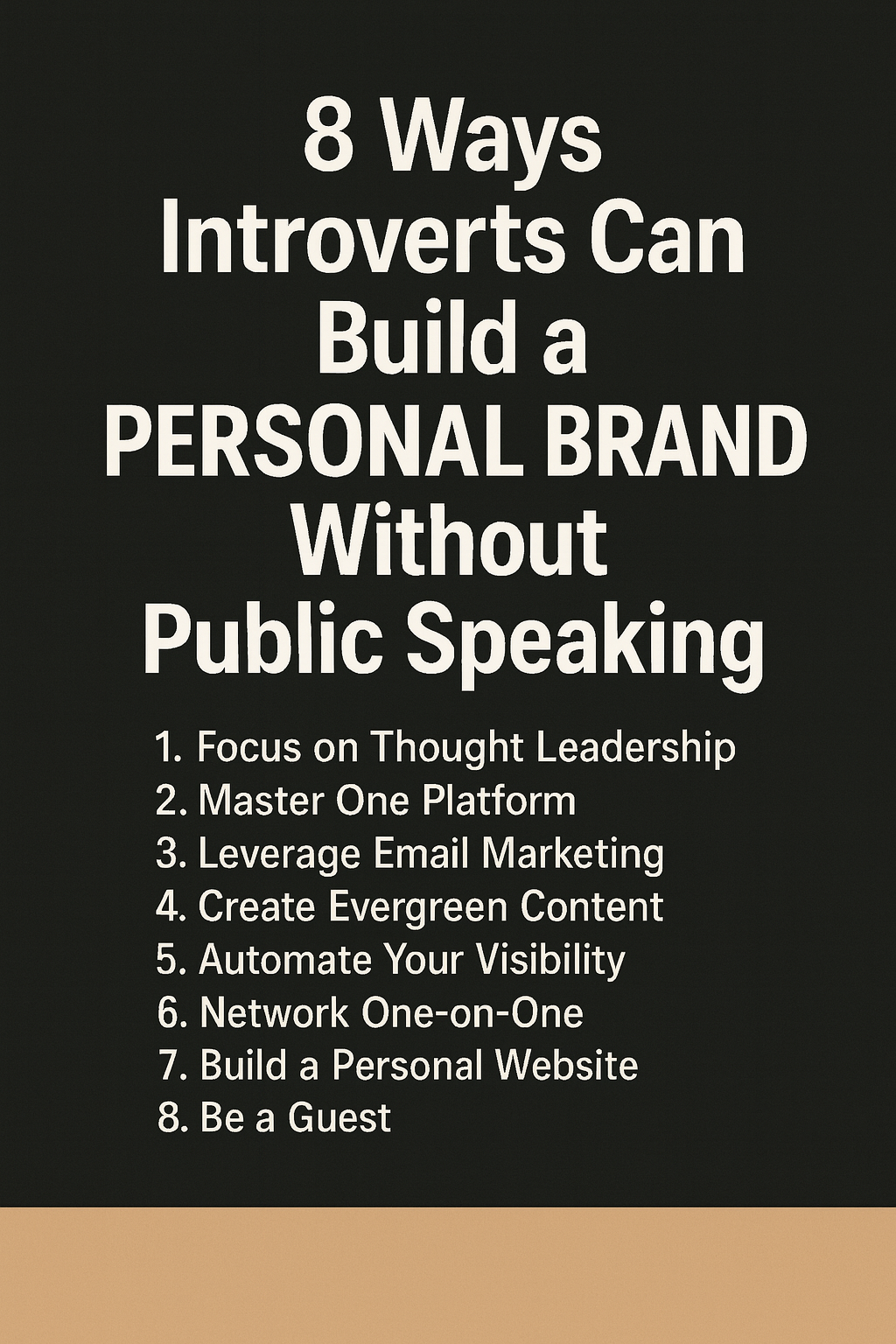
Building a personal brand is no longer optional—it’s essential in today’s digital-first world. But if you’re an introvert, the thought of constant networking events, live speaking engagements, or endless self-promotion might feel overwhelming. The good news? You don’t need to stand on a stage or dominate a room to create impact.
Research shows that introverts often excel in personal branding because they bring depth, focus, and authenticity—qualities audiences crave in a noisy digital landscape. Here are eight expert-backed, research-driven strategies that allow introverts to shine without public speaking.
1. Focus on Thought Leadership Through Writing
Instead of live speaking, introverts can build influence through written content. Publishing long-form blogs, eBooks, or whitepapers not only establishes authority but also creates evergreen assets that continue to attract readers for years.
Example: HubSpot found that businesses publishing 16+ blogs per month generated 3.5x more traffic than those that didn’t. Writing gives introverts the space to think deeply and share well-researched perspectives without real-time pressure.
2. Master One Platform Instead of Many
Spreading yourself thin across multiple channels leads to burnout. Experts recommend mastering one platform that aligns with your energy and content style.
Love long-form writing? → LinkedIn
Prefer visuals & guides? → Pinterest
Enjoy micro-blogging? → Twitter (X)
Pro Tip: Consistency matters more than everywhere presence. One strong channel can outperform three weak ones.
3. Leverage Email Marketing for Deeper Connections
Email remains one of the most personal and trusted communication channels. A curated email list allows introverts to build relationships at scale without constant visibility.
Studies show email marketing delivers a 4400% ROI, making it a low-cost yet high-impact branding tool. Introverts can use newsletters to:
Share curated advice
Offer exclusive tips
Build long-term trust with readers
4. Create Evergreen Content That Compounds Over Time
Instead of chasing trends, focus on evergreen content—guides, tutorials, or resources that stay relevant for years.
For example:
“The Ultimate Guide to Personal Branding for Introverts”
“Step-by-Step: How Introverts Can Succeed on LinkedIn”
Evergreen content not only ranks well in search engines but also reduces the pressure of constant new creation. One well-crafted blog can be repurposed into Pinterest pins, carousels, or email sequences.
5. Automate Your Visibility
Automation tools like Buffer, Tailwind, or Hootsuite allow introverts to stay visible without daily posting anxiety. You can batch-create content once a week, then schedule it to run on autopilot.
This keeps your brand active while freeing mental space to focus on deeper, creative work.
6. Network One-on-One (Not in Crowds)
Introverts thrive in meaningful one-on-one connections rather than large group settings. Instead of conferences, focus on:
Thoughtful LinkedIn DMs
Small mastermind groups
Virtual coffee chats
Research from Harvard Business Review suggests that quality connections (even in small numbers) can open more opportunities than surface-level networking at events.
7. Build a Personal Website as Your Digital Home
A personal website is a silent spokesperson for your brand. It allows you to showcase:
Your story and expertise
Case studies or projects
Testimonials and credibility markers
Unlike social platforms, your website is fully yours—an asset that builds authority, ranks on Google, and works 24/7 to represent you.
8. Be a Guest Instead of Hosting
If hosting a podcast or YouTube channel feels daunting, consider guest blogging or guest appearances instead. This allows you to share insights without the responsibility of managing the platform.
Example: Guest posting on high-traffic sites like Medium or industry blogs can drive thousands of new eyes to your brand without extra pressure.
Introverts don’t need to “become extroverts” to succeed in personal branding. In fact, introverts’ natural strengths—deep thinking, writing, listening, and authenticity—are superpowers in today’s attention economy.
By choosing strategies that align with your energy, you can build a powerful personal brand without ever stepping on stage.
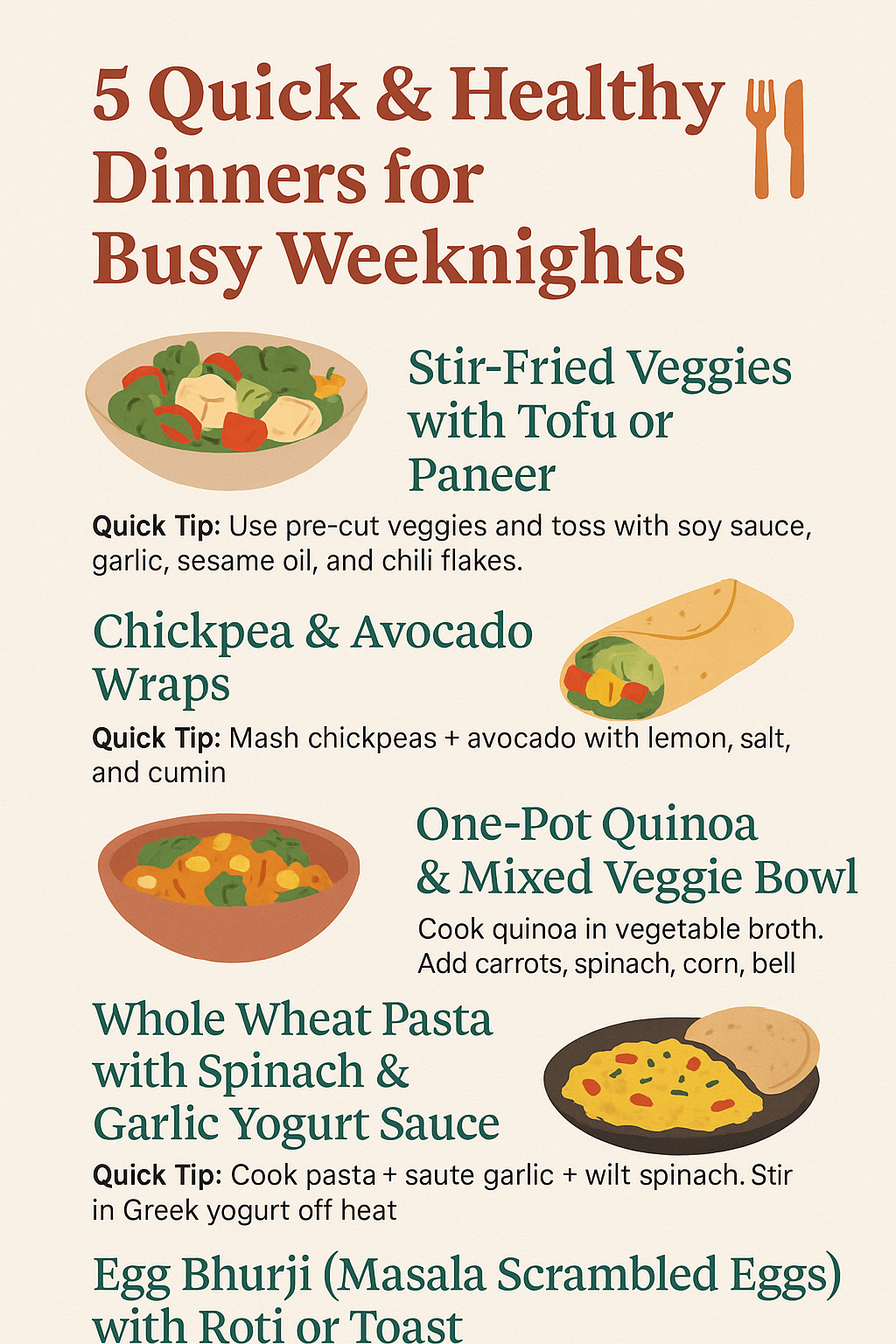
After a long day, the last thing you want is to stress over dinner. But eating healthy doesn’t have to be complicated. These 5 dinner ideas are perfect for busy weeknights—quick to cook, full of nutrients, and family-friendly.
Let’s dive into easy meals that keep you energized without spending hours in the kitchen.
1. Stir-Fried Veggies with Tofu or Paneer
This one-pan wonder is packed with flavor, fiber, and plant-based protein. Customize it with your favorite vegetables and sauces—ready in under 20 minutes.
Why it works:
High in antioxidants and protein
Easily adjustable for spice and taste
No need for side dishes—one bowl is enough
Quick tip:
Use pre-cut veggies and toss with soy sauce, garlic, sesame oil, and chili flakes.
2. Chickpea & Avocado Wraps
These wraps are fresh, filling, and totally meal-prep friendly. Chickpeas give fiber and protein, while avocado adds healthy fats for brain and skin health.
Why it works:
No cooking required if using canned chickpeas
Budget-friendly and gluten-free option
Great for lunch leftovers too
Quick tip:
Mash chickpeas + avocado with lemon, salt, and cumin. Add crunchy veggies and roll into whole wheat tortillas.
3. One-Pot Quinoa & Mixed Veggie Bowl
This warm bowl is cozy, nutritious, and comes together with whatever veggies you have in the fridge. Quinoa cooks fast and adds complete protein to the dish.
Why it works:
Quick-cooking grain
High in fiber and iron
Can be made ahead for multiple days
Quick tip:
Cook quinoa in vegetable broth. Add carrots, spinach, corn, bell peppers. Top with tahini or lemon dressing.
4. Whole Wheat Pasta with Spinach & Garlic Yogurt Sauce
Skip the heavy cream sauces. This dinner uses a protein-packed Greek yogurt base, spinach, and garlic for a creamy, guilt-free flavor.
Why it works:
Balanced mix of carbs, protein, and greens
Kid-friendly and comforting
Can be made in under 25 minutes
Quick tip:
Cook pasta + sauté garlic + wilt spinach. Stir in Greek yogurt off heat to avoid curdling.
5. Egg Bhurji (Masala Scrambled Eggs) with Roti or Toast
This Indian-style scrambled egg is spicy, satisfying, and cooks in 10 minutes flat. Pair it with whole grain roti or toast for a balanced plate.
Why it works:
High-protein meal
Perfect for vegetarians (who eat eggs)
You can toss in chopped veggies for extra nutrients
Quick tip:
Sauté onion, tomato, green chili, turmeric, and cumin. Add whisked eggs. Cook until fluffy.
Final Thoughts: Simple Can Still Be Nourishing
Healthy food doesn’t mean complicated recipes or long prep times. With the right ingredients and a little planning, you can eat clean even on your busiest nights.
Choose one or two recipes above to rotate weekly, and you’ll save time, energy—and probably money too.
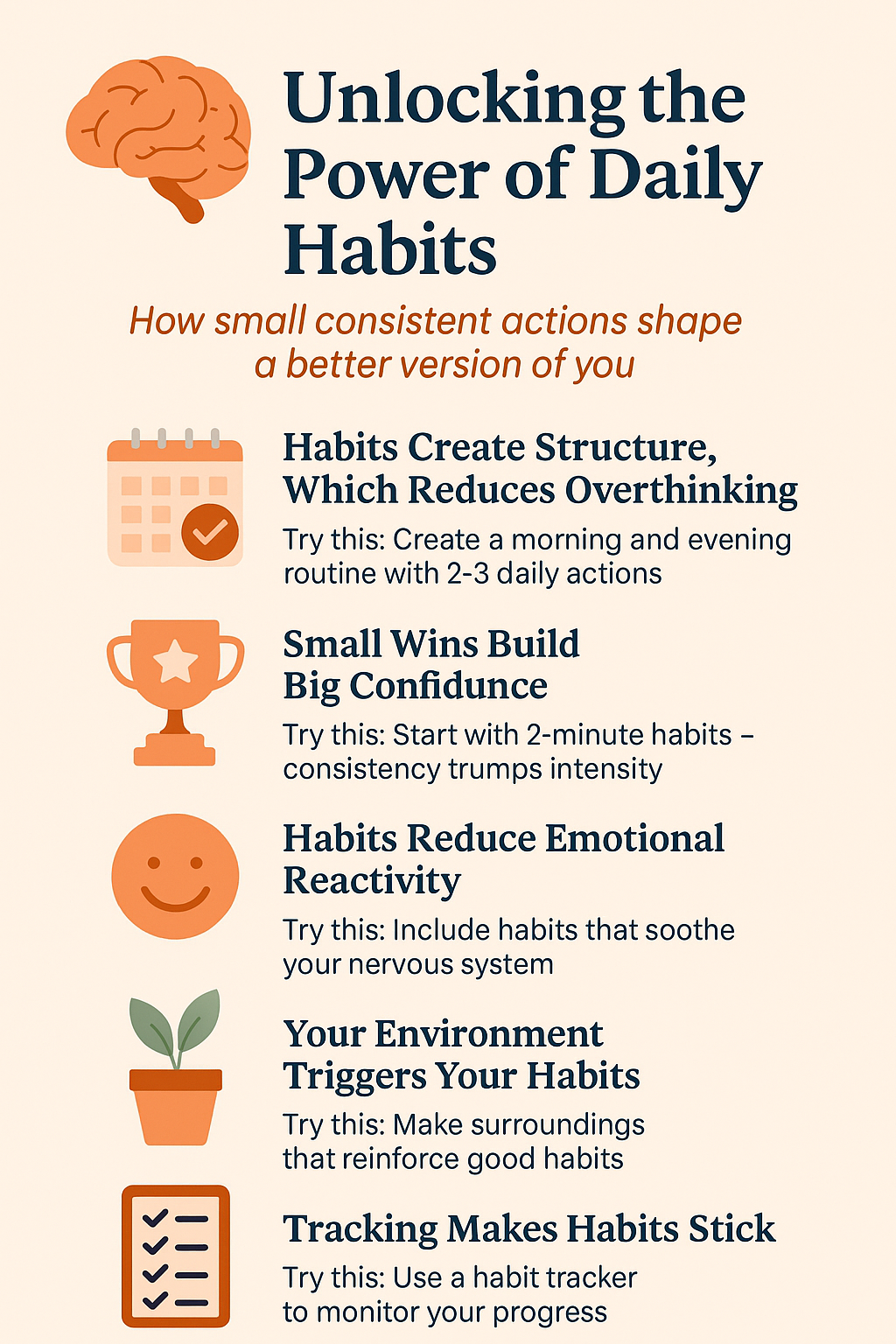
How small consistent actions shape a better version of you
Big life changes often feel overwhelming—but what if the secret isn’t in giant leaps, but tiny steps repeated daily? Daily habits, when done intentionally, can rewire your mindset, boost productivity, and improve emotional well-being. It’s not about perfection—it’s about showing up again and again for yourself.
Let’s break down how daily habits work and why they’re one of the most powerful tools for self-growth.
1. Habits Create Structure, Which Reduces Overthinking
When your day follows a predictable rhythm, your brain doesn’t have to constantly decide what to do next. This frees up mental energy and keeps decision fatigue at bay.
Why it matters:
Reduces anxiety and over-planning
Makes room for creative and emotional clarity
Builds consistency, even on “bad” days
Try this:
Create a morning and evening routine that includes 2–3 non-negotiable actions (like drinking water, making your bed, or reading 5 minutes).
2. Small Wins Build Big Confidence
Every time you complete a habit—even something small—you reinforce trust in yourself. These “micro-wins” stack up into a solid sense of self-worth. Why it matters:
Boosts motivation and momentum
Shifts your identity: “I’m someone who finishes what I start.”
Encourages more positive action naturally
Try this:
Start with 2-minute habits: 2-minute journaling, 2 push-ups, 2-minute meditation. Consistency is more powerful than intensity.
3. Habits Reduce Emotional Reactivity
When your nervous system is balanced through healthy routines, you’re less likely to spiral during stress or setbacks. Habits provide stability when life feels unstable. Why it matters:
Regulates mood over time
Makes emotional healing more sustainable
Keeps you grounded during tough days
Try this:
Include habits that soothe your nervous system: walking, stretching, deep breathing, or unplugging from screens daily.
4. Your Environment Triggers Your Habits
Where you spend your time—and what’s around you—either helps or hurts your habits. Your surroundings shape your behavior without you even realizing it.
Why it matters:
Makes good habits easier to start
Makes bad habits harder to continue
Reinforces routine without relying on willpower
Try this:
Keep a water bottle on your desk, put books on your nightstand, place your phone out of reach before bed.
5. Tracking Makes Habits Stick
What gets measured, gets improved. When you track your habits visually (like in a journal or app), you stay more accountable—and feel rewarded seeing your progress.
Why it matters:
Creates a feedback loop of success
Builds self-discipline through visibility
Helps you reflect on what’s working
Try this:
Use a simple habit tracker with checkboxes or color coding. Reward streaks with mini self-care moments.
Final Thoughts: Show Up for Yourself Daily
You don’t need to change your entire life in one day. Just build one small habit at a time, and let the ripple effects unfold. Daily habits shape your identity, and your identity shapes your future. Start small. Stay consistent. Watch yourself transform.
Burnout isn’t just about being tired; it’s a state of chronic stress that leads to physical and emotional exhaustion, cynicism, and a reduced sense of accomplishment. Even the most driven individuals, like Tony Robbins and Tim Ferriss, have faced its debilitating grip. They’ve discovered that true high performance isn’t about relentless grind, but about strategic self-care and a deliberate “mental reset” routine that allows them to bounce back stronger.
The Silent Drain: How Burnout Takes Hold
Our brains aren’t wired for constant, high-stress output. When we push too hard for too long without adequate recovery, several things start to happen:
Amygdala Enlargement: Chronic stress can enlarge the amygdala, the brain’s fear center, making us more reactive, irritable, and anxious.
Prefrontal Cortex Thinning: The prefrontal cortex, responsible for decision-making, planning, and focus, can thin, impairing cognitive function and memory.
Dopamine Dysregulation: Our “feel-good” dopamine system can get out of whack, leading to low motivation, anhedonia (inability to feel pleasure), and a sense of dread.
Attention Residue & Decision Fatigue: As discussed in previous posts, constantly switching tasks and making endless small decisions drains our mental batteries.
Burnout isn’t a badge of honor; it’s a warning signal that your most valuable asset—your brain—is under attack.
The Science of the Reset: Why It Works
A mental reset routine isn’t just “taking a break.” It’s a series of deliberate actions designed to:
Activate the Parasympathetic Nervous System: Shifting from “fight or flight” (sympathetic) to “rest and digest” (parasympathetic) calms the body and mind, reducing cortisol levels.
Promote Neuroplasticity: Engaging in new or calming activities helps the brain build new, healthier neural pathways, counteracting the negative effects of stress.
Clear Mental Clutter: Giving the mind space to process and release accumulated thoughts, worries, and incomplete tasks.
Restore Cognitive Resources: Replenishing the finite mental energy needed for focus, creativity, and effective decision-making.
The Mental Reset Routine: Lessons from Robbins and Ferriss
While their specific routines vary, both Tony Robbins and Tim Ferriss emphasize similar core principles to prevent and recover from burnout. They prioritize practices that shift their mental and physical states, allowing for deep restoration and renewed focus.
Tony Robbins: The Power of State Change
Robbins’s philosophy hinges on the idea that emotion is created by motion. To change your mental state, you must first change your physical state and focus.
Physiology First: Robbins is famous for his “priming” routine. This often involves:
Movement: Jumping, power posing, or vigorous exercise to immediately shift energy. He emphasizes that a change in posture or movement can instantly alter your mood and confidence.
Breathwork: Deep, controlled breathing exercises to oxygenate the brain and calm the nervous system.
Science Link: Physical activity and specific breathing patterns directly influence neurotransmitter release (like dopamine and endorphins) and vagal nerve tone, promoting relaxation.
Focus on Gratitude: Immediately after shifting his physiology, Robbins directs his focus to what he is grateful for, often envisioning desired outcomes.
Science Link: Practicing gratitude has been shown to boost mood, reduce stress, and even improve sleep quality by shifting focus from threat to abundance.
Strategic Language: He consciously chooses empowering language, reframing challenges as opportunities.
Science Link: The words we use, especially in self-talk, shape our perception and emotional response. This is a core tenet of cognitive behavioral therapy.
Tim Ferriss: Deliberate Decompression & Optimization
Ferriss, known for “deconstructing” peak performance, focuses on systematic routines that optimize his mental and physical state for long-term sustainability. He often speaks to managing energy, not just time.
Morning Rituals (Anchors): Before diving into work, Ferriss typically engages in a series of “anchoring” activities:
Cold Exposure: Cold showers or plunges to “wake up” the nervous system, reduce inflammation, and provide a mental reset.
Meditation/Mindfulness: Short periods of meditation to clear the mind, improve focus, and reduce reactivity.
Journaling: A “brain dump” to offload anxieties, plan the day, and practice gratitude.
Science Link: Cold exposure can increase dopamine and norepinephrine. Meditation alters brain waves and reduces amygdala activity. Journaling reduces cognitive load and promotes emotional processing.
Strategic Breaks & “Un-Scheduling”: Ferriss advocates for “slow productivity” and building in recovery.
Micro-Resets: Short breaks (e.g., 5-17 minutes) throughout the day to stretch, walk, or simply disconnect.
Time Blocking for Recovery: Deliberately scheduling “off” time, not just work time.
Science Link: Regular breaks prevent attention residue, reduce mental fatigue, and allow for diffused mode thinking, fostering creativity.
Digital Boundaries: Ferriss is disciplined about managing his digital inputs, avoiding app-hopping and setting clear boundaries around notifications and email.
Science Link: This directly combats cognitive overload and decision fatigue, reserving mental bandwidth for deep work.
Implementing Your Own Mental Reset Routine
You don’t need a billionaire’s budget or a guru’s stage to benefit from these strategies. The key is consistency and personalization.
Identify Your Burnout Triggers: What specifically drains you? Excessive meetings, constant notifications, lack of clear goals, poor sleep?
Start Small, Be Consistent: Pick one or two habits to begin. A 5-minute gratitude journal in the morning, a 10-minute walk at lunch, or cutting off screen time 30 minutes before bed are great starts.
Prioritize Physiology: Integrate movement and breathwork. Even a few deep breaths before a tough meeting can make a difference.
Create “Sacred” Time: Designate periods (morning, midday, evening) where you are unreachable and fully focused on your reset activity.
Listen to Your Body & Mind: Pay attention to how different activities affect you. Your routine is unique.
A mental reset routine isn’t a luxury; it’s a vital component of sustainable high performance. By deliberately building in moments of recovery and conscious state change, you can navigate the pressures of modern business, bounce back from setbacks, and continue to operate at your peak without sacrificing your well-being.
What’s one small mental reset you can commit to starting today?






![What “Thought Leadership” Really Means (and What It Doesn’t) Thought leadership isn’t about being the loudest voice. It’s about creating clarity where others feel confused. True thought leaders: Have a point of view (POV) rooted in experience, data, and ethics. Synthesize ideas from multiple sources into simple, actionable frameworks. Publish consistently enough that their name becomes associated with a niche. You don’t need a stage. You need a system. Step 1: Choose a Narrow, Valuable Niche The smaller the starting niche, the faster you become known. Use the 3-Overlaps Test: Audience: Who has a recurring pain you understand? Expertise: What have you solved repeatedly (for yourself/clients)? Demand: Are people already searching for it, asking questions, or paying for help? Examples: “Pinterest SEO for Health Coaches” “Retention Analytics for D2C Brands” “Faceless Branding for Introvert Creators” Document your niche in one sentence: I help [specific audience] achieve [specific result] with [specific method]. Step 2: Craft a Sharp Point of View (POV) Your POV differentiates you from “tips and tricks” content. POV Builder (answer in 1–2 lines each): What is the common belief in your niche that’s wrong or incomplete? What do people overlook that actually drives results? What is your repeatable method? (Give it a memorable name.) What do you refuse to do? (Values = trust.) Example POV: “Most brands shout on every platform. My Quiet Compounding Method focuses on one platform, one list, and one offer—until the signals prove expansion.” Step 3: Build a Research & Notes Engine (Introvert-Friendly) Great thought leadership is evidence-led. Create a private “idea vault.” Set up three folders (or Notion/Obsidian): Signals: statistics, case studies, user interviews, screenshots of real wins/failures. Synthesis Notes: your summaries + what it means for the audience. Frameworks: checklists, step-by-step processes, templates you refine over time. Weekly habit (45–60 min): Capture 5–10 signals → write 3 synthesis notes → refine 1 framework. This becomes endless content fuel. Step 4: Define Your Content Pillars Pick 3–4 pillars that map to the buyer journey. Mindset & Myths (break bad assumptions) Frameworks & How-Tos (your method in action) Case Studies & Proof (before/after, charts, screenshots) Tools & Templates (starter kits, checklists) This mix positions you as credible + practical, not just inspirational. Step 5: Publish Asynchronously (No Live Stage Needed) Introverts thrive with asynchronous creation. Use this cadence: Weekly Cadence (example): Mon: One long-form post (LinkedIn article or blog; 800–1200 words) Tue: 3–5 short posts pulled from the long-form (threads/carousels/pins) Thu: Case-study snippet + CTA to your email list or offer Fri: “Field notes” post (lessons from the week, 5 bullets) Monthly: one deep dive (pillar guide), one case study, one live-free resource (template/cheatsheet). Batch on one quiet day, schedule with Buffer/Tailwind. Your brand stays visible while you recharge. Step 6: Create Credibility Assets (Quiet but Powerful) Social proof can be built without being “everywhere.” Before/After Analyses: show the exact metric that changed. Annotated Screenshots: circle what matters, write a 3-line lesson. Client/Project Timelines: what you did, in what order, and why. Method Page on Your Site: name your framework, list steps, link to proofs. Reading List: what informs your thinking (signals intellectual honesty). These assets convert lurkers into subscribers and buyers. Step 7: Distribution Without the Drain You don’t need to network at scale; you need precision distribution. 1:1 Expert DMs: send a short note + a relevant resource (no ask). Curated Communities: answer questions deeply once/week (save answers as future posts). Guesting over Hosting: pitch 1 guest post or podcast a month. Provide your framework + case proof; request one link to your “Method” page. Newsletter Swaps: trade a short ad or resource with a peer list of similar size. Step 8: Measure Signal, Not Noise Ignore vanity metrics. Track signal metrics tied to trust and demand: Saves / Shares / Replies (content resonance) Qualified Replies/DMs (lead quality) Email Subscribers & Reply Rate (relationship depth) Consult Call Bookings / Trials / Sales (commercial traction) Set a 90-day scoreboard: if saves, replies, and subscribers rise, your positioning and POV are working—even if likes are modest. The Quiet Compounding Method (90-Day Plan) Days 1–7: Foundation Finalize niche + POV statement. Organize your research vault. Write your “Method” page and create a simple one-page site (About + Method + Work With Me + Newsletter). Weeks 2–6: Publish & Prove 1 pillar article/week (5 total). 2 mini case notes/week (before/after, annotated screenshots). Start a biweekly newsletter: “Field Notes” with 3 insights + 1 template. Weeks 7–12: Distribute & Deepen Pitch 4 guest posts/podcasts (aim for 2 wins). Run 4 “office-hours” emails—invite replies with a specific question. Build one flagship resource (Checklist/Template/Calculator) and gate it with email opt-in. By Day 90, you’ll have: 5 pillar articles, 10 case notes, 6 newsletters, 1 flagship resource, 2 guest placements, and a clear POV that compounds. Templates You Can Copy POV Post Template (LinkedIn/Blog): Hook: the broken belief. Insight: what most miss. Framework: 3–5 steps you use. Mini case: where it worked. CTA: “Reply with X” or “Get the checklist.” Case Note Template: Context → Constraint → Action → Outcome → Lesson → Next Step. Newsletter Structure (8–10 min write time): One theme → three bullets of proof → one practical prompt → one link to a resource. Energy Management for Introverts (Sustainability) Batching: create in one sitting when energy is high; schedule the rest. Boundaries: calendar blocks for “off-platform” thinking; one day/week with zero publishing. Asynchronous Mentoring: write public answers, not private meetings. Rituals: same desk, same tea/coffee, same playlist—reduce friction. Common Mistakes to Avoid Trying to be everywhere. Depth beats ubiquity. Sharing tips without proof. Case notes > generic advice. No clear POV. If you don’t stand for something, you blend in. Inconsistent cadence. Compounding stops when you do. Hiding your offer. Expertise without a pathway wastes demand. Sample “About the Author” (use/modify) I’m an introvert who helps [audience] achieve [result] with [method]. I share evidence-based frameworks, real case studies, and tools that reduce noise and increase results. Subscribe to my Field Notes newsletter for one practical idea each week. FAQs 1) Can I become a thought leader without speaking on stage? Yes. Asynchronous content (blogs, newsletters, carousels, guest posts) builds durable authority—especially when backed by case-level proof. 2) How often should I publish? Once weekly long-form + several short derivatives is enough. Consistency and quality beat volume. 3) What if I don’t have client case studies yet? Run public experiments on your own projects. Share your hypothesis, steps, and outcomes transparently. 4) Which platform should I start with? Pick the platform that suits your energy and audience: LinkedIn (B2B), Pinterest/Blog (search + evergreen), X (fast synthesis), or Newsletter (relationship depth). 5) How do I avoid imposter syndrome? Teach what you’ve actually done. Document your process. Let results—however small—be your proof.](https://www.futuremakernews.co.in/wp-content/uploads/2025/08/ChatGPT-Image-Aug-23-2025-05_03_09-PM.png)