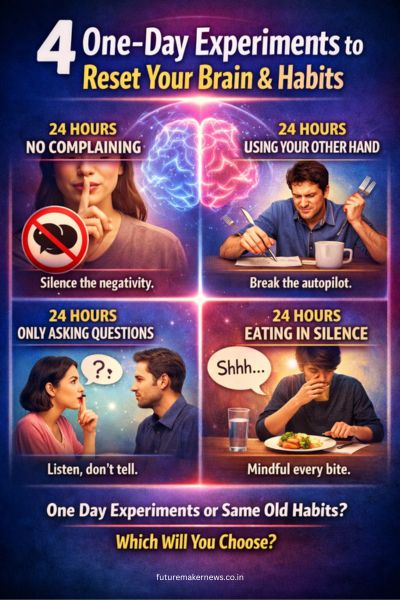
Can One Day Really Change Your Brain?
Brain- Most people assume habit change requires months of effort. Neuroscience suggests otherwise.
Short, intentional disruptions can activate neuroplasticity, interrupt autopilot behaviors, and increase self-awareness—even in just 24 hours.
These four one-day habit experiments are simple, uncomfortable, and surprisingly effective. Each targets a different mental loop: negativity, automatic behavior, poor listening, and mindless consumption.
1. Go 24 Hours Without Complaining
Complaining is one of the most ingrained mental habits. Studies in cognitive psychology show that repeated negative thought patterns strengthen neural pathways associated with stress and reactivity.
When you stop complaining for one day, you interrupt those loops.
Benefits:
- Reduces mental noise
- Improves emotional regulation
- Increases awareness of negative self-talk
This process is sometimes referred to as neuroplastic silence—when the brain begins to loosen old patterns simply because they are no longer repeated.
2. Stop Using Your Dominant Hand for 24 Hours
Use your non-dominant hand to eat, write, brush your teeth, and perform daily tasks.
This simple disruption forces the brain out of automatic mode. Research on motor learning shows that unfamiliar movements activate new neural pathways and increase focus.
Benefits:
- Breaks autopilot behavior
- Improves attention and mindfulness
- Stimulates neuroplasticity
The goal isn’t skill—it’s awareness.
2. Stop Using Your Dominant Hand for 24 Hours
Use your non-dominant hand to eat, write, brush your teeth, and perform daily tasks.
This simple disruption forces the brain out of automatic mode. Research on motor learning shows that unfamiliar movements activate new neural pathways and increase focus.
Benefits:
- Breaks autopilot behavior
- Improves attention and mindfulness
- Stimulates neuroplasticity
The goal isn’t skill—it’s awareness.
4. Eat in Complete Silence for 24 Hours
- No phone. No television. No conversation.
Eating without distractions reveals how often we consume food mindlessly. Mindful eating studies show that silence increases satiety awareness and improves self-control.
Benefits:
- Resets relationship with food
- Improves digestion awareness
- Strengthens discipline through mindfulness
You don’t need a new diet. You need attention.
Why One-Day Experiments Work
A single day functions as a microcosm of long-term behavior. It exposes:
- Automatic habits
- Emotional triggers
- Learned behaviors mistaken for identity
People who resist these experiments often believe habits are fixed. Those who try them treat habits as modifiable systems.
The difference isn’t willpower—it’s experimentation.
Final Thoughts: Are Your Habits Identity—or Experiments?
Some say, “One day can’t change anything.”
Others realize one day reveals everything.
You don’t need motivation to run an experiment.
You need curiosity.
So ask yourself:
Are you defending your habits—or testing them?