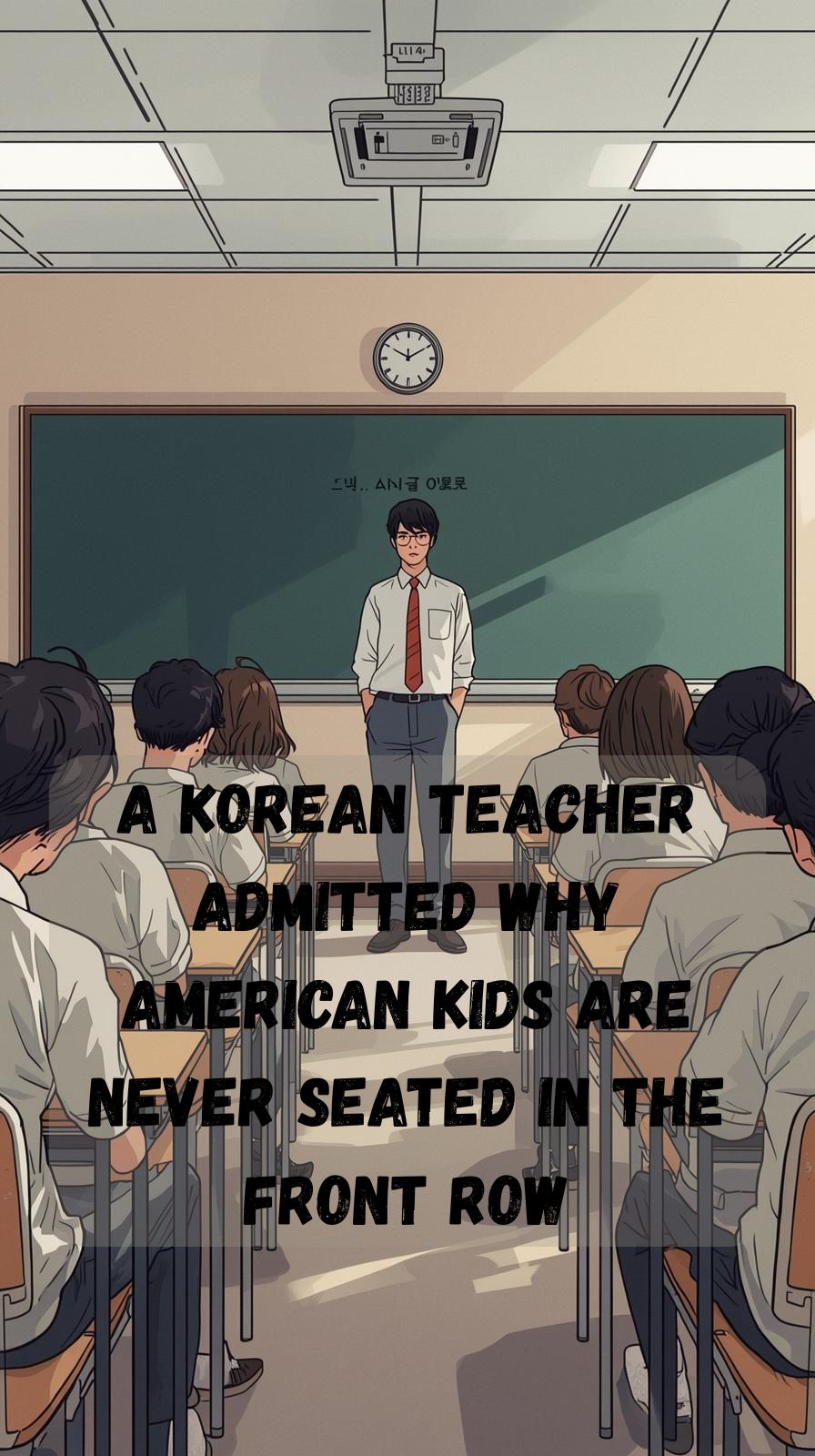
1. “Front-row seats aren’t a privilege — they’re a responsibility.”
A Korean elementary school teacher in Busan told me something that completely shifted my perspective:
“You don’t put a child in the front row unless their nervous system can anchor the room.”
In Korea, front seats are not given to the “smartest” or the most confident.
They’re given to the emotionally steady — the kids who can model attention, rhythm, and regulation for the entire class.
Many Western children don’t get placed there simply because they’ve never been trained for collective regulation.
2. “Western kids learn visibility before stability.”
She gave an example:
A 9-year-old American boy in her class spent the entire first week turning around to check if his friends were watching him.
“He wasn’t misbehaving — he was performing. Western kids learn visibility before stability.”
In Korea, front-row children are chosen for:
- emotional steadiness
- minimal reactivity
- consistent focus
If a child responds to every sound or movement, they can’t sit there — it destabilizes the group.
3. The secret difference: attention inheritance
Korean parents naturally train focus through something she called quiet proximity:
- Children do homework
- Parents read or work silently nearby
The child learns:
- to concentrate in shared space
- to be calm while being observ
- to regulate attention without isolation
By contrast, Western kids often study:
- alone
- in private bedrooms
- with no observational pressure
“They can focus,” she said, “but not while being watched. The front row demands both.”
4. Front row = leadership role
In Korea, front-row students rotate responsibilities:
- leading note-taking
- summarizing lessons
- timing activities
This builds confidence and shared ownership.
But when she tried this with American students?
“They panicked. Not because they’re incapable — but because they think school is individual, not communal.”
In Western culture, visibility = exposure.
In Korean culture, visibility = service.
5. The final truth: it’s not about academics at all
Her concluding line said everything:
“Western kids fear the front row because they think it exposes them. Korean kids accept it because they think it supports others.”
This is not about intelligence, discipline, or personality.
It’s about how each culture trains a child’s nervous system to handle pressure, observation, and responsibility.