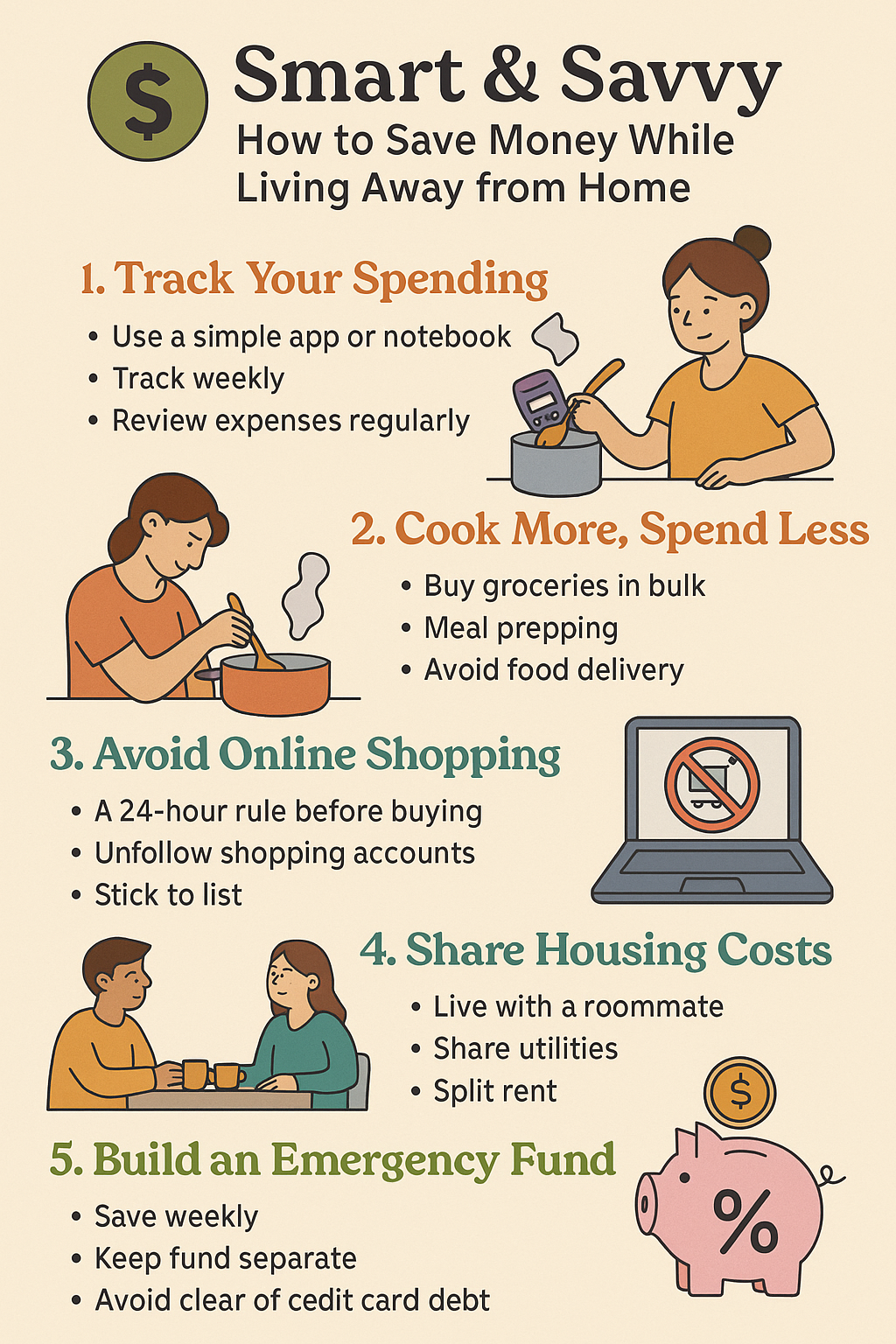
Smart & Savvy: How to Save Money While Living Away from Home

Because adulting is hard enough—your wallet shouldn’t suffer too.

Living away from home comes with freedom, late-night snacks, and no one telling you when to sleep—but it also comes with surprise bills, food costs, and rent that drains your bank account faster than you’d think. The good news? Saving money isn’t about cutting all the fun—it’s about building small, smart habits that actually give you more freedom long term.

Here’s your practical guide to saving money while still enjoying your life.

1. Start by Tracking Every Rupee (or Dollar)

You can’t fix what you don’t know. Most people don’t realize how much they’re spending until they actually track it. So before you make a budget, start by writing down every expense—even that Rs. 99 coffee or random Amazon buy.

Try this:

  • Use free apps like Walnut, Money Manager, or even Google Sheets
  • Track weekly instead of monthly so it’s not overwhelming
  • Review your spending every Sunday night (make it a ritual!)

Why it works:

  • Helps you spot patterns and money leaks
  • Makes budgeting feel doable, not scary
  • Encourages mindful spending

2. Cook More, Spend Less (And Eat Healthier Too)

Ordering food every day might feel convenient, but it’s one of the biggest money drains. Cooking at home, even basic meals, can cut your food budget in half—and it’s better for your health.

Try this:

  • Cook in bulk on Sundays (think: rice, curries, pasta sauces)
  • Buy staples like dal, oats, and frozen veggies in bulk
  • Use simple 3-ingredient recipes to avoid burnout

Why it works:

  • Meal prepping saves time during busy weekdays
  • Cooking with roommates = fun + shared grocery bills
  • Homemade food is cheaper, cleaner, and satisfying

3. Say No to Mindless Shopping Sprees

Impulse buying online? We’ve all been there. But “just browsing” leads to just broke. That dopamine hit from a cart checkout fades fast, but the financial hangover stays.

Try this:

  • Follow the “24-hour rule” before buying anything online
  • Unfollow tempting shopping pages on Instagram
  • Only buy what’s already on your planned shopping list

Why it works:

  • Cuts down emotional and late-night purchases
  • Helps you spend with intention, not impulse
  • Saves money for things that actually matter

4. Split Rent and Share Resources

Living solo sounds dreamy, but your wallet might not agree. Sharing your space can cut housing costs by 30–50%, and give you more to spend (or save) elsewhere.

Try this:

  • Look for roommates on trusted platforms (Facebook groups, local student forums)
  • Share bills: Netflix, groceries, laundry detergent—everything adds up
  • Use apps like Splitwise to manage shared expenses fairly

Why it works:

  • Less pressure to afford high rent alone
  • Shared utilities = shared savings
  • Bonus: built-in social life if your roommate’s cool

5. Avoid Debt, But Build an Emergency Fund

Credit cards may seem like a savior in tight months—but they often lead to stressful debt traps if not used wisely. Instead, focus on building a small emergency fund for surprise expenses.

Try this:

  • Save a small fixed amount weekly—even ₹100 adds up
  • Keep a separate digital wallet just for emergencies
  • Avoid “Buy Now, Pay Later” schemes unless you have a repayment plan

Why it works:

  • Reduces anxiety about broken phones, late fees, or medical bills
  • Gives you freedom to say “no” when you can’t afford something
  • Helps avoid long-term interest charges and penalties

6. Use Discounts, Cashback & Freebies (It’s Not Cheap—It’s Smart!)

Why pay full price when you don’t have to? Student discounts, referral codes, and cashback offers are everywhere—you just need to look.

Try this:

  • Use Chrome extensions like Honey or CashKaro for cashback
  • Check for student plans on Spotify, Microsoft, or even Dominos
  • Attend free college events for food, goodies, or networking

Why it works:

  • Lets you enjoy fun stuff without guilt
  • Encourages smarter digital shopping
  • Gives the joy of saving without the stress of “missing out”

Final Thoughts: Build Habits, Not Restrictions

You don’t have to live like a monk to save money. You just have to be a little more aware, a little more intentional, and a lot more clever. The small habits you build now—budgeting, cooking, sharing—will help you stay independent, stress-free, and financially confident for life.

Remember: Living smart is cooler than living broke.
Why Every Smart Businessman Keeps a Decision Log (And How It Saves Millions)

In the high-stakes world of business, decisions are currency. Every choice, big or small, carries weight — impacting revenue, strategy, team morale, and your bottom line. Yet, how often do we make a decision, move on, and never truly reflect on its outcome or the process behind it? This is where many businesses bleed money and miss massive opportunities.

The smartest business leaders don’t just make decisions; they meticulously log them. This isn’t just about record-keeping; it’s a powerful tool for learning, accountability, and strategic growth that can genuinely save (and make) millions.

The Hidden Cost of Unlogged Decisions

Without a systematic way to track your choices, you’re flying blind. This leads to several expensive pitfalls:

  • Repeating Mistakes: Ever feel like you’re facing the same problem, or making a similar poor choice, again and again? Without a log, your brain struggles to connect past actions to present outcomes, leading to recurring, costly errors.
  • Missed Opportunities: Did a great idea fail because of poor execution, or was the idea itself flawed? Without tracking, you can’t dissect the past to identify what worked and what didn’t, missing chances to refine and capitalize.
  • Hindsight Bias: After an outcome is known, it’s easy to rationalize a decision (“I knew that would happen!”). A decision log forces you to capture your thinking before the outcome, providing an honest record for true learning.
  • Lack of Accountability: When decisions aren’t documented, it’s harder to hold yourself or your team accountable for the rationale and results, hindering growth and learning.

The Brain Science Behind the Breakthrough

A decision log isn’t just a fancy journal; it’s a powerful tool leveraging fundamental cognitive principles:

  • Metacognition: The act of reviewing your decisions explicitly engages metacognition — thinking about your thinking. This self-awareness helps you understand your biases, improve your reasoning, and learn more effectively from experience.
  • Reinforced Learning: By creating a formal feedback loop, you transform vague experiences into concrete lessons. Your brain builds stronger neural pathways between actions, context, and outcomes, leading to better future judgment.
  • Reduced Cognitive Load: Externalizing your decision-making process frees up your working memory. Instead of trying to recall complex chains of thought, you have a clear record, reducing mental fatigue and allowing for more strategic thinking.
  • Pattern Recognition: Over time, a decision log reveals patterns in your successes and failures. You’ll identify your strengths, common pitfalls, and environmental factors that consistently influence outcomes, helping you make more predictable and positive choices.

The Decision Log: How It Saves (and Makes) Millions

This isn’t an exaggeration. By improving the quality of your decisions, a log directly impacts your bottom line:

  • Avoid Costly Failures: By learning from past missteps, you avoid repeating expensive marketing campaigns, product launches, hiring mistakes, or investment choices.
  • Optimize Successful Strategies: When you know why something worked, you can replicate and scale it. This leads to more efficient resource allocation and higher returns on investment.
  • Faster, Smarter Decisions: With a clear historical record and an understanding of your own decision patterns, you can make future choices with greater speed and confidence, reducing analysis paralysis.
  • Enhanced Strategic Foresight: Regularly reviewing decisions helps you spot emerging trends, anticipate market shifts, and identify competitive advantages before your rivals do.
  • Improved Delegation & Team Performance: A well-maintained decision log can serve as a living case study, guiding your team to make better decisions independently and aligning their choices with your strategic intent.

How to Build Your Own Million-Dollar Decision Log

You don’t need complex software. A simple spreadsheet, a dedicated digital note, or even a physical notebook can work. The key is consistency and structure.

For each significant decision, capture these points:

  1. Date: When was the decision made?
  2. Decision: Clearly state the choice you made (e.g., “Launch X product by Q3,” “Hire Jane Doe for role Y,” “Invest $10k in marketing channel Z”).
  3. Context/Situation: What was the environment like? What were the key factors at play?
  4. Assumptions: What did you assume to be true when you made this decision? (This is crucial for learning.)
  5. Expected Outcome: What result did you anticipate?
  6. Rationale/Why: Why did you make this particular choice? What alternatives did you consider and reject?
  7. Actual Outcome (to be filled later): What actually happened? (Give it time — days, weeks, months, depending on the decision’s scope).
  8. Lessons Learned: What did you discover? What would you do differently next time? What biases were at play?

Consistency is key. Make it a part of your weekly review or daily shutdown routine to log new decisions and check in on past ones.

Your Business’s Most Valuable Asset: Learning

The world’s smartest businessmen aren’t just making good decisions; they’re creating a system that allows them to learn from every single one. A decision log transforms raw experience into actionable intelligence, turning potential pitfalls into stepping stones and maximizing every opportunity for growth. It’s not just a record; it’s your personal business school, saving millions by helping you make smarter bets, every single time.

Are you ready to stop repeating mistakes and start learning strategically? What’s the first decision you’ll log?

This ‘One Tab Rule’ Doubled My Output — A Focus Habit That Actually Works

Open your browser right now. How many tabs do you have open? Five? Ten? Twenty? More?

If you’re like most people, your digital workspace is a chaotic labyrinth of half-finished research, unread articles, social media feeds, and urgent emails. We tell ourselves it’s “multitasking” or “staying on top of things.” But the brutal truth is, it’s a silent assassin of focus and a productivity drain.

I used to be a tab hoarder. My browser looked like a digital battlefield, each open tab a siren call, pulling my attention in a million different directions. Then I discovered something deceptively simple, yet profoundly powerful: The ‘One Tab Rule.’ And honestly, it’s doubled my output.

The Problem: Your Brain Hates Open Tabs (Even If You Don’t)

What’s the real cost of those countless open tabs? It’s not just visual clutter. It’s a constant, low-level drain on your most precious resource: attention.

  • Attention Residue (Science Alert!): Dr. Sophie Leroy’s research introduced the concept of “attention residue.” When you switch from one task to another (even just glancing at a different tab), a portion of your attention lingers on the previous task. This residue significantly reduces your focus and performance on the new task. Each open tab is a potential source of residue, constantly pulling your brain in multiple directions.
  • Decision Fatigue: Every time you see an open tab, your brain makes a mini-decision: “Should I look at that? Do I need that now? What was I doing there?” Multiply this by twenty tabs, and you’re exhausting your cognitive resources on trivial choices, leaving less for the actual work.
  • Cognitive Overload: Your working memory has a limited capacity. Too many open tabs create a visual and mental burden, making it harder to process current information and retain new ideas. It’s like trying to listen to ten conversations at once — you hear noise, not meaning.

The Solution: The ‘One Tab Rule’

The ‘One Tab Rule’ is exactly what it sounds like: At any given moment, your browser should have only ONE active tab open that is directly related to the task you are currently working on.

That’s it. Simple, right? But the discipline required to maintain it is where the magic happens.

How it works in practice:

  • Starting a task? Open the single tab you need.
  • Need information from another site? Copy the link, close your current tab, open the new one, get your info, then close it again before returning to your main task. Or, if it’s brief, jot it down.
  • Distraction pops up? Close it immediately. If it’s something you need later, add it to a “Later” list or a dedicated tab management tool (like OneTab or Pocket), but don’t keep it open.

Why It Works (The Unlocked Productivity)

This seemingly restrictive rule forces your brain into a state of monotasking, unleashing several powerful cognitive benefits:

  • Eliminates Attention Residue: When there’s only one tab, there’s nothing for your attention to linger on. Your focus is singular and complete. This is the bedrock of deep work.
  • Reduces Decision Fatigue: No more internal debates about which tab to click. Your path is clear, allowing your brain to conserve energy for the actual work.
  • Fosters Flow State: With distractions minimized, your brain can more easily enter a “flow state” — that highly productive, almost effortless zone where you perform at your best. This is where truly innovative ideas and high-quality output emerge.
  • Increases Task Completion: By focusing on one task at a time, you complete tasks faster and more thoroughly, leading to a profound sense of accomplishment and genuine progress.

Real Impact (My Experience & High-Performers’ Principles)

While I don’t have a named CEO specifically advocating for a “one tab rule” (they’re usually thinking at a higher level of strategic focus, but this is a tactical application of their principles), the impact I’ve seen in my own output and observed in high-performers is profound:

  • No More “Lost Time”: I no longer waste minutes jumping between unrelated tasks, trying to remember where I left off. Each work block is surgical.
  • Higher Quality Work: With undivided attention, the quality of my writing, research, and problem-solving has significantly improved.
  • Less Mental Fatigue: By removing constant context switching, my mental energy lasts longer throughout the day. I feel less drained by lunchtime.
  • Actual Completion: Projects that used to drag on now get finished faster because fragmented attention is no longer slowing me down.

This rule forces you to make conscious choices about where your attention goes, rather than letting your browser dictate it. It’s about respecting your brain’s limitations and leveraging its strengths.

Start Your One-Tab Revolution Today

Ready to reclaim your focus and double your output?

  1. Close Everything: Seriously. Right now. Close every single unnecessary tab.
  2. Pick ONE Task: Choose the single most important thing you need to do right now.
  3. Open ONE Tab: Open only the browser tab directly related to that task.
  4. Work: Dive in. Resist the urge to open another. If you need something else, close the current tab first.
  5. Be Patient: It will feel awkward at first. Your brain is used to the chaos. But consistency builds discipline.

The ‘One Tab Rule’ is simple, but simple doesn’t mean easy. It requires discipline. But the payoff — a calmer mind, doubled output, and the ability to consistently enter a state of deep, impactful work — is worth every effort.

Are you ready to embrace the simplicity and power of the ‘One Tab Rule’? Share your initial thoughts in the comments!

Why the World’s Richest Men Practice Daily Stillness (And You Should Too)

Why the World’s Richest Men Practice Daily Stillness (And You Should Too)

It’s fascinating, isn’t it? In a world that glorifies constant motion and packed schedules, some of the most influential and successful people on the planet are deliberately carving out time for… well, nothing. They practice stillness. And it’s not just a trend; it’s a strategic weapon for unparalleled clarity and performance.

In an age of relentless notifications and the pressure to always be “on,” true stillness seems counter-intuitive. Yet, from legendary investors to tech visionaries, many of the world’s wealthiest individuals attribute a significant portion of their success to a consistent practice of quiet reflection, contemplation, or meditation. This isn’t about escaping reality; it’s about mastering it.

What Does “Stillness” Really Mean?

Stillness isn’t necessarily sitting cross-legged chanting “Om.” For these high-achievers, it can mean:

  • Mindful Moments: A few minutes of deep breathing before checking email.
  • Contemplative Walks: A solitary stroll without a phone, simply observing.
  • Scheduled Reflection: Blocking out time in the calendar just to think, read, or stare out a window.
  • Meditation: Formal practice, often Transcendental Meditation (TM) or Vipassana.

The common thread? Deliberately disconnecting from external noise to connect with internal wisdom.

The Brain Science Behind the Billion-Dollar Benefit

This isn’t woo-woo; it’s hard science:

  1. Reduced Stress & Cortisol: Stillness activates the parasympathetic nervous system (our “rest and digest” mode), significantly lowering the stress hormone cortisol. Studies have shown even short periods of silence can reduce heart rate and blood pressure more effectively than relaxing music.
  2. Enhanced Prefrontal Cortex Function: Regular stillness practices, particularly meditation, have been shown to thicken the prefrontal cortex, the brain’s command center for decision-making, planning, and emotional regulation. This leads to clearer, more rational choices under pressure.
  3. Boosted Creativity & Insight: When the brain isn’t constantly reacting to external stimuli, its Default Mode Network (DMN) — often associated with mind-wandering and rumination — can quiet down. This creates mental space for “aha!” moments, innovative ideas, and deeper insights that don’t emerge from frantic activity. An animal study from 2013 even suggested silence can stimulate the growth of new cells in the hippocampus, related to memory.
  4. Improved Focus & Attention: Stillness acts like a workout for your attention muscle. By gently bringing your mind back to the present moment, you strengthen your ability to sustain focus and resist distractions throughout the day.

Real Examples: Billionaires Who Swear By Stillness

  • Ray Dalio (Founder, Bridgewater Associates): The founder of the world’s largest hedge fund credits Transcendental Meditation (TM) as “the single biggest reason for whatever success I’ve had.” He practices 20 minutes, twice a day, calling it a “20-minute vacation” that gives him “calmness and equanimity” and helps him make better decisions. He started after being inspired by The Beatles in 1968.
  • Jack Dorsey (Co-founder, Twitter & Block): Known for extreme routines, Dorsey used to undertake 10-day silent Vipassana meditation retreats annually, meditating up to 17 hours a day and abstaining from speaking. He attributes his ability to “stay above water” amidst the stress of running two major companies to this practice, providing him “enhanced mental clarity.”
  • Bill Gates (Co-founder, Microsoft): Once skeptical, Gates now meditates 2-3 times a week for about 10 minutes. He calls it “exercise for the mind” and notes it helps him “think more clearly” and “gain a little bit of distance” from his thoughts. He even schedules “Think Weeks” where he isolates himself just to read and contemplate.
  • Oprah Winfrey (Media Mogul): A long-time proponent of mindfulness, Oprah introduced TM to her entire staff. She emphasizes that meditation helps her to “quiet the noise” and access her “inner wisdom,” enabling her to make impactful decisions for her media empire.

How YOU Can Practice Daily Stillness

You don’t need a private island or hours of free time. Start small, be consistent:

  1. The Micro-Pause: Take 1-2 minutes every hour to simply stop. Close your eyes, take a few deep breaths, and notice your surroundings without judgment.
  2. Digital Boundaries: Implement a “no-phone zone” for the first 30 minutes of your morning and the last 30 minutes before bed. Let your mind wander freely.
  3. Mindful Movement: Turn a walk, your commute, or even doing dishes into a stillness practice. Focus entirely on the sensations, sounds, and sights. No podcasts, no calls.
  4. Scheduled Reflection: Block 5-15 minutes in your calendar each day (or even just 3x a week) for intentional non-doing. This is your brain’s recovery time.
  5. Use a Timer: For formal meditation, start with just 5 minutes. As Ray Dalio and Jack Dorsey show, consistency builds over time.

The Ultimate Competitive Edge

In a world drowning in data and distraction, stillness is your ultimate competitive advantage. It’s the secret weapon that allows the world’s most successful individuals to think clearly, innovate boldly, and lead with purpose.

By embracing daily stillness, you’re not just finding peace; you’re cultivating the mental acuity, emotional resilience, and visionary insight required to thrive in any endeavor.

What’s your favorite way to find stillness amidst the chaos? Share in the comments below!

7 Brain-Training Habits Every Successful Businessman Uses Before 9 AM

1. The 5-Minute Mind Reset: Conscious Breathing

  • What it is: Not full meditation, just 5 deep, intentional breaths. Focus purely on the inhale & exhale.
  • Science: Activates your parasympathetic nervous system (the “rest and digest” mode). This instantly lowers cortisol (stress hormone) and increases vagal tone, improving emotional regulation.
  • Who uses it: Oprah Winfrey starts her day with moments of quiet reflection and breath work, crediting it with bringing clarity and calm before her demanding schedule kicks in.
  • Impact: Shifts you from reactive stress to a state of calm, centered readiness. Eliminates morning chaos from your mind.

2. Hydrate & Activate: The Big Glass of Water Hack

  • What it is: First thing out of bed, chug 16-20 oz of plain water. Add lemon for an extra kick.
  • Science: Your body is dehydrated after 7-8 hours of sleep. Rehydration boosts brain performance (cognitive function) and energy. Even mild dehydration can impair concentration and memory.
  • Who uses it: Tech mogul Tim Cook is known to wake up “very early” and drink a big glass of water, setting his body and mind in motion before diving into emails.
  • Impact: Wakes up your cells, kickstarts metabolism, and instantly improves mental alertness, warding off the morning “brain fog.”

3. Move Your Mind: The Morning Burst

  • What it is: A short, intense burst of physical activity. Could be 10 minutes of burpees, jumping jacks, or a brisk walk.
  • Science: Exercise increases blood flow to the brain, releasing BDNF (Brain-Derived Neurotrophic Factor) – essentially “Miracle-Gro” for your brain cells. It also boosts dopamine and serotonin.
  • Who uses it: Richard Branson starts most days with kitesurfing, tennis, or a run. He famously says exercise gives him “at least four hours of extra productive time” daily.
  • Impact: Sharpens focus, enhances creativity, reduces stress, and boosts mood for hours. Your brain wakes up, ready to tackle complex problems.

4. The “No-Swipe” Zone: Phone Detox

  • What it is: Keep your phone out of reach for the first 30-60 minutes after waking. No checking emails, news, or social media.
  • Science: Avoiding immediate digital input prevents your brain from entering a reactive state (constant distraction). It allows your prefrontal cortex to activate and set your own agenda.
  • Who uses it: Bill Gates used to be known for his deep work focus. While his routine has evolved, many highly productive leaders enforce a “no-screens” rule to protect their morning ideation time. Real users are now adopting this, too!
  • Impact: Protects your mental clarity. You initiate your day on your terms, not in response to others’ demands, fostering proactive thinking.

5. Prime Your Day: The “Top 3” Decision

  • What it is: Before the workday officially begins, identify your absolute top 3 highest-impact tasks for the day. Write them down.
  • Science: This leverages the Zeigarnik Effect, where incomplete tasks create mental tension. By clearly defining tasks, you reduce cognitive load and activate your brain’s “goal-seeking” mechanism.
  • Who uses it: Many CEOs, including Indra Nooyi (former PepsiCo CEO), are known for meticulous daily planning that prioritizes critical objectives. This structure allows focused execution.
  • Impact: Eliminates decision fatigue, ensures you focus on what truly matters, and provides a clear mental roadmap for your most productive hours.

6. Future Focus: Quick Visualization

  • What it is: Spend 2-3 minutes vividly imagining yourself successfully achieving your daily goals or a long-term aspiration. Feel the emotions of success.
  • Science: Neuroplasticity allows your brain to “rehearse” success. Visualization activates the same neural pathways as actually performing the action, building confidence and readiness.
  • Who uses it: Renowned motivational speaker and businessman Tony Robbins frequently discusses the power of “priming” and visualization to prepare for success.
  • Impact: Boosts confidence, reduces anxiety, and subconsciously aligns your actions throughout the day with your desired outcomes.

7. Fuel Your Growth: Intelligent Input

  • What it is: Dedicate 15-20 minutes to consume high-quality information: read a business book, listen to an educational podcast, or review industry reports.
  • Science: This taps into the brain’s neurogenesis (creation of new neurons) and synaptic plasticity, keeping your mind agile and open to new ideas. It’s active learning.
  • Who uses it: Warren Buffett famously spends a significant portion of his day reading. Bill Gates also devotes time to reading diverse non-fiction, attributing much of his learning and success to this habit.
  • Impact: Continuously expands your knowledge base, sparks new ideas, and keeps your thinking sharp and adaptable in an ever-changing business landscape.
AI Tools That Helped Me Launch My Online Business

Launching a business solo is not a small task. Between branding, content creation, marketing, and actually offering a service or product—it’s easy to burn out before you even begin.

That’s why I leaned into AI tools. They didn’t just “help” me — they replaced the need to hire a designer, content writer, and project manager (at least in the early stages).

Let me show you exactly which tools I used, how I used them, and the systems I built around them.


1. Canva Pro + Magic Tools (for Design, Branding, and Marketing)

Problem: I needed to launch my visual identity (logo, social media content, PDF lead magnet) — but had no design experience.

Solution: I used Canva Pro, but specifically their AI-powered tools, including:

  • Magic Design: Upload a photo or input brand colors, and Canva generates branded templates instantly.
  • Magic Resize: One design for Instagram? Now ready for Pinterest, Facebook, and Email in seconds.
  • AI Text Generator for Graphics: I used this for writing CTAs like “Download Now,” “Limited Time Offer,” etc., without overthinking.

What I did:

  • Created my brand kit (logo, palette, fonts)
  • Designed a free eBook lead magnet + opt-in graphic
  • Built 30 days of Pinterest + Instagram content
    Time saved: At least 20 hours per month

2. ChatGPT (for Messaging, Copywriting & Funnel Strategy)

Problem: I was struggling to write my website text, welcome email series, and content in a way that actually sounded human and persuasive.

Solution: I used ChatGPT to help me:

  • Draft homepage and about page copy
  • Write email welcome flows using prompts like: “Write a friendly onboarding email for new subscribers to a women-led digital business.”
  • Generate product descriptions in different tones (friendly, confident, expert)
  • Plan out a 5-day launch sequence with high-converting CTAs

Bonus tip: I even asked ChatGPT to create a content calendar for 4 weeks, targeting Pinterest, blog, and Instagram posts.

Time saved: 3–5 hours/week and helped boost copy confidence massively.


3. Trello + ChatGPT Plugin (for Launch Planning & Task Automation)

Problem: I had zero idea how to organize all the moving pieces: branding, email list setup, website, Pinterest strategy, etc.

Solution: I installed the ChatGPT Plugin for Trello and asked:

“Create a 30-day pre-launch checklist for a solo entrepreneur launching a digital product business.”

It gave me:

  • Weekly goals broken down into daily actions
  • Tags for “Design,” “Email,” “Copy,” “Research,” “Automation”
  • A ready-to-go Trello board I could use daily to track everything from content creation to backend automation (like setting up Flodesk and Zapier)

Real-life outcome:
I avoided overwhelm, stayed focused, and hit my launch deadline without chaos.


Final Thoughts: The Smartest Way to Start

Here’s the truth no one tells you:
AI is your secret co-founder — it’s always available, always scalable, and never gets tired.

Whether you’re a first-time business owner, creator, or freelancer — if you learn how to use these tools well, you can:

✅ Launch fast
✅ Stay organized
✅ Avoid hiring too early
✅ And actually enjoy the process


My real launch setup (no fluff):

  • Design & Brand Identity → Canva Magic Tools
  • Website Copy, Emails, Captions → ChatGPT with strategic prompts
  • Launch Project Plan → Trello + AI-generated workflows

I launched without burnout, without debt, and with clarity. You can too.