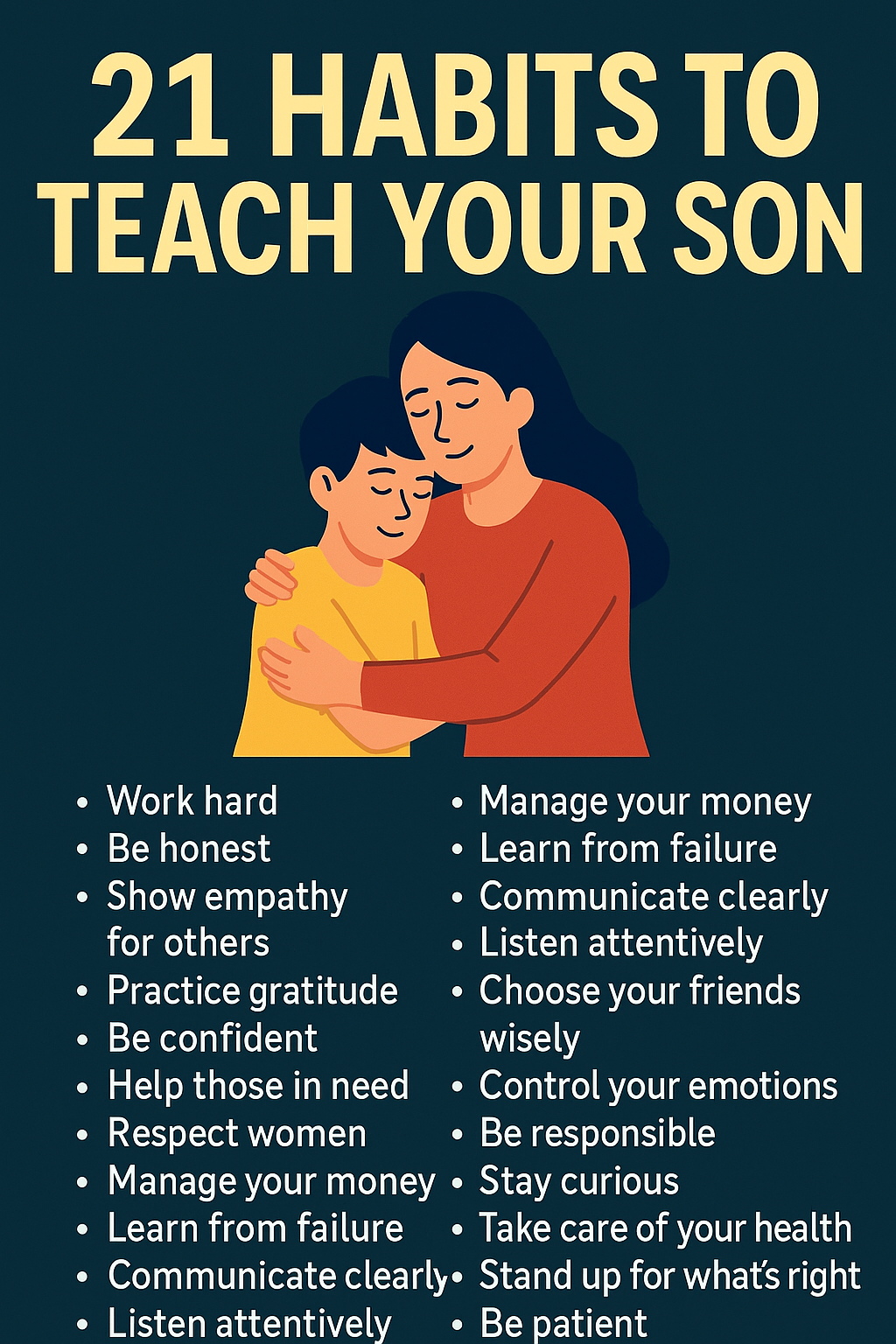
21 Transformative Habits to Instill in Your Son

Embrace Proactivity
Inspired by Sean Covey’s “The 7 Habits of Highly Effective Teens”
Teach your son to take initiative, understanding that he is responsible for his actions and attitudes.

Begin with the End in Mind
From Covey’s principles
Encourage goal-setting and envisioning desired outcomes to guide daily decisions.

Prioritize Tasks Effectively
Another of Covey’s habits
Instill the importance of distinguishing between what’s urgent and what’s important.

Cultivate a Growth Mindset
Based on Carol Dweck’s research
Encourage viewing challenges as opportunities to learn rather than insurmountable obstacles.

Develop Financial Literacy
Inspired by Robert Kiyosaki’s “Rich Dad Poor Dad”
Teach the value of money, saving, investing, and understanding assets versus liabilities.

Practice Delayed Gratification
Echoing Walter Mischel’s studies
Help him understand the benefits of waiting for larger rewards rather than seeking immediate pleasures.

Engage in Deep Work
From Cal Newport’s “Deep Work”
Encourage focused, undistracted efforts on meaningful tasks to achieve excellence.

Build Atomic Habits
Inspired by James Clear’s “Atomic Habits”
Teach the power of small, consistent changes leading to significant improvements over time.

Foster Emotional Intelligence
Based on Daniel Goleman’s research
Help him recognize, understand, and manage his emotions and empathize with others.

Encourage Reading and Continuous Learning
Echoing various educational philosophies
Promote a love for reading to expand knowledge and perspective.

Promote Physical Well-being
Aligned with holistic development approaches
Instill the importance of regular exercise, proper nutrition, and adequate rest.

Teach Effective Communication
From Dale Carnegie’s principles
Encourage active listening, clear articulation, and respectful dialogue.

Instill Time Management Skills
Inspired by productivity experts
Help him plan, prioritize, and allocate time efficiently to various tasks.

Encourage Mindfulness and Reflection
Based on mindfulness practices
Teach the value of being present and reflecting on experiences to gain insights.

Develop Resilience
Echoing Angela Duckworth’s research on grit
Encourage perseverance in the face of challenges and the ability to bounce back from setbacks.

Promote Ethical Decision-Making
From various moral development theories
Guide him to consider the ethical implications of his choices and act with integrity.

Encourage Curiosity and Questioning
Aligned with inquiry-based learning
Foster a mindset that seeks understanding and challenges assumptions.

Teach the Value of Collaboration
Based on teamwork principles
Highlight the importance of working effectively with others and valuing diverse perspectives.

Instill Gratitude Practices
From positive psychology findings
Encourage regular acknowledgment and appreciation of the positives in life.

Promote Civic Responsibility
Echoing community engagement philosophies
Teach the importance of contributing to society and understanding civic duties.

Encourage Lifelong Learning
Based on continuous improvement models
Instill the belief that learning doesn’t stop after formal education but is a lifelong journey.

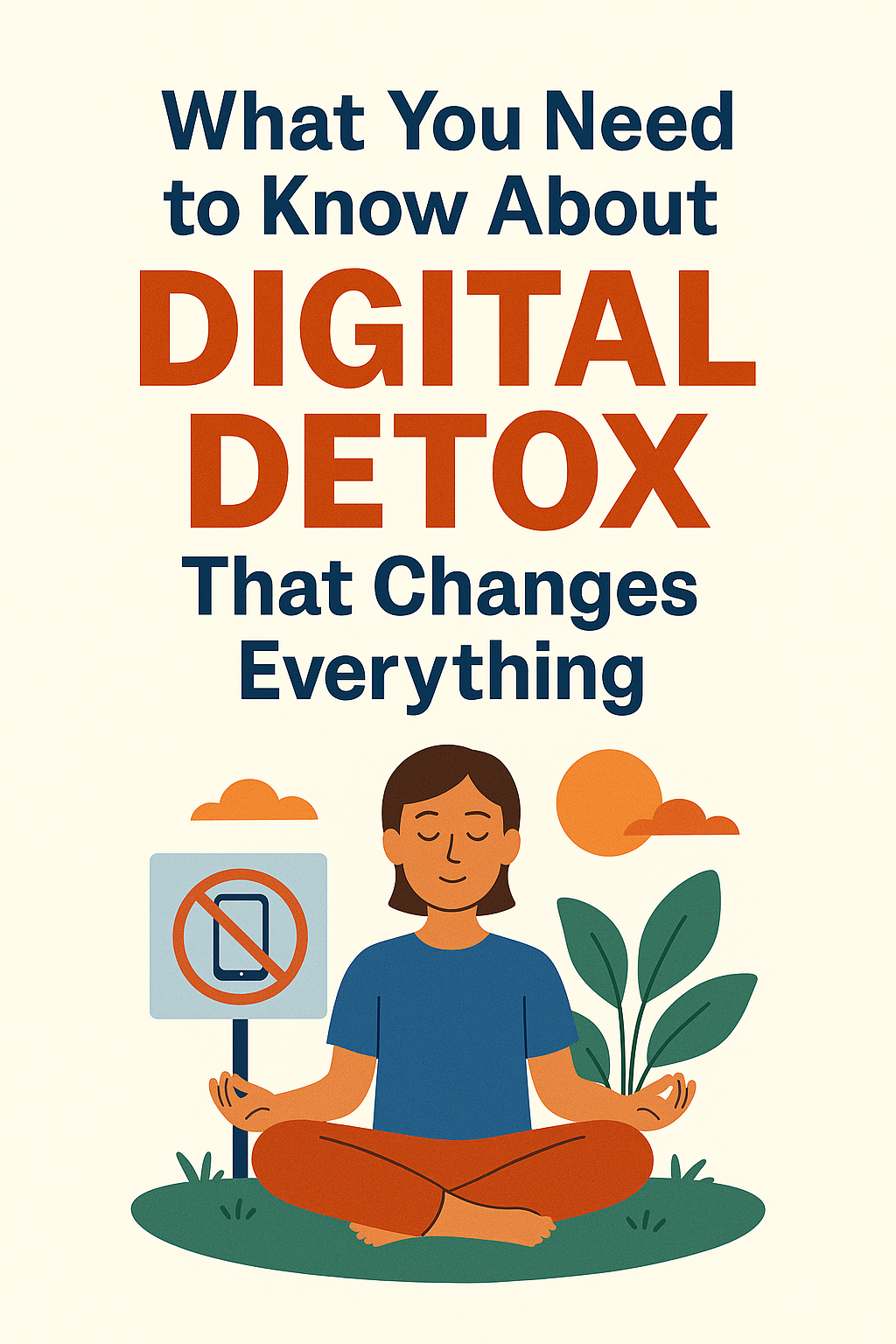
Illustration of a person unplugging from devices, embracing nature and mindfulness

In our hyper-connected world, constant digital engagement has become the norm. But what if stepping back from screens could revolutionize your mental health, focus, and overall well-being? Here’s what you need to know about digital detox that changes everything.

1. Reclaim Your Attention Span

Continuous notifications and multitasking have been shown to fragment our attention. A digital detox allows your brain to reset, improving concentration and productivity.

2. Enhance Sleep Quality

Exposure to blue light from screens can disrupt melatonin production, affecting sleep patterns. Reducing screen time, especially before bed, can lead to deeper, more restful sleep.

3. Boost Mental Health

Constant comparison on social media platforms can lead to anxiety and depression. Taking a break helps in reducing these feelings, promoting a more positive self-image.

4. Strengthen Real-Life Relationships

Being present without digital distractions fosters deeper connections with those around you, enhancing interpersonal relationships.

5. Rediscover Hobbies and Passions

Time away from screens opens up opportunities to engage in activities you love, be it reading, painting, or exploring the outdoors.

6. Improve Physical Health

Reducing screen time can alleviate issues like eye strain, neck pain, and sedentary habits, contributing to overall physical well-being.

7. Cultivate Mindfulness

Without the constant buzz of digital devices, you can practice mindfulness, leading to increased awareness and a calmer mind.

8. Increase Creativity

Stepping away from digital inputs allows your mind to wander, often leading to enhanced creativity and problem-solving skills.

9. Develop Healthier Digital Habits

A detox can help you reassess your relationship with technology, leading to more intentional and balanced usage in the future.

10. Experience Greater Life Satisfaction

By being more present and engaged in real-life activities, many report a heightened sense of fulfillment and happiness.

Ready to transform your life? Start your digital detox journey today and experience the profound benefits firsthand.

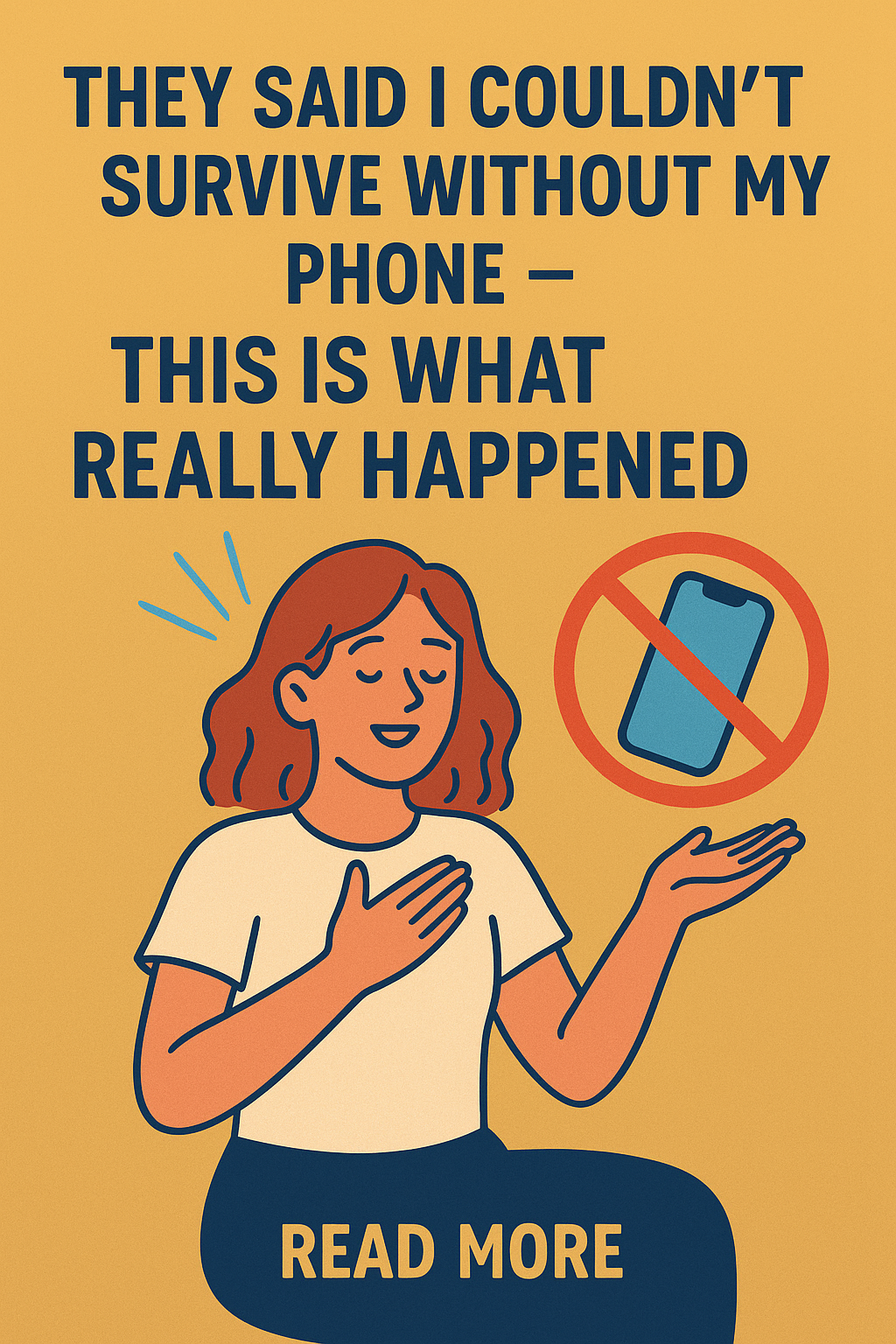
Woman smiling with relief and surprise after surviving without her phone, holding a no-phone sign

When I told my friends I was taking a full digital break for a week, they laughed. “You’ll be back in a day,” one said. “You’ll miss everything,” said another. Honestly, I was scared too. But what happened surprised all of us.

The First Day Was Brutal

I instinctively reached for my phone every 10 minutes. I felt lost, anxious, disconnected. I kept thinking, “What if I miss something important?”

Then Something Shifted

By day two, the anxiety started to fade. I slept better, felt more focused, and actually had time to think—not just react. I started journaling. I remembered hobbies I had forgotten. My mornings were quiet and slow, not rushed and reactive.

Here’s What I Learned

  • Your brain needs boredom – Silence helped me think creatively and clearly.
  • You’re not missing much – The news, memes, and reels can wait. Most aren’t urgent or even useful.
  • You notice people more – I listened better, made deeper conversations, and felt more present.
  • Your energy comes back – I wasn’t drained by 3 PM. I actually had more focus and patience.

How You Can Try This (Without Going Crazy)

  1. Start with a weekend break—24 to 48 hours without social apps or non-essential screen time.
  2. Leave your phone in another room during meals and morning hours.
  3. Replace phone time with something physical: walk, stretch, draw, write, or just sit in nature.
  4. Use a paper planner or a journal to track the difference in your mood and energy.

The Long-Term Benefits

After just one week, I felt more confident in my ability to control my attention. I was calmer, more productive, and more connected—to myself and to others. Most of all, I proved to myself that I wasn’t dependent on my phone. That changed everything.

They said I couldn’t survive without my phone. Turns out, I was barely living with it.

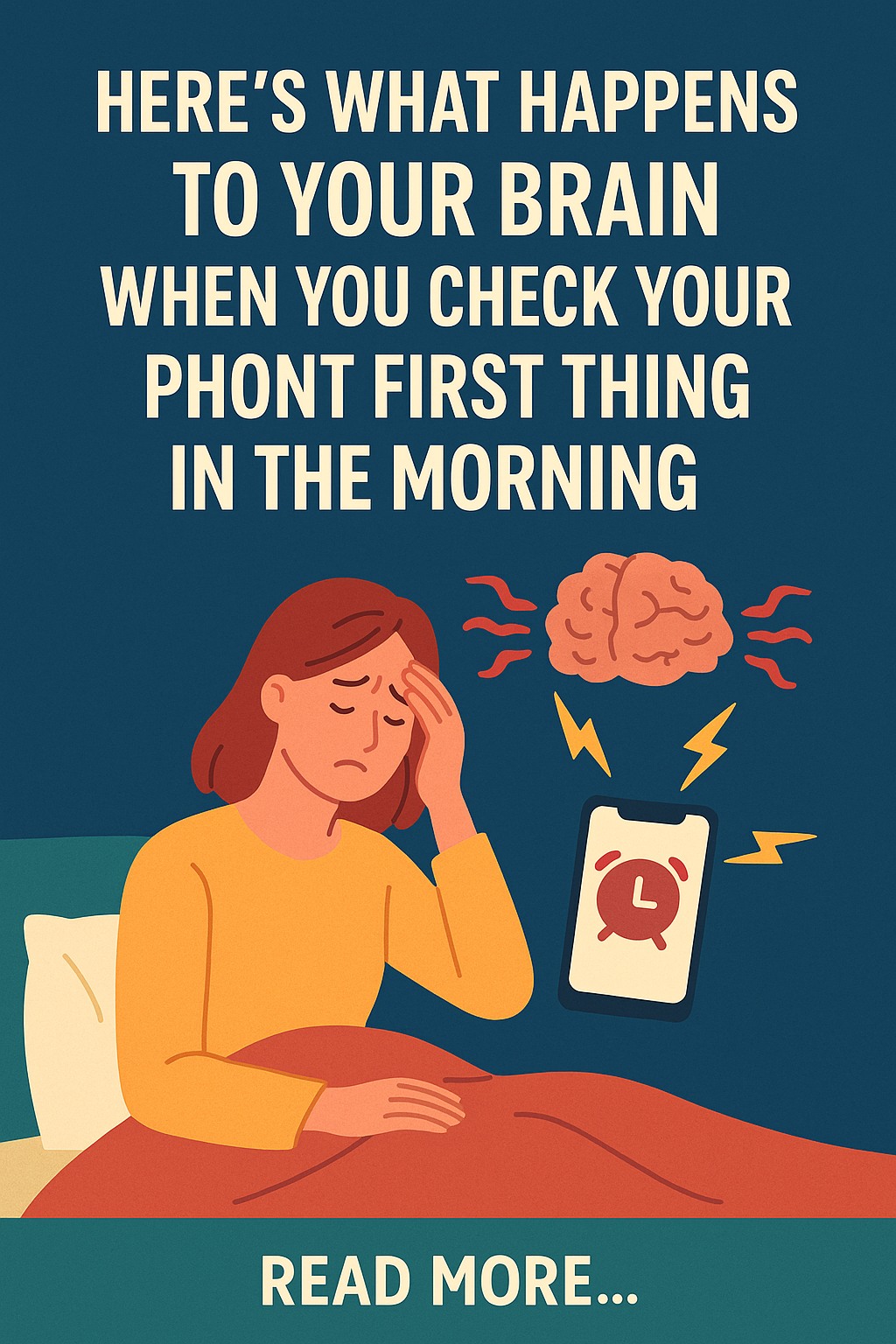
Illustration of a woman feeling overwhelmed by phone notifications in bed, representing morning screen time and brain stress

Many of us wake up, roll over, and immediately grab our phones. It feels normal, even necessary—but neuroscientists warn that this one small habit could be doing more harm than we realize.

1. You Spike Your Cortisol Levels Instantly

When you wake up, your body is already releasing cortisol to help you feel alert. Flooding your brain with emails, alerts, or social media content adds an extra jolt of stress, leading to heightened anxiety throughout the day.

2. It Hijacks Your Attention System

Your brain’s reticular activating system (RAS) determines what gets your attention. Early exposure to overwhelming content pulls your focus toward chaos, not calm—and your brain follows that lead all day.

3. You Interrupt Your Natural Brain-Wave Cycle

In the first 30 minutes after waking, your brain is in theta waves—a calm, creative state ideal for reflection and planning. Checking your phone switches you to high-alert beta waves too quickly, killing creativity and clarity.

4. It Reduces Motivation and Focus

Scrolling first thing fills your mind with other people’s priorities before you’ve even thought about your own. That can dampen your inner drive and shift your focus outward, away from your actual goals.

5. You Train Your Brain for Reactivity, Not Intention

Neuroscience shows that repeated habits rewire your neural pathways. When you start each day reacting to notifications, your brain gets better at reacting and worse at initiating meaningful focus.

6. It Contributes to Mental Fatigue by Noon

Your prefrontal cortex, which handles decision-making and impulse control, gets overloaded early—making it harder to stay productive later in the day.

What to Do Instead

  • Delay screen time: Give yourself 30–60 minutes before checking your phone.
  • Start with silence: Breathe, stretch, or meditate before external input.
  • Write down your top 3 intentions for the day instead of reading notifications.
  • Use a real alarm clock to avoid reaching for your phone upon waking.
  • Train your mind for focus by controlling how you start your day.

Changing this one habit could be the biggest shift you make in your mental energy. Don’t let your phone set the tone for your day—let your mind lead instead.

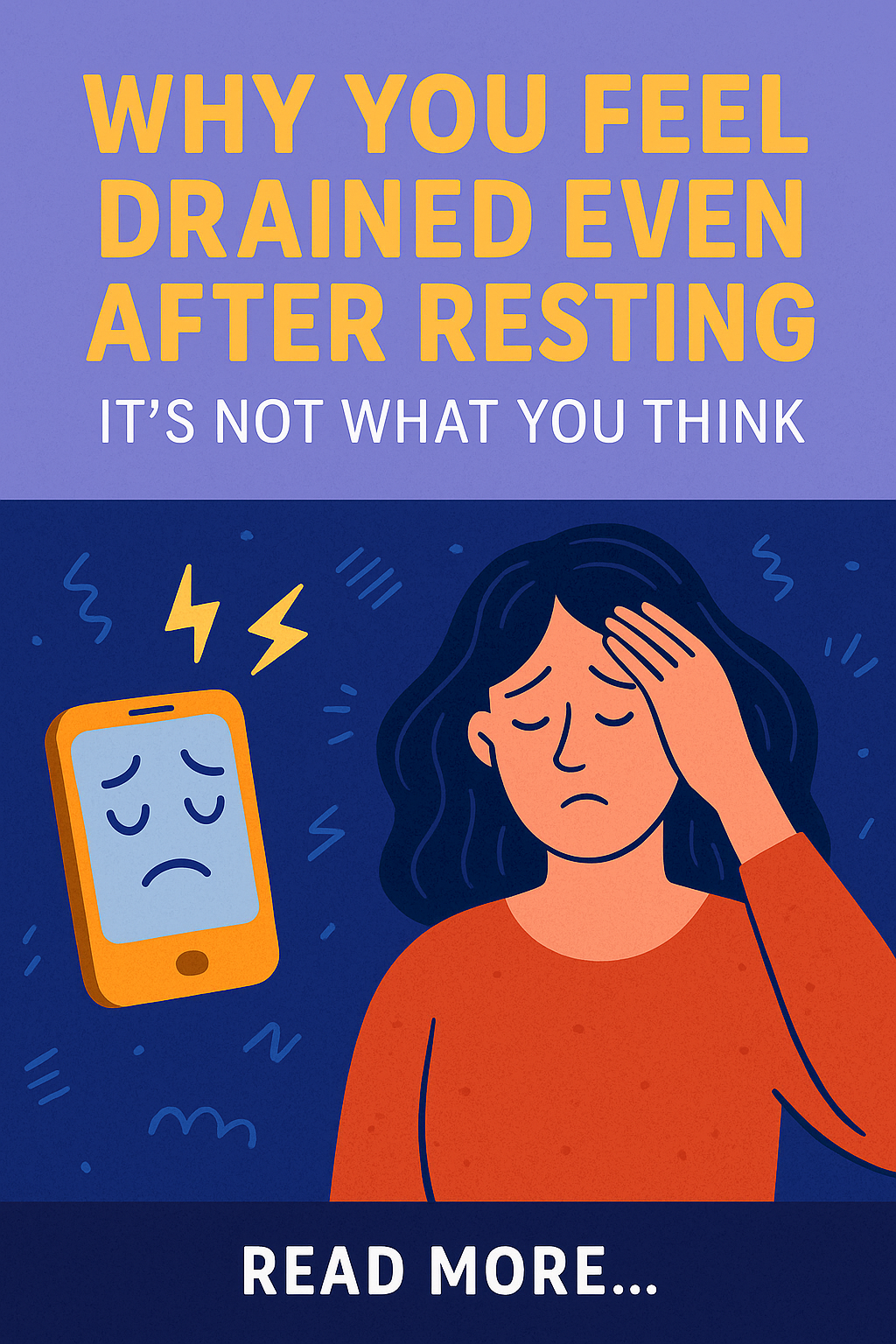
Illustration of a tired woman and a fatigued smartphone representing mental exhaustion and digital overload

Have you ever taken a full day off, done absolutely nothing strenuous, and still felt mentally and physically exhausted? If so, you’re not imagining it. According to recent neuroscience research, rest is no longer just about sleep—it’s about how we manage our brains in a world overloaded with digital noise.

Understanding Modern Fatigue

Feeling drained today doesn’t always come from physical labor. Instead, our mental exhaustion is more linked to constant stimulation, digital multitasking, and neurochemical overload.

1. Glutamate Overload in the Brain

Recent studies show that prolonged mental tasks cause a buildup of glutamate in the prefrontal cortex—the brain region responsible for decision-making. This buildup leads to mental fatigue and reduced cognitive performance.

Source: Medical News Today

2. Constant Digital Exposure Triggers Mental Exhaustion

Every notification, scroll, and video stimulates your brain’s attention system. Over time, this “digital overload” leads to anxiety, forgetfulness, and burnout symptoms.

Source: GoodRx Health

3. Social Media Fatigue Is Real

Heavy social media usage is linked with higher stress and lower self-control. One study found that users often experience information fatigue, reducing their emotional resilience.

Source: PMC Research

4. Your Attention Is Always Divided

The phenomenon of “continuous partial attention”—where you’re never fully focused—keeps your brain in a state of constant low-level stress. This prevents deep rest even when you’re technically relaxing.

Source: Wikipedia

5. Poor Sleep Caused by Screens

Blue light from screens suppresses melatonin, the hormone that signals your body it’s time to sleep. Without quality sleep, your brain doesn’t get the reset it desperately needs.

Source: Digital Detox – Wikipedia

6. Your Brain Was Never Meant for This Pace

Humans evolved with long periods of silence, slowness, and physical activity. Modern tech has created an unnatural mental environment that we’ve never biologically adapted to handle.

How to Truly Recharge – Backed by Neuroscience

  • Take intentional tech breaks – Try 1 hour per day without screens.
  • Use your brain differently – Read books, draw, or reflect in silence.
  • Practice mindfulness – Even 10 minutes a day reduces cortisol and clears your thoughts.
  • Get into nature – Green spaces have proven restorative effects on attention and mood.
  • Sleep better – Avoid screens 1 hour before bed and keep your room dark and cool.
  • Mono-task – Train your brain to focus on one thing at a time to rebuild attention strength.

So next time you feel tired after “doing nothing,” remember—true rest comes not just from lying down, but from shutting out the noise your brain never stops processing.

Illustration of a man outdoors with a crossed-out phone, representing a 24-hour digital detox challenge

In a world where we check notifications every few minutes, spending even one hour away from social media sounds unrealistic. But I decided to give it a try—and what happened shocked me.

1. My Thoughts Slowed Down

Without constant scrolling, my mind actually felt like it was breathing. I wasn’t jumping from reel to reel. I was thinking clearly.

2. I Noticed My Environment

For the first time in a while, I looked out the window and noticed the sky, the trees, the little things we often ignore.

3. I Felt Less Anxious

No likes to count, no comparison, no bad news to absorb. That one hour felt like a mini vacation for my brain.

4. I Had Time for Me

I wrote in a notebook. I made tea. I just sat in silence—and it felt calming, not boring.

5. I Realized I Wasn’t Missing Anything

When I went back to my phone, nothing major had changed. But inside, I felt refreshed and lighter.

So, what if you tried the same? You might be surprised too.

It sounded like a simple idea—24 hours without my phone. No scrolling, no swiping, no checking the clock every five minutes. What could possibly go wrong?

1. The First Few Hours Were Restless

I kept reaching for my phone unconsciously. It was like my brain was trained to touch the screen, even when there was no real reason.

2. My Mind Started to Calm Down

By mid-day, something strange happened. I felt present. I noticed sounds, small things, even the breeze on my face. It felt… peaceful.

3. I Talked More, Thought More

I had real conversations without distraction. I journaled. I even found myself just sitting and thinking. When was the last time that happened?

4. I Slept Better Than Ever

No bedtime scrolling. No blue light. I fell asleep faster and woke up clearer. One simple break changed my whole night.

5. I Realized How Dependent I Am

This challenge wasn’t easy—but it showed me how often I use my phone just to fill time. I wasn’t bored. I was free.

Ready to know what changed the most by the end?
Click the link below to read the full experience and try it for yourself.

Infographic showing 8 simple ways to unplug and reconnect with life, including walking without a phone, setting phone-free hours, reading a physical book, and more.

In a world that never stops buzzing, sometimes you just need to hit pause. Here are eight practical and realistic ways to unplug from digital overload and reconnect with yourself and the people around you.

1. Go for a Walk Without Your Phone

Take a short walk in the park or around your neighborhood. Focus on what you see, hear, and feel—without any screen distractions.

2. Set Phone-Free Hours Daily

Choose certain hours of the day when you won’t check your phone. Mealtime and bedtime are great places to start.

3. Read a Physical Book

Turn off your device and grab a real book. Let your mind travel without a glowing screen.

4. Limit Screen Time With App Timers

Use built-in phone settings or apps to set daily limits for social media and other high-use platforms.

5. Have a Digital-Free Meal

Whether eating alone or with others, keep your phone out of sight and enjoy your food with full attention.

6. Start a No-Screen Morning Routine

Begin your day without reaching for your phone. Use the first 30 minutes to stretch, write, or simply breathe.

7. Connect With Someone Face-to-Face

Spend quality time with friends or family. Real conversations are refreshing compared to online chats.

8. Create a Wind-Down Routine Before Bed

Turn off screens at least 30 minutes before sleeping. This improves sleep quality and relaxes your mind.

This Is What Happens When You Take a Break From Your Phone

In today’s fast-paced life, we are constantly surrounded by mobile phones, laptops, and social media. From the moment we wake up to the time we go to bed, screens have become a part of our daily routine. But have you ever thought about how this is affecting your health and mind?

What is Digital Detox?

Digital detox means taking a break from your phone, the internet, and social media for a certain period. It’s like a mental and physical cleanse that helps you feel refreshed and balanced again.

Why is Digital Detox Important?

  • Too much screen time affects your eyes
  • Your brain stays in alert mode all the time, increasing stressPoor sleep quality due to screen exposure
  • Less time for family and real-life relationships

How to Start a Digital Detox – Easy Tips

  1. Set phone-free hours: Stay away from your phone for at least an hour in the morning and before bed.
  2. Turn off notifications: Only keep important alerts on, and mute the rest to avoid distractions.
  3. Limit social media time: Set daily limits for apps like Instagram and Facebook.
  4. Have a digital-free day: Pick one day a week to stay off screens and spend time offline.
  5. Read books or go outdoors: Use your free time to read, walk in a park, or just relax in nature.

What Happens When You Take a Digital Detox?

You’ll notice your mind feels calmer, your sleep improves, and your focus increases. You may also reconnect with people around you and feel more present and joyful in the real world.

Final Thoughts

Being connected online is important, but staying connected to yourself is even more important. Even a few hours of digital detox every week can bring big positive changes in your life. Start today — and feel the difference.

Everyone’s travel preferences are different, which is probably why everyone has that one (or even several) dream trips they’ve been thinking about for awhile. Sometimes that involves being totally alone, no added stress of matching interests and schedules. But what should someone do when it turns out that a friend desperately wants to come with you?

A woman asked the internet for advice on what to do when she learned her friend had just invited herself to join a solo trip to Portugal she was planning. Every move she made to dissuade her didn’t land, so finally she decided to ask netizens what to do and if she was even being unreasonable in the first place.

Telling a friend “no” can be complicated

Woman in yellow dress with suitcase at airport, watching plane take off, reflecting on solo holiday and friend invitation situation

Image credits: Getty Images / Unsplash (not the actual photo)

So one woman turned to people online for advice when her friend invited herself on her trip

Woman wonders what to do when her friend invites herself on her solo holiday during a precious caregiving break
Text about a woman excited for her first solo holiday after arranging respite, wondering what to do when a friend invites herself.
Woman wonders what to do when her friend just invites herself to her solo holiday, feeling conflicted about the situation.
Woman wonders what to do when her friend just invites herself to her solo holiday, feeling unburdened and excited.
Woman looking thoughtful while considering what to do when friend invites herself on solo holiday trip
Woman sitting on sofa, looking concerned while talking on phone, pondering what to do when friend invites herself on solo holiday.

Image credits: freepik / Freepik (not the actual photo)

Woman wonders what to do when her friend invites herself to her solo holiday, causing a dilemma in travel plans.
Woman wonders what to do when her friend unexpectedly invites herself on her solo holiday trip.
Text discussing a woman wondering what to do when her friend invites herself to her solo holiday and books a nearby hotel.
Text post showing a woman wonders what to do when her friend just invites herself to her solo holiday.

Image credits: OrtsandNoughts

Woman with backpack and hat enjoying a solo holiday, contemplating what to do when a friend invites herself along.

Image credits: Bluewater Sweden / Unsplash (not the actual photo)

Solo travel is a way to just focus on yourself and your needs

Planning a solo trip is all about tailoring every detail to your own pace, interests, and need for discovery. Traveling in a group can be fun, but it often comes with all sorts of complications. One person sleeps in, one is always late, one is a picky eater and so on. So when a friend announces they’re tagging along without actually checking in, it can feel like someone has wandered onto your carefully charted and personalized map. The first step is to take a breath and make sure you understand exactly what happened, sometimes it’s a simple miscommunication rather than a deliberate assumption.

Once you’ve clarified the situation in your own mind, think about why you chose to travel alone in the first place. Perhaps it’s the solitude you crave, the opportunity for uninterrupted reflection, or the freedom to follow whims without compromise. Pinning down your personal reasons will help you explain your perspective clearly and honestly to your friend. Some folks might struggle to understand that even their friends need alone time and it’s very probably not personal. Unfortunately, the internet is full of stories that do show why some folks might not take it the right way.

Having that conversation sooner rather than later is key. A quick, direct chat, ideally in person or over the phone, gives you room to adjust bookings if necessary and prevents awkward last-minute changes. When you talk, frame your words around your needs: “I’m really looking forward to this time alone to reflect,” or “This itinerary is structured around my own interests, and I don’t want to lose that flexibility.” By using “I” statements, you keep the focus on your plans rather than on any perceived misstep by your friend. The fact is, if you let it get to the stage where your friend has already bought tickets, you’ve waited all too long.

Two women drinking coffee and chatting by a window, pondering what to do when a friend invites herself on a solo holiday.

Image credits: lookstudio / Freepik (not the actual photo)

Honesty is important, but it’s also good to be sensitive

If you value the friendship but still want to keep this trip solo, offer an alternative outing. Suggest a weekend getaway or a shorter adventure that suits you both. This shows you appreciate their enthusiasm and enjoy their company, just not on this particular journey. If you truly need the trip to be alone, be firm and kind in your boundary-setting: “I hope you understand, I really need this time to travel solo.” The truth is, if your friend does feel like they are getting enough of your attention, they should understand. At the same time, it’s true, sometimes people have abandonment issues and might struggle.

Many of the readers suggested this, to be clear that this is and should be a solo trip, but that you can do more together in the future. Unfortunately, time is of the essence, since it gets a lot harder to cancel things the closer you get to them. In this case, perhaps in the worst scenario, the friend can go on the trip and both can just do things separately.

Your friend might feel disappointed or even a little hurt, and that’s okay. Give them space to process, and stay calm if they react emotionally. Remember that their impulse likely sprang from excitement rather than disregard for your plans. Once you’ve made your position clear, wrap up any logistical changes, cancel that extra hotel bed or amend your restaurant reservations, then refocus on the adventure ahead.

Solo travel is a form of self-care, a chance to disconnect and recharge on your own terms. Protecting that intention isn’t selfish; it’s essential. By approaching the situation with honesty, respect, and a dash of empathy, you’ll keep your travel dreams intact, and preserve the friendship for the many journeys you might take together in the future. The fact is that forcing yourself to have this trip the way you don’t want it will just breed resentment. If she wants to preserve this friendship, it’s important to realize that short term discomfort is still a better option than secretly hating her forever.