Top 6 Foods That Help You Sleep Better

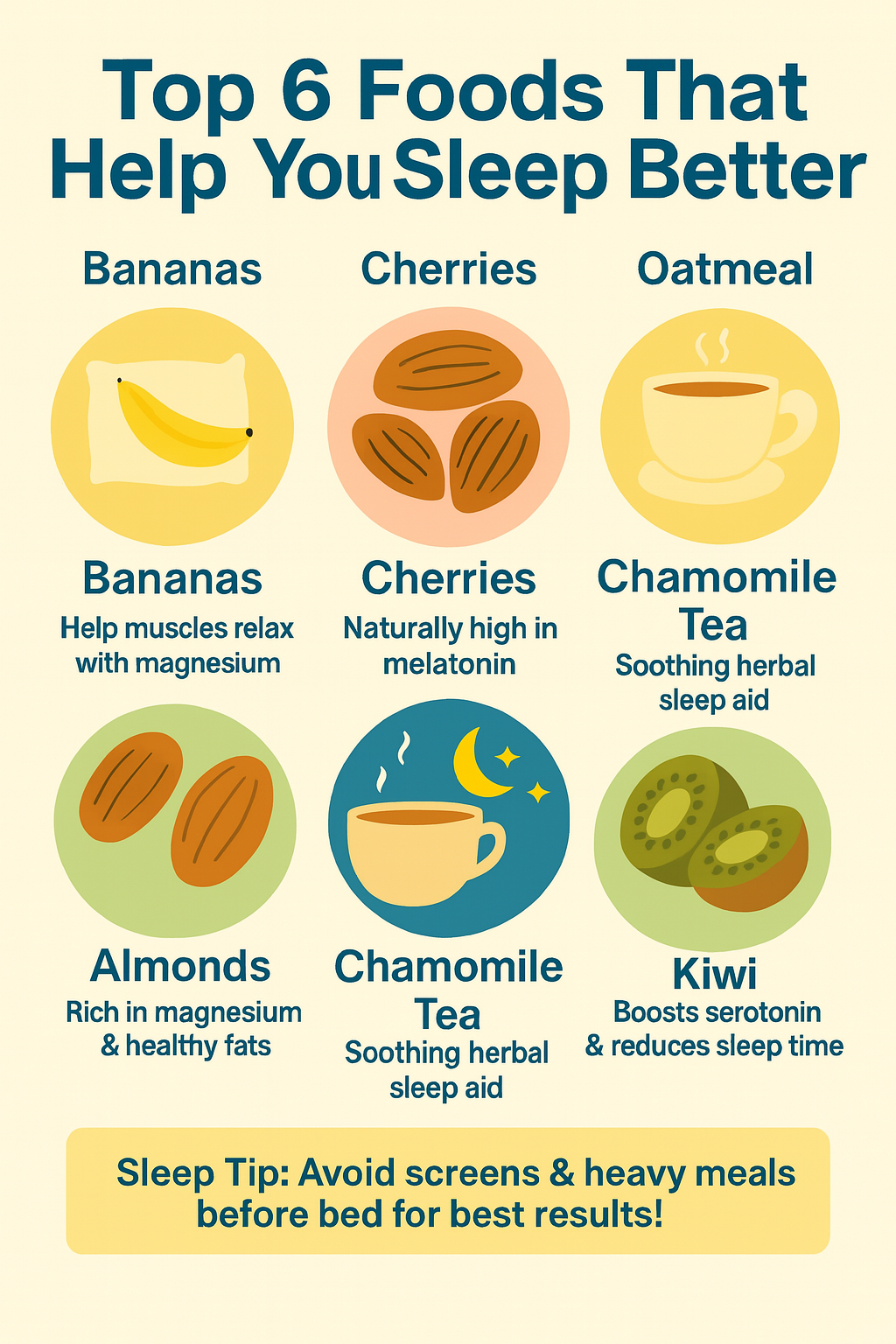
Top 6 Foods That Help You Sleep Better

1. Bananas

Bananas are rich in magnesium and potassium, which help relax muscles and nerves. They also support melatonin production for improved sleep quality.

2. Cherries

Cherries, especially tart cherries, are a natural source of melatonin, the hormone that regulates sleep cycles. Consuming cherries or cherry juice can help you fall asleep faster and stay asleep longer.

3. Oatmeal

Oatmeal contains complex carbohydrates that promote serotonin release, a calming neurotransmitter. It also has melatonin-supporting nutrients like vitamin B6 and magnesium.

4. Almonds

Almonds are packed with magnesium, healthy fats, and protein—all of which contribute to better sleep by calming the nervous system and regulating blood sugar levels through the night.

5. Chamomile Tea

Chamomile tea is known for its relaxing and mildly sedative properties. It contains apigenin, an antioxidant that binds to receptors in the brain to promote sleepiness and reduce insomnia.

6. Kiwi

Kiwi is high in antioxidants and serotonin, which help improve sleep onset and duration. Eating kiwi an hour before bed may reduce the time it takes to fall asleep and enhance sleep efficiency.

Sleep Tip: Avoid screens & heavy meals before bed for best results!

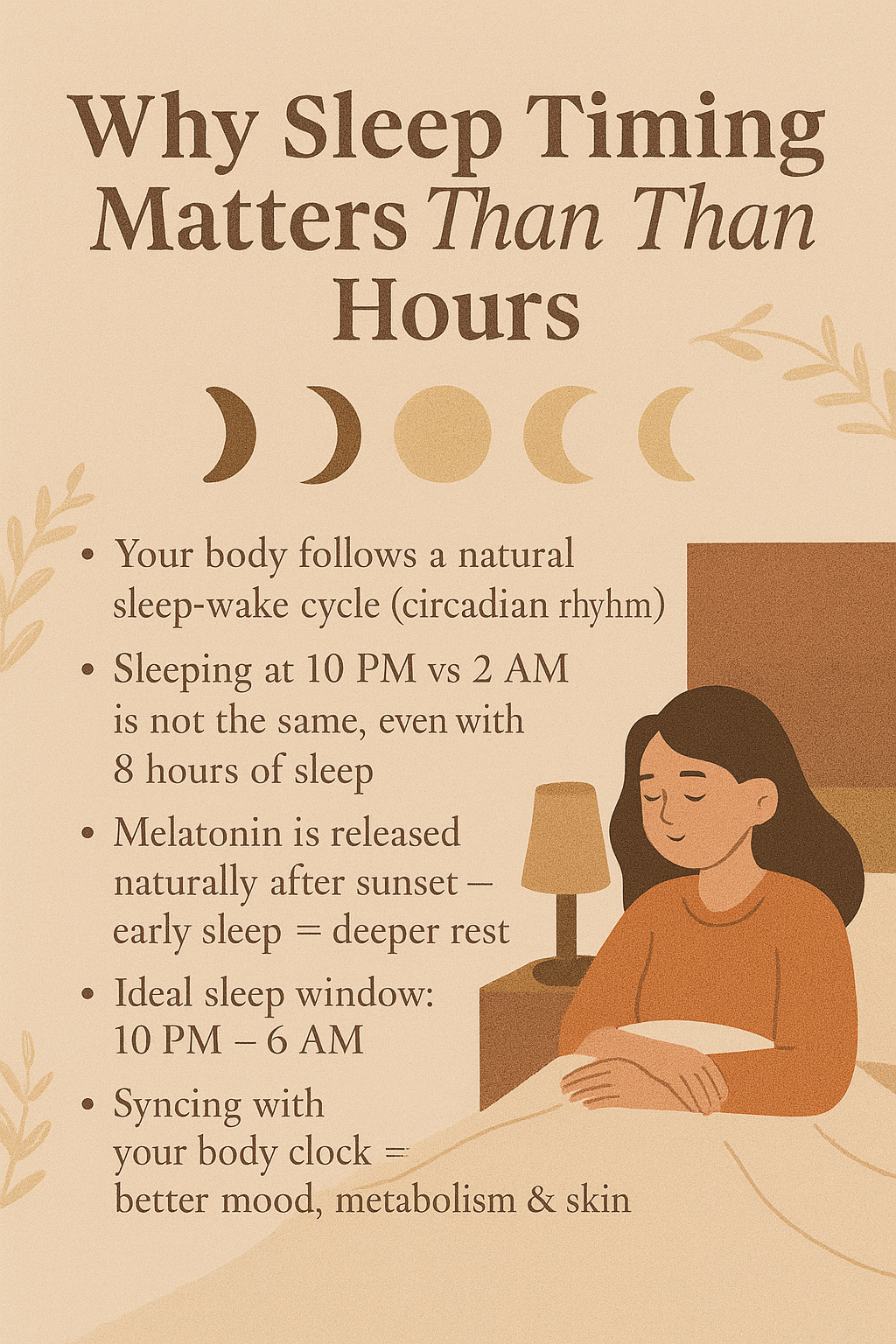
Why Sleep Timing Matters More Than Hours

Why Sleep Timing Matters More Than Just the Number of Hours You Sleep

We often hear that getting eight hours of sleep is essential—but what’s rarely talked about is when you sleep. Timing plays a major role in how restorative your sleep truly is. Sleeping at the right time, in sync with your body’s natural rhythm, can dramatically improve your mental and physical well-being.

Your Body Follows a Natural Sleep-Wake Cycle

This internal clock is known as the circadian rhythm, and it controls your energy levels, alertness, hormone production, and sleep patterns over a 24-hour period. It responds to natural cues like sunlight and darkness, telling your body when to feel awake and when to rest. Ignoring this rhythm—like staying up late and waking up late—can disrupt everything from mood to metabolism.

Sleeping at 10 PM vs 2 AM Is Not the Same

Even if you clock in eight hours of sleep, the results can vary drastically based on when those hours occur. Sleeping from 2 AM to 10 AM might leave you feeling foggy, irritable, or emotionally off. In contrast, going to bed by 10 PM allows your body to align with its natural hormonal cycles, helping you feel more refreshed and mentally clear.

Melatonin Peaks After Sunset

Melatonin is a hormone released by your brain to signal that it’s time to wind down. This release starts naturally around 9 to 10 PM, as darkness falls. When you sleep in alignment with this natural process, you’re more likely to fall asleep quickly, stay asleep, and enter deep sleep cycles. Delaying bedtime past midnight can blunt melatonin production, making your sleep feel lighter and less effective.

The Ideal Sleep Window: 10 PM – 6 AM

While everyone’s sleep needs are slightly different, the 10 PM to 6 AM window is considered ideal for most adults. This is when your body naturally undergoes critical processes such as tissue repair, immune regulation, and memory consolidation. Sleeping during this time ensures you’re not just resting—but truly recovering.

Syncing with Your Body Clock Has Real Benefits

When your sleep aligns with your natural circadian rhythm, you may notice a boost in:

  • Morning alertness and energy
  • Emotional stability and lower stress
  • Digestive efficiency and metabolism
  • Skin clarity and cellular repair
  • Immune strength and hormonal balance

Final Thought: Quality Sleep Starts with the Clock

The next time you think about getting “enough” sleep, ask yourself when that sleep is happening. Prioritizing earlier bedtimes in line with your circadian rhythm can have a profound effect on your overall health—one that lasts far beyond the morning alarm.

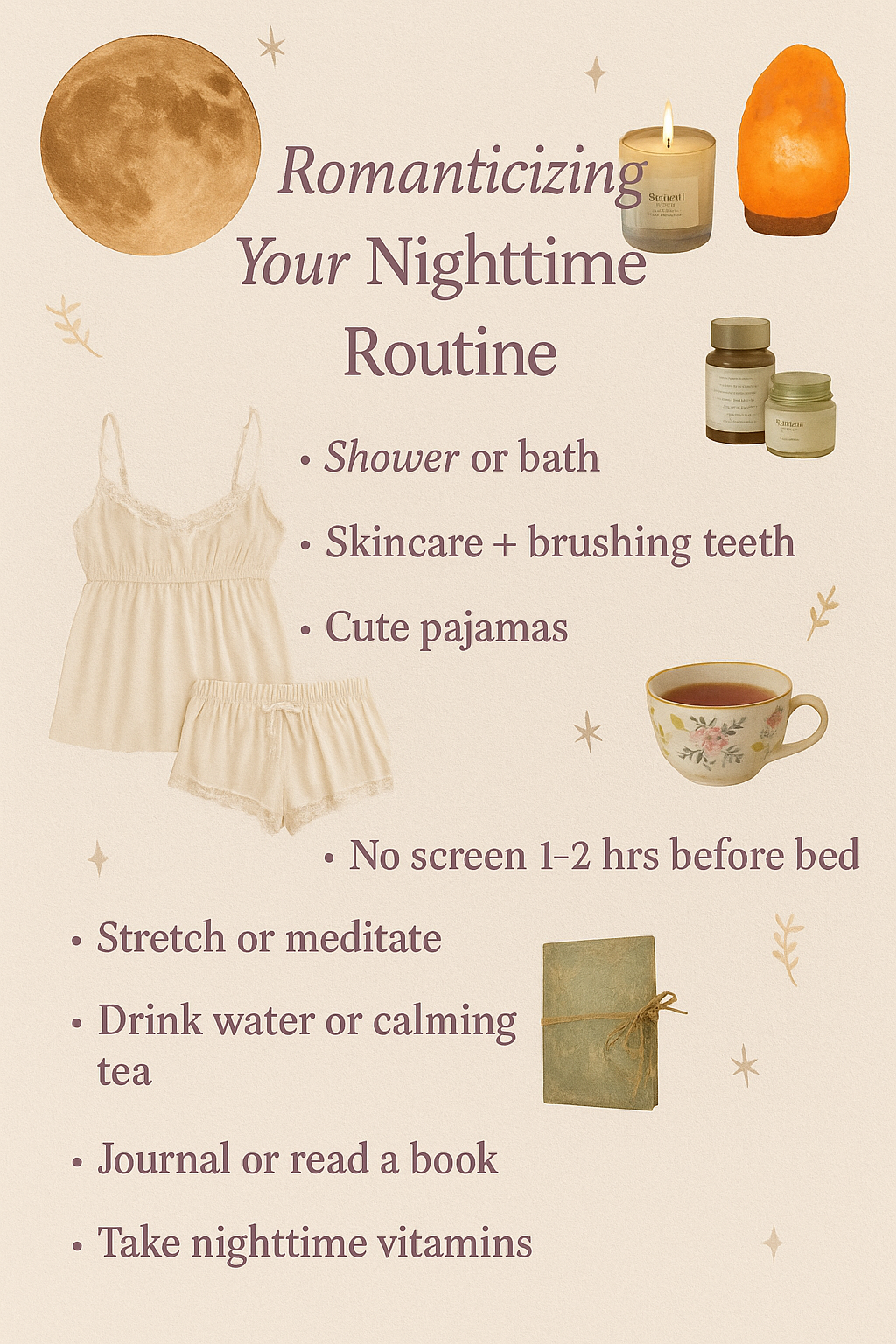
Romanticizing Your Nighttime Routine | Soft Girl Bedtime Ritual

Romanticizing Your Nighttime Routine: A Soft-Girl Sleep Ritual

If you’ve been dreaming of peaceful nights, soft self-care, and winding down without endless scrolling — it’s time to romanticize your nighttime routine. This gentle and cozy ritual isn’t just about better sleep — it’s about creating a lifestyle that soothes your mind, body, and soul before bed.

Steps to a Cozy Night Routine:

  • Take a warm shower or bath
    Wash the day off and relax your muscles with warm water and soft lighting.
  • Brush your teeth + complete your skincare routine
    Use calming, natural products to pamper your skin and set the tone for rest.
  • Put on cute pajamas
    Comfortable, breathable sets (think cotton or silk) signal it’s time to unwind.
  • No screen time 1–2 hours before sleep
    Reduce blue light to help your brain produce melatonin naturally.
  • Stretch or meditate
    A few minutes of gentle yoga or deep breathing calms your nervous system.
  • Make herbal tea or drink warm water
    Choose chamomile, lavender, or lemon balm to ease into restfulness.
  • Read a book or write in a journal
    Replace scrolling with inspiring pages or mindful thoughts.
  • Take nighttime supplements or vitamins
    Magnesium, ashwagandha, or melatonin (if needed) can promote deep sleep.

Why This Works:

This routine taps into both sleep optimization science and the aesthetic joy of slowing down. By incorporating calming habits, intentional rituals, and screen-free self-care, you create a space where your body and brain can fully relax and reset.

Tags

#NighttimeRoutine #SleepOptimization #MindfulEvening #GenZSelfCare #PinterestNightRoutine #RomanticizeYourLife #SoftGirlAesthetic #HealthySleepHabits #BedtimeRituals #SelfCareRoutine

Let your night routine become your favorite part of the day.

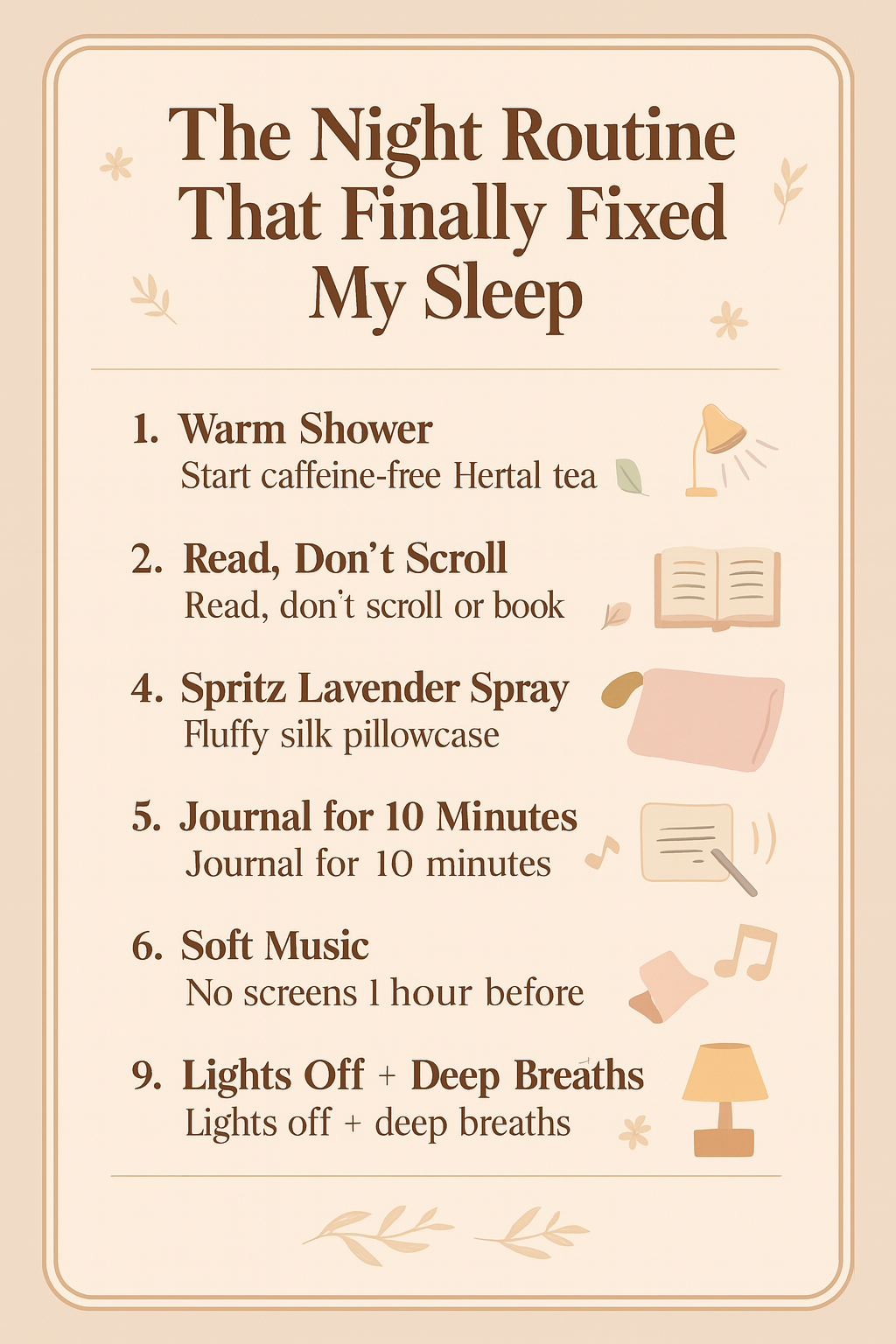
The Night Routine That Finally Fixed My Sleep

The Night Routine That Finally Fixed My Sleep

A simple and soothing 10-step reset that actually worked

In a world full of overstimulation and blue light, sleep doesn’t come easily—especially when your mind is buzzing and your body feels wired. After months of tossing and turning, I simplified my evenings and built a realistic, gentle night routine that changed everything. Here’s exactly what helped me sleep deeper, faster, and wake up feeling more restored:

1. Warm Shower Before Bed

A warm shower 60 to 90 minutes before sleep helps lower core body temperature, which signals your brain that it’s time to wind down. It also releases muscle tension and eases you into a state of calm.

2. Herbal Tea (No Caffeine)

Swapping evening caffeine for caffeine-free herbal teas like chamomile, lavender, or lemon balm creates a natural calming ritual. I noticed it instantly slowed my racing thoughts and supported a smoother transition to rest.

3. Reading (Not Scrolling)

Instead of mindlessly scrolling on my phone, I now read a few pages of a novel, short stories, or even a calming magazine. This lowers mental stimulation and prevents the blue light exposure that delays melatonin release.

4. Lavender Pillow Spray

Just a light mist of lavender or eucalyptus essential oil on my pillow helped my body associate scent with sleep. Over time, it became a cue for my nervous system to soften and release the day.

5. Silk Pillowcase

Beyond skincare benefits, switching to a silk or satin pillowcase brought a sense of luxury and physical comfort to my nighttime environment—making bedtime something to look forward to.

6. Gratitude Journaling

Each night, I write down 3 things I’m grateful for. It’s a small but powerful mindset shift that reduces anxiety, replaces spiraling thoughts with peace, and brings emotional closure to the day.

7. Soft Music or Ambient Sounds

Whether it’s gentle lo-fi beats, ocean waves, or white noise, soft background sounds help mask environmental noise and calm the mind. I now associate those sounds with rest, not distraction.

8. No Screens 1 Hour Before Sleep

I made a hard rule: no phone, laptop, or TV at least 60 minutes before bed. This cut down blue light exposure and taught my brain to separate day stimulation from night relaxation.

9. Gentle Stretching or Night Yoga

A 5-minute routine of light stretching—neck rolls, forward folds, or legs-up-the-wall pose—helps my body let go of the day’s physical tension. This improved not just how quickly I fall asleep, but how deeply I sleep too.

10. Set a Bedtime Alarm

Instead of just waking up with an alarm, I now set one at night too. When it goes off, I stop whatever I’m doing and start my sleep ritual. This one trick created consistency, which improved my circadian rhythm over time.

Final Thoughts

The key to this routine wasn’t perfection — it was consistency and softness. When I stopped pressuring myself to have the “perfect” night and focused on winding down gently, my sleep naturally improved. Now, bedtime feels like self-care instead of a struggle.

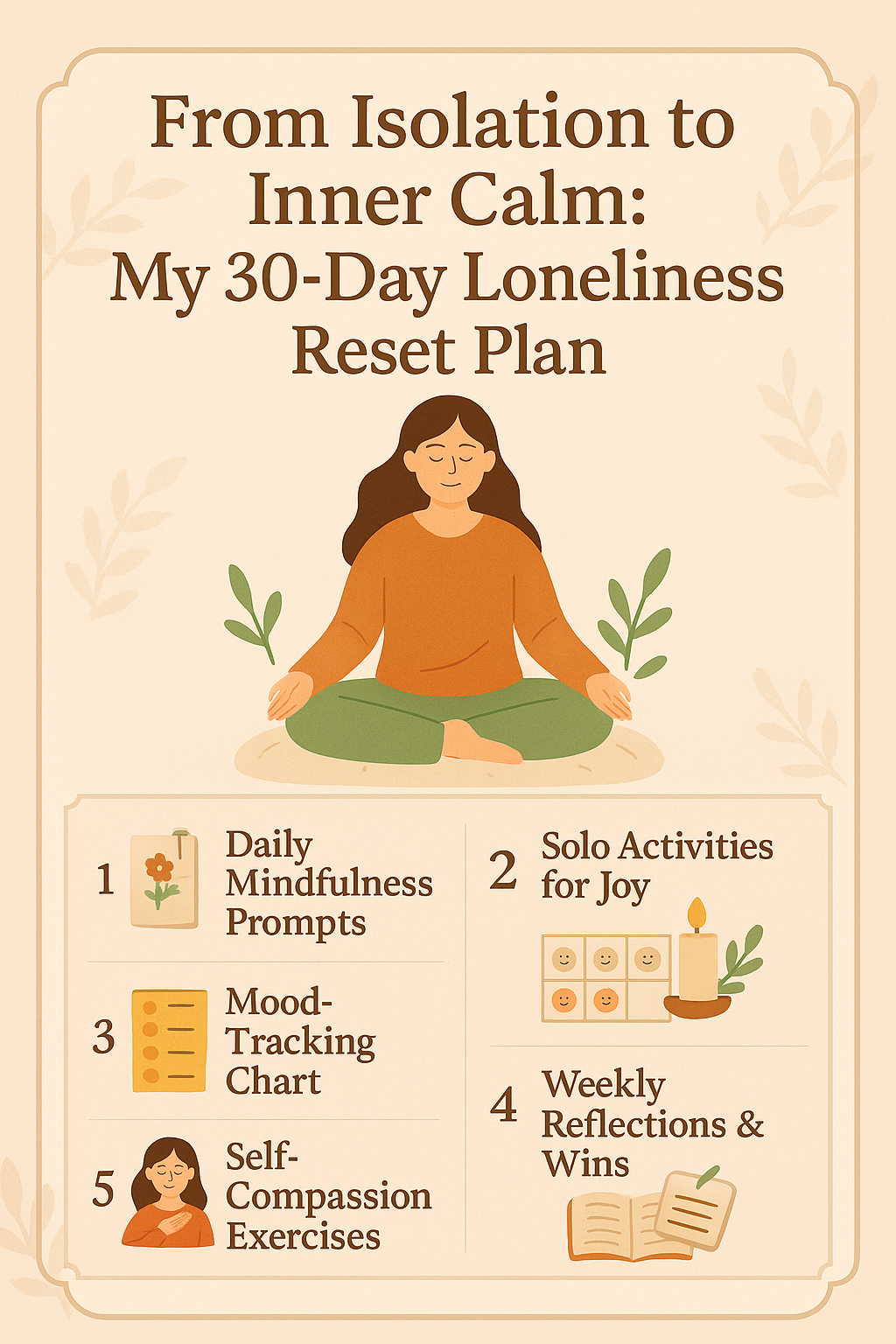
30-Day Loneliness Reset Plan

From Isolation to Inner Calm: My 30-Day Loneliness Reset Plan

A soothing reset to turn silence into self-connection — one peaceful day at a time.

1. Daily Mindfulness Prompts

Activities:

  • Start your day by journaling for 5 minutes
  • Meditate with soft background sounds or silence
  • Practice deep breathing while lighting a candle

Avoid:

  • Reaching for your phone first thing in the morning
  • Overloading your to-do list before checking in with yourself

Prompts to Try:

  • How is my body feeling today?
  • What do I need emotionally right now?
  • One gentle goal for today is…

2. Solo Activities for Joy

Activities:

  • Make a cozy reading corner
  • Try mindful cooking with calming music
  • Declutter one small space with intention
  • Explore hobbies like sketching, knitting, or puzzles
  • Take yourself on a “solo date” (park, café, movie)

Avoid:

  • Mindlessly watching stressful social media reels
  • Comparing your timeline with others’ highlight reels

3. Mood-Tracking Chart

Activities:

  • Use 3–4 colors to represent your moods
  • Draw small symbols or boxes for each day
  • Log emotional triggers or supportive habits

Avoid:

  • Ignoring recurring low moods — write about them kindly
  • Using mood tracking as self-criticism

Tip: End the week by reflecting: What helped me feel better most days?

4. Self-Compassion Exercises

Activities:

  • Mirror affirmations: “I am enough as I am”
  • Write about a recent hard moment without judgment
  • Treat yourself the way you’d treat a close friend

Avoid:

  • Shaming yourself for feeling low
  • Trying to “fix” every emotion instantly

Kind Reminders:

  • “It’s okay to rest.”
  • “Progress isn’t linear — and that’s normal.”

5. Weekly Reflections & Wins

Activities:

  • List 3 small wins every Sunday
  • Share your progress with a supportive friend
  • Make a “Joy Jar” — add one joyful moment each week

Avoid:

  • Skipping reflection just because the week felt “meh”
  • Only focusing on what went wrong

Closing Thought

This journey isn’t about fixing loneliness overnight — it’s about learning to be at peace in your own presence.

These small rituals will slowly help you build a life that feels calm, cozy, and connected — even on the quiet days.

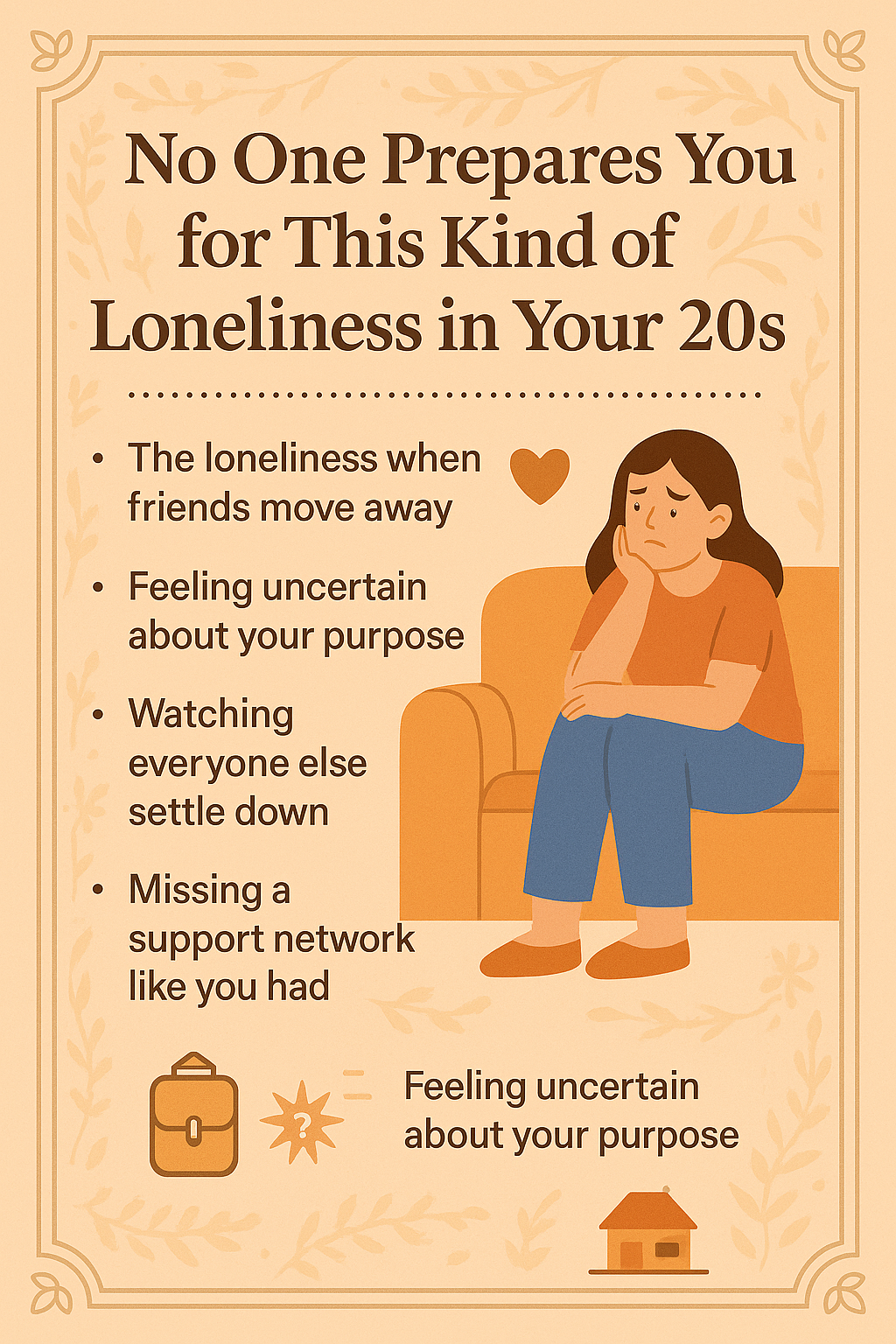
No One Prepares You for This Kind of Loneliness in Your 20s

No One Prepares You for This Kind of Loneliness in Your 20s

You enter your 20s expecting freedom, growth, and chaos — but no one talks about the strange ache that slowly creeps in. This kind of loneliness is quiet, confusing, and deeply personal. Let’s not just name it — let’s heal through it.

1. Friends Drift Without Drama

They don’t text like they used to. You didn’t fight — but you stopped showing up for each other. And it stings in ways that are hard to explain.

What Helps:

  • Reach out anyway. Reconnection isn’t desperate — it’s courageous.
  • Accept that not all friendships are meant to last forever.
  • Make space for new friendships that reflect who you are now.

2. Social Media Feels Like Noise

You’re surrounded by constant updates, but still feel unseen. Everyone is celebrating — yet you’re questioning if you’re falling behind.

What Helps:

  • Mute or unfollow accounts that drain you emotionally.
  • Follow people who feel human, relatable, or uplifting.
  • Take 24-hour detoxes weekly to reconnect with real life.

3. Making Friends Feels Weirdly Hard

In school, friendship was automatic. Now, everyone’s busy or guarded. You’re ready to connect — but don’t know where to begin.

What Helps:

  • Join spaces based on hobbies — yoga, art, books, volunteering.
  • Don’t overthink. Invite someone for coffee — people are lonelier than they seem.
  • Focus on depth, not popularity. One true friend changes everything.

4. You Miss the Parents You Wanted Space From

The independence you once craved now feels hollow. You miss your parents — their presence, their routines, their concern.

What Helps:

  • Call home regularly, even if for 5 minutes.
  • Recreate rituals: your childhood meal, your mom’s playlist, or a quiet walk like your dad used to take.
  • Let yourself feel homesick — it’s a sign of love, not weakness.

5. You Crave Deeper Conversations

Small talk doesn’t satisfy anymore. You long for people who want to talk about purpose, healing, and fears — not just work or parties.

What Helps:

  • Ask deeper questions: “What’s been on your mind lately?”
  • Find emotionally safe spaces — journaling clubs, support groups, or open-hearted podcasts.
  • Be the depth you’re seeking — and the right people will find you.

6. Everyone Is Busy, But No One Feels Present

Schedules are full. Calendars are packed. But people don’t show up fully. You crave presence, not availability.

What Helps:

  • Be present yourself. Put your phone away when you’re with others.
  • Create sacred time — weekly rituals, no-device meals, silent walks.
  • Choose a few people to invest deeply in rather than many surface-level connections.

7. You Think It’s Just You — But It’s Not

This is the hardest part. You feel like you’re the only one struggling — but most 20-somethings feel lost, disconnected, or behind. They just don’t say it out loud.

What Helps:

  • Talk about it. Vulnerability builds connection.
  • Follow voices online that normalize the messiness of this stage.
  • Know that this phase isn’t permanent — it’s just a passage.

Final Reflection

This kind of loneliness doesn’t mean you’re failing — it means you’re growing.

You’re building your life from scratch: your people, your values, your peace. Be gentle. Stay open. And know: the heaviness you feel today will one day become the strength you carry forward.

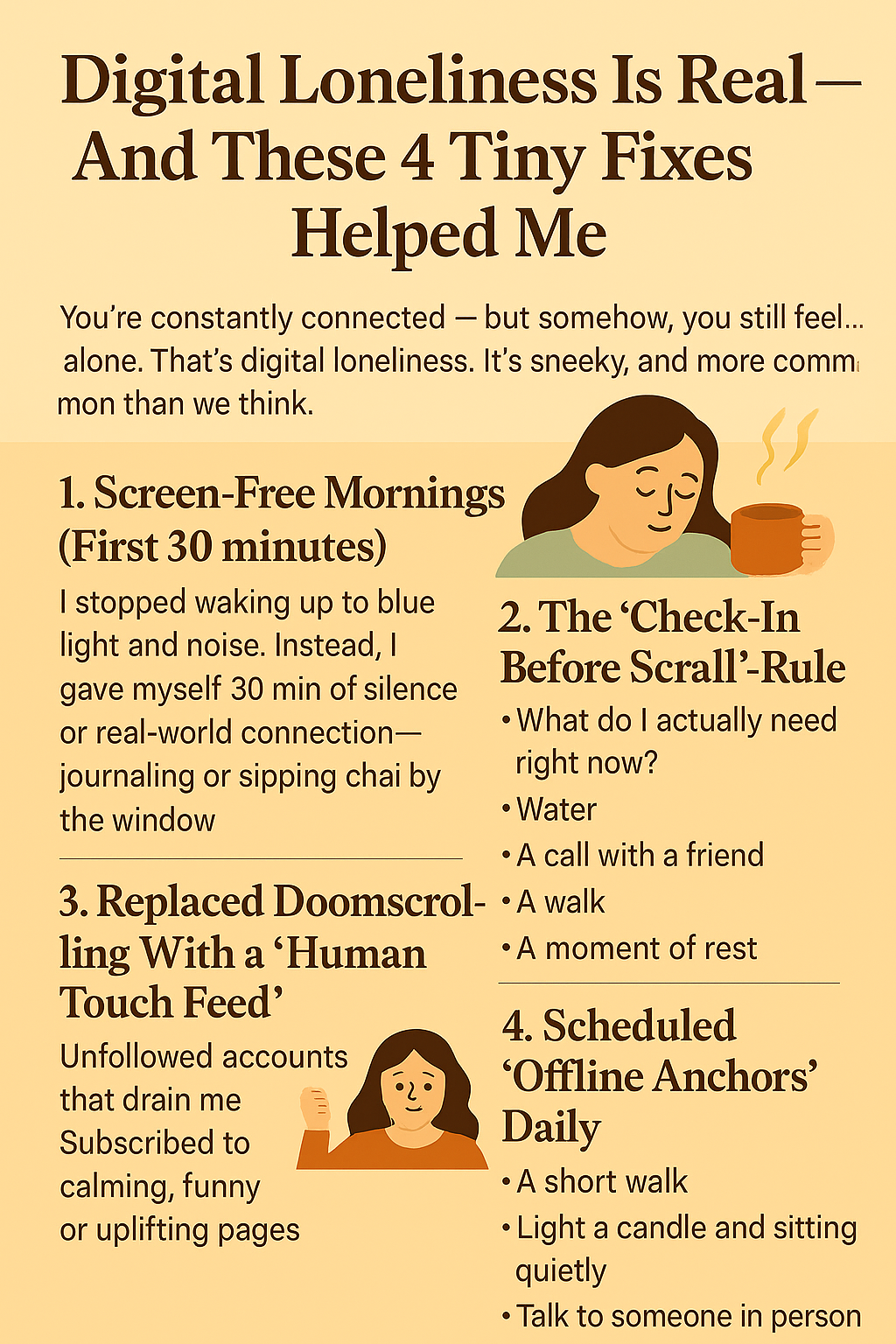
Digital Loneliness Is Real — And These 4 Tiny Fixes Helped Me

Digital Loneliness Is Real — And These 4 Tiny Fixes Helped Me

We live in an always-connected world — yet somehow, I still felt painfully alone. That’s when I realized I wasn’t imagining it. I was experiencing something many people don’t talk about: digital loneliness. It’s when your screen is full, but your soul feels empty. Here are four small, realistic changes that helped me reconnect — not with a screen, but with myself.

1. Screen-Free Mornings (First 30 Minutes)

Instead of starting my day with the usual scroll, I began guarding the first 30 minutes after I woke up. No news, no messages, no emails.

I spent that time stretching near the window, sipping chai, or simply writing one line in a notebook about how I felt. Sometimes I just stared at the sky. That silence — free from headlines and hashtags — slowly began to heal something inside me.

2. The “Check-In Before Scroll” Rule

Before I open any app, I now ask myself a simple question: “What do I actually need right now?”

  • A glass of water?
  • Movement — a short walk or stretching?
  • Human connection — a call to someone I trust?
  • A moment to breathe — not scroll?

Social media isn’t inherently harmful — it’s how we use it. By pausing to check in with myself, I stopped using it as a band-aid and started using it more mindfully.

3. Replaced Doomscrolling with a “Human Touch Feed”

I did a full clean-up of my social feeds. Gone were the accounts that left me comparing, criticizing, or feeling empty.

I began following creators who made me laugh, taught me something useful, or simply felt like warm company. I prioritized calm — dog videos, nature reels, soft music, poetry. This wasn’t toxic positivity. It was human presence, through a screen.

4. Scheduled “Offline Anchors” Daily

Every day, I now make time for at least one thing that grounds me in the real world. No screens, no noise.

  • Sitting quietly with a cup of tea
  • Lighting a candle in silence
  • Writing a short note to myself
  • Taking a walk without my phone
  • Listening to ambient sounds outside my window

These small moments felt awkward at first — but over time, they became my anchors in a world that constantly pulls us online.

Final Reflection

You don’t have to quit tech to escape digital loneliness. But you do need space — to hear your own thoughts, feel your own body, and remember you’re more than just an algorithm’s target. These fixes are simple, yes — but when done consistently, they brought me back to myself.

Tags: loneliness, emotional wellness, solo living, reconnect with self, self-care routine, quiet habits, gentle healing

I Thought I Was Fine — Until Loneliness Hit Me Like a Wall

6 Ways I Gently Reconnected With Myself

I was busy. I was productive.
But one night, the loneliness hit hard — out of nowhere.
It wasn’t about being alone. It was about feeling disconnected… even from myself.

These small shifts helped me cope — without pretending, without forcing. Here’s what actually helped me feel human again:

1. Recognize the Signs Early

Loneliness isn’t always loud. Sometimes, it hides behind routines and to-do lists.

  • I stopped enjoying little things
  • My energy dropped for no reason
  • I felt off, even around people

Once I saw the signs, I could respond with care — not panic.

2. Create a Simple Morning Anchor

Instead of grabbing my phone first thing, I started small:

  • A 5-minute stretch
  • Sipping warm water by the window
  • Writing one calming sentence in a notebook

This helped me start the day with myself, not with distraction.

3. Make a Safe Evening Ritual

I realized that my evenings were empty — just endless scrolling. Now, I do this instead:

  • Journal one sentence about how the day felt
  • Light a candle or play low music
  • Avoid content that overstimulates my brain

This helps me close the day with softness.

4. Personalize Your Alone Time

I created one small cozy corner:

  • Warm blanket
  • Calming scent
  • One photo that feels safe

When the loneliness felt too much, I’d go sit there — not to fix it, but to hold it.

5. Talk Kindly to Yourself

My self-talk used to sound like: “Get over it.”
Now, it’s more like:

  • “You’re not broken. You’re adjusting.”
  • “This wave won’t last.”
  • “You’re not weak for feeling this.”

Sticky notes on the wall remind me daily.

6. Let the Emotion Exist — Without Panic

I stopped fighting the feeling. Instead, I whispered to myself:

“Okay. This is loneliness. You’re allowed to feel it.”

I closed my eyes, breathed, and let it pass. It always did.

Final Note

You don’t have to feel okay all the time. Loneliness doesn’t mean something’s wrong — it means you’re human.

Be gentle. Move slow. And let these small shifts reconnect you to the version of yourself that’s still in there — waiting patiently.


Tags: loneliness, emotional wellness, solo living, reconnect with self, self-care routine, quiet habits, gentle healing

No One Talks About These Simple Ways to Beat Loneliness

No One Talks About These Simple Ways to Beat Loneliness

(But They Actually Saved My Mental Health)

I didn’t realize I was lonely until I stopped distracting myself. And when the silence settled in — I had to face it. No podcast, scroll, or chat could fix what I needed to feel.

These aren’t big, bold mental health tips. They’re small. Gentle. But they worked — and they might help you too.

1. I Set a “Start My Day” Ritual

Every morning, before checking my phone, I did 3 things:

  • Made my bed
  • Opened the window for fresh air
  • Drank water while standing in silence

This 3-minute sequence signaled to my body: I’m here. I matter. I’m taking care of myself.

2. I Started Talking to Myself Out Loud

Sounds strange, I know. But I’d say things like:

  • “You’ve got this today.”
  • “I know yesterday was hard. But we’re showing up.”
  • “You’re safe now.”

It rewired my inner voice to be kinder — and gave me comfort when no one else was around.

3. I Created “Mini Check-In” Alarms

Twice a day, I set silent alarms on my phone with these labels:

  • “Pause. Breathe.”
  • “Are you feeling okay?”

Each time they went off, I’d stop, close my eyes for 20 seconds, and just notice my state. These pauses were tiny resets for my mind.

4. I Wrote One Sentence a Night

No full journaling. Just one line:

“Today felt ____ because ____.”

Sometimes it was:
“Today felt heavy because I didn’t talk to anyone.”

And that honesty — even in a few words — helped me release the tension. It gave me closure to the day.

5. I Made a “Comfort Corner” in My Room

I picked one chair near a window, added a blanket, a candle, and one photo I loved. That spot became my emotional retreat.

Whenever I felt off, I’d sit there. No phone. No expectations. Just stillness.

Eventually, that space became a reset button for my nervous system.

6. I Let the Loneliness Exist — Without Shame

This was the hardest.
I stopped trying to “fix” the loneliness and started witnessing it.

“Okay. You feel disconnected right now. That’s okay. Let’s just sit through this wave.”

And strangely, when I stopped resisting it — it passed more quickly.

Final Thought

No one talks about these small habits. They’re not glamorous. They don’t get viral. But they helped me come back to myself — one day at a time.

Try just one for a week. You might be surprised how much better you feel.


Tags: beat loneliness, self-care, minimalist mental health, comfort routines, journaling, daily rituals, feel connected

Feeling Lonely Living Away From Family? These Tricks Will Shock You…

Feeling Lonely Living Away From Family? These Tricks Will Shock You…

“Some days, it felt like no one really knew me anymore — like I disappeared the moment I left home.”

If you’ve ever moved to a new city, country, or just away from family — you’ve likely felt it. The quiet ache. The isolation in a crowd. The emotional gap between what you’re experiencing and the people who used to understand you best.

That’s where I was too. Until I tried a few tricks that — quite honestly — shocked me with how well they worked.

Trick #1: Create a “Family Wall”

This sounds simple — but it’s emotionally powerful.

I printed 5 pictures of my favorite family memories and arranged them in a small corner of my room. I called it my “connection corner.”

Every morning, I’d look at that wall for just 10 seconds.

Without even trying, I began to feel grounded — like my people were still close, still cheering me on.

Trick #2: Record a “Future Message” for Yourself

On a day when you’re feeling okay, open your voice recorder and say something like:

“Hey, I know it’s been tough sometimes. But look how far you’ve come. You’re not alone. You’re growing — even when it doesn’t feel like it.”

Save it. Play it back when you need it most. This sounds weird — until you hear your own voice offering you compassion. It’s powerful.

Trick #3: Swap Scrolling for a 2-Minute Movement Break

Loneliness loves idle scrolling — but scrolling makes it worse. So I made a rule: anytime I wanted to numb out with social media, I’d first do 2 minutes of movement.

  • Gentle stretching
  • Walk to the window
  • 10 jumping jacks

After 2 minutes, I often didn’t even want to scroll. My mood had shifted.

Trick #4: One-Sentence Gratitude Text

Instead of long convos, I started sending one sentence to someone I missed.

  • “Thinking of you today.”
  • “Your voice popped into my head this morning.”
  • “Wish I could hug you right now.”

Short. Simple. Powerful. It often sparked longer chats — but even when it didn’t, I felt connected.

Trick #5: Create an “Anchor Activity”

This was the most shocking of all — because it worked instantly.

I chose one activity to do at the same time every evening — for me, it was lighting a candle and writing a sentence in my journal.

That one act became my emotional anchor. It told my body: You’re home. You’re safe. You’re not invisible.

Bonus: Stop Waiting for the Feeling to Go Away

Loneliness isn’t something you can think yourself out of. It shifts through action. Through routine. Through quiet, daily rituals that bring you back to yourself.

Final Thought

You don’t have to wait for your next visit home. You don’t need to pretend everything is okay.

You just need a few real habits that make you feel emotionally seen — by your family, by others, and most importantly, by yourself.

Start with just one of these tricks. It might shock you… in the best possible way.


Tags: feel less lonely, homesick tips, emotional wellness, living far from family, self-care habits, beat loneliness, connection tips