How to Journal for Mental Clarity & Emotional Healing

In a noisy world full of overthinking, unspoken emotions, and daily chaos, journaling is a gentle tool that helps you come back to yourself. It’s not just writing—it’s healing. Whether you’re feeling anxious, overwhelmed, heartbroken, or simply unfocused, putting your thoughts on paper creates space for clarity and emotional release.

Let’s break down how to journal in a way that genuinely helps you feel lighter, clearer, and emotionally more balanced.

1. Start with a Daily Mental Dump

Every morning or night, take 5–10 minutes to write down everything that’s on your mind—without editing or judging.
Why it works:

  • Clears out mental clutter
  • Identifies hidden worries
  • Prepares your mind for focus or rest

Prompt:

“Right now, I’m thinking about…” or “I can’t stop worrying about…”

2. Use Prompts to Explore Deeper Emotions

When you’re feeling stuck or confused, use emotional prompts to understand what you’re truly feeling and why.

Why it works:

  • Uncovers suppressed feelings
  • Builds self-awareness
  • Helps process difficult emotions

Try prompts like:

“What emotion am I avoiding right now and why?”
“What hurt me recently that I haven’t addressed?”

3. Practice Gratitude Journaling

Focusing on the good doesn’t mean ignoring pain—it’s about balancing your emotional lens.

Why it works:

  • Boosts mood and optimism
  • Reduces anxiety and rumination
  • Grounds you in the present

How to do it:

List 3 things you’re grateful for each day—big or small. Write why they matter.

4. Write Letters You’ll Never Send

If someone hurt you, disappointed you, or if you need closure—write them a letter (but don’t send it). This is about release, not revenge.
Why it works:

  • Processes emotional pain safely
  • Provides a sense of closure
  • Prevents emotional bottling

Prompt:

“Dear [Name], here’s what I need to say…”

5. Track Emotional Patterns

Over time, review your journal entries to notice patterns—what triggers you, what soothes you, what repeats.
Why it works:

  • Helps break unhealthy cycles
  • Shows your emotional growth
  • Builds awareness of emotional triggers

Tip: Use color codes or symbols to track moods over days/weeks.

6. Create a Safe Space—No Rules

Your journal is your judgment-free zone. You don’t need to write every day or have perfect handwriting. Some days you may write a full page, other days, just one word.

Why it works:

  • Builds trust with yourself
  • Encourages emotional honesty
  • Makes journaling sustainable, not stressful

Reminder: You’re not writing for anyone else. Just show up as you are.

Final Thoughts: It’s Not Just About Writing—It’s About Healing

Journaling is not about being a “good writer.” It’s about being an honest feeler. Even five minutes a day can lead to breakthroughs, clarity, and peace. Over time, your journal becomes a mirror—a place where you understand, forgive, and grow.

Start today. Your mind and heart deserve the space to breathe.

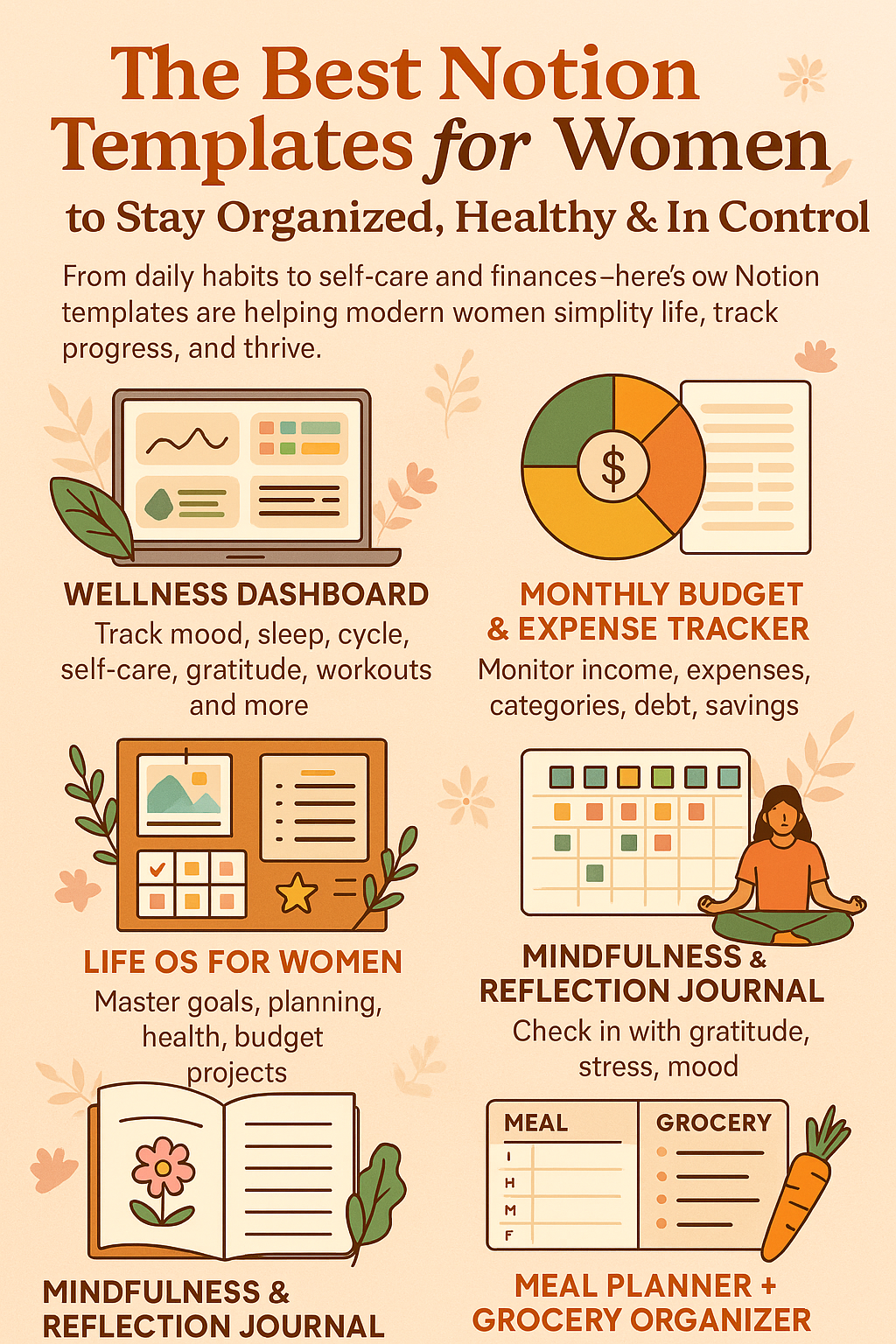
The Best Notion Templates for Women to Stay Organized, Healthy & In Control

From daily habits to self-care and finances—here’s how Notion templates are helping modern women simplify life, track progress, and thrive.

Life can feel like a constant juggling act—work, wellness, relationships, money, routines. That’s where Notion steps in. For women who want to take charge of their goals, stay healthy, and manage finances, Notion offers beautifully designed, customizable templates to do it all in one place.

Whether you’re a student, entrepreneur, homemaker, or working professional, these female-focused Notion templates will help you organize every area of life with ease.

1. Wellness Dashboard – Prioritize Mind & Body

This all-in-one self-care and wellness template is designed for mental clarity, emotional well-being, and physical health.
What’s Inside:

  • Mood tracker
  • Cycle & PMS journal
  • Sleep log
  • Self-care ideas library
  • Gratitude journal
  • Workout & hydration tracker

Why Women Love It:

It blends emotional check-ins with physical wellness, letting you reflect on how you’re feeling while keeping up with your health goals.

2. Monthly Budget & Expense Tracker – For Financial Clarity

Money stress is real, especially when bills, subscriptions, and shopping lists pile up. This budgeting template makes things simple.
What’s Inside:

  • Monthly income vs. expense dashboard
  • Categories for food, self-care, bills, shopping
  • Debt tracker
  • Savings goals
  • Visual pie charts

Why Women Love It:

The interface is clean and feminine, and the visuals make it easier to see where your money is going. Ideal for women managing homes, side hustles, or solo finances.

3. Habit Tracker – Build the Woman You Want to Be

This minimalist habit tracker helps you build the routines that support your bigger dreams—whether that’s waking up earlier, journaling, or drinking more water.
What’s Inside:

  • Monthly/weekly habit calendar
  • Color-coded goal progress
  • Morning & evening routine checklist
  • Productivity dashboard

Why Women Love It:

Tracking habits gives you daily wins and a clear sense of momentum. Plus, it feels so satisfying to mark things “done.”

4. Life OS for Women – One Template for Everything

Think of this as a digital life planner. It combines wellness, productivity, money, and goals into a master control panel.
What’s Inside:

  • Vision board
  • Weekly planning section
  • Health tracker
  • Goal setting system (quarterly + yearly)
  • Budget overview
  • Project boards (career, personal life, etc.)

Why Women Love It:

This one’s for the planner girl in you. It saves time and energy by centralizing everything in one beautiful, structured space.

5. Mindfulness & Reflection Journal

A gentle, guided template for checking in with yourself regularly—especially helpful during stressful or emotional times.
What’s Inside:

  • Daily prompts for gratitude, stress, joy, and lessons
  • Mood + anxiety scale
  • Weekly reflections
  • Meditation & breathwork logs

Why Women Love It:

It supports emotional regulation and mental well-being. Many users say it feels like “therapy in a notebook.”

6. Meal Planner + Grocery Organizer

For women managing homes or meal-prepping with intention, this Notion template saves time and brain space.
What’s Inside:

  • Weekly meal plan grid
  • Grocery list auto-population
  • Pantry tracker
  • Nutrition goals

Why Women Love It:

Makes it easy to stick to health goals, avoid food waste, and cut the chaos of last-minute cooking.

Final Thoughts:

You don’t need to use all of these. Start with just one template that fits your current season of life. The beauty of Notion is how it grows with you.

Want to feel calmer, clearer, and more in control? Try one of these templates, personalize it, and see how it transforms your daily flow.

Why Every Billion-Dollar Founder Reads Obsessively (And What They’re Reading Now)

In the lightning-paced world of startups and tech giants, it’s easy to assume that billion-dollar founders spend every waking moment on calls, in meetings, or coding. While they certainly put in the hours, there’s a powerful, often quiet, habit that underpins their success: obsessive reading.

From the methodical Bill Gates to the visionary Elon Musk, these titans of industry aren’t just scanning headlines; they’re devouring books across diverse genres, treating knowledge acquisition as a non-negotiable part of their daily routine. For them, reading isn’t a leisure activity; it’s a strategic investment, a secret weapon that saves and makes millions.

The Cognitive Edge: Why Reading Is Their Superpower

The brain of a prolific reader is constantly being optimized for high-level performance:

  • Mental Models & Pattern Recognition: Reading exposes founders to a vast array of scenarios, strategies, and outcomes. This helps them build a rich library of mental models — frameworks for understanding how the world works. When faced with a new challenge, they can quickly recognize patterns and apply proven solutions or avoid common pitfalls.
  • Enhanced Critical Thinking: Engaging with complex ideas in books strengthens the prefrontal cortex, the part of the brain responsible for critical analysis, problem-solving, and decision-making. It teaches them to evaluate arguments, synthesize information, and form independent judgments.
  • Expanded Empathy & Perspective: Biographies, history, and even fiction cultivate empathy by allowing founders to step into the minds of others. This is invaluable for understanding customers, employees, competitors, and market dynamics.
  • Reduced Cognitive Load & Stress: While seemingly paradoxical, deep, focused reading can reduce mental clutter. By immersing themselves in a single, coherent narrative or argument, founders give their brains a break from the constant context-switching of daily business, lowering stress and improving clarity.
  • Continuous Learning & Adaptation: The business landscape evolves rapidly. Reading is the most efficient way to stay abreast of new technologies, economic theories, historical lessons, and scientific breakthroughs. It fosters intellectual curiosity, a hallmark of enduring success.

What Billion-Dollar Founders Are Reading Now (Or Recently Recommended)

While specific “current” reads can change week to week, these founders consistently recommend and demonstrate a preference for books that expand their worldview, offer new frameworks, and provide deep insights. Here’s a glimpse into their recent reading habits:

Bill Gates (Microsoft Co-founder, Philanthropist)

Known for reading around 50 books a year, Gates’s recommendations often span science, global health, history, and memoirs. He publishes regular reading lists on his “Gates Notes” blog.

  • Recent Recommendations (Summer 2025 & Winter 2024 lists):
    • An Unfinished Love Story by Doris Kearns Goodwin (Memoir/History)
    • The Coming Wave by Mustafa Suleyman (AI/Future Tech)
    • The Anxious Generation by Jonathan Haidt (Social Science/Youth Well-being)
    • Born a Crime by Trevor Noah (Memoir/Social Commentary)
    • Surrender: 40 Songs, One Story by Bono (Memoir)

Mark Zuckerberg (Meta CEO)

Zuckerberg launched his “A Year of Books” challenge, emphasizing books that help him understand how society functions and evolves, covering science, history, philosophy, and technology.

  • Key Themes & Recent Mentions (General and 2024/2025 aligned interests):
    • Sapiens: A Brief History of Humankind by Yuval Noah Harari (History/Sociology) — A perennial favorite for understanding human evolution and society.
    • High Output Management by Andrew Grove (Business/Management) — A classic for operational excellence.
    • The Beginning of Infinity by David Deutsch (Science/Philosophy) — Exploring how knowledge grows and transforms the world.
    • The Three-Body Problem by Cixin Liu (Science Fiction) — Often cited for its grand scale and philosophical implications regarding humanity’s future.

Elon Musk (Tesla, SpaceX, X CEO)

Musk’s reading habits are famously tied to his ambitions in engineering, space, AI, and the future of humanity, heavily favoring biographies, science fiction, and technical books.

  • Key Themes & Recent Mentions (General and 2024/2025 aligned interests):
    • Superintelligence: Paths, Dangers, Strategies by Nick Bostrom (AI/Future) — A foundational text for his AI safety concerns.
    • Life 3.0: Being Human in the Age of Artificial Intelligence by Max Tegmark (AI/Future) — Another deep dive into the implications of advanced AI.
    • The Hitchhiker’s Guide to the Galaxy by Douglas Adams (Science Fiction) — A childhood favorite that shaped his philosophical outlook on the universe.
    • Biographies of inventors and leaders like Benjamin Franklin and Albert Einstein (by Walter Isaacson).

Jeff Bezos (Amazon Founder)

Bezos is known for his “Day 1” philosophy and customer obsession, often drawing inspiration from books on long-term thinking, innovation, and company culture.

  • Key Themes & Recent Mentions (General and 2024/2025 aligned interests):
    • The Innovator’s Dilemma by Clayton M. Christensen (Business/Innovation) — Hugely influential on Amazon’s strategy.
    • Good to Great by Jim Collins (Business/Management) — Focuses on what makes companies achieve sustained superior performance.
    • Built to Last by Jim Collins (Business/Management) — Explores characteristics of visionary companies.
    • Dune by Frank Herbert (Science Fiction) — Often cited for its themes of long-term planning and ecology.

Cultivating Your Own Obsessive Reading Habit

You don’t need a private jet to access the wisdom of these leaders. Here’s how to build your own impactful reading routine:

  1. Prioritize It: Schedule reading time daily, just like you would a crucial meeting. Even 30 minutes a day adds up to many books a year.
  2. Read Diverse Genres: Don’t just stick to business books. Explore history, science, philosophy, and even fiction to broaden your perspectives and stimulate creativity.
  3. Take Notes: Highlight, annotate, or keep a separate “reading journal.” This active engagement helps solidify learning and makes ideas easier to recall.
  4. Audiobooks Count: For busy schedules, audiobooks during commutes, workouts, or chores are an excellent way to consume content.
  5. Be Intentional: Read with a purpose. Ask yourself: “What problem am I trying to solve?” or “What new perspective do I want to gain?”
  6. Join a Reading Community: Discussing books with others can deepen your understanding and introduce you to new titles.

Reading isn’t just about accumulating facts; it’s about training your brain to think, adapt, and innovate at the highest level. By embracing the obsessive reading habits of billion-dollar founders, you’re not just expanding your knowledge base; you’re developing the cognitive architecture necessary to navigate complexity, seize opportunities, and ultimately, build your own enduring success.

What book is currently expanding your mind? Share your latest read in the comments!

The Mental Reset Routine That Helped Tony Robbins and Tim Ferriss Bounce Back From Burnout

Burnout isn’t just about being tired; it’s a state of chronic stress that leads to physical and emotional exhaustion, cynicism, and a reduced sense of accomplishment. Even the most driven individuals, like Tony Robbins and Tim Ferriss, have faced its debilitating grip. They’ve discovered that true high performance isn’t about relentless grind, but about strategic self-care and a deliberate “mental reset” routine that allows them to bounce back stronger.

The Silent Drain: How Burnout Takes Hold

Our brains aren’t wired for constant, high-stress output. When we push too hard for too long without adequate recovery, several things start to happen:

  • Amygdala Enlargement: Chronic stress can enlarge the amygdala, the brain’s fear center, making us more reactive, irritable, and anxious.
  • Prefrontal Cortex Thinning: The prefrontal cortex, responsible for decision-making, planning, and focus, can thin, impairing cognitive function and memory.
  • Dopamine Dysregulation: Our “feel-good” dopamine system can get out of whack, leading to low motivation, anhedonia (inability to feel pleasure), and a sense of dread.
  • Attention Residue & Decision Fatigue: As discussed in previous posts, constantly switching tasks and making endless small decisions drains our mental batteries.

Burnout isn’t a badge of honor; it’s a warning signal that your most valuable asset—your brain—is under attack.

The Science of the Reset: Why It Works

A mental reset routine isn’t just “taking a break.” It’s a series of deliberate actions designed to:

  • Activate the Parasympathetic Nervous System: Shifting from “fight or flight” (sympathetic) to “rest and digest” (parasympathetic) calms the body and mind, reducing cortisol levels.
  • Promote Neuroplasticity: Engaging in new or calming activities helps the brain build new, healthier neural pathways, counteracting the negative effects of stress.
  • Clear Mental Clutter: Giving the mind space to process and release accumulated thoughts, worries, and incomplete tasks.
  • Restore Cognitive Resources: Replenishing the finite mental energy needed for focus, creativity, and effective decision-making.

The Mental Reset Routine: Lessons from Robbins and Ferriss

While their specific routines vary, both Tony Robbins and Tim Ferriss emphasize similar core principles to prevent and recover from burnout. They prioritize practices that shift their mental and physical states, allowing for deep restoration and renewed focus.

Tony Robbins: The Power of State Change

Robbins’s philosophy hinges on the idea that emotion is created by motion. To change your mental state, you must first change your physical state and focus.

  1. Physiology First: Robbins is famous for his “priming” routine. This often involves:
    • Movement: Jumping, power posing, or vigorous exercise to immediately shift energy. He emphasizes that a change in posture or movement can instantly alter your mood and confidence.
    • Breathwork: Deep, controlled breathing exercises to oxygenate the brain and calm the nervous system.
    • Science Link: Physical activity and specific breathing patterns directly influence neurotransmitter release (like dopamine and endorphins) and vagal nerve tone, promoting relaxation.
  2. Focus on Gratitude: Immediately after shifting his physiology, Robbins directs his focus to what he is grateful for, often envisioning desired outcomes.
    • Science Link: Practicing gratitude has been shown to boost mood, reduce stress, and even improve sleep quality by shifting focus from threat to abundance.
  3. Strategic Language: He consciously chooses empowering language, reframing challenges as opportunities.
    • Science Link: The words we use, especially in self-talk, shape our perception and emotional response. This is a core tenet of cognitive behavioral therapy.

Tim Ferriss: Deliberate Decompression & Optimization

Ferriss, known for “deconstructing” peak performance, focuses on systematic routines that optimize his mental and physical state for long-term sustainability. He often speaks to managing energy, not just time.

  1. Morning Rituals (Anchors): Before diving into work, Ferriss typically engages in a series of “anchoring” activities:
    • Cold Exposure: Cold showers or plunges to “wake up” the nervous system, reduce inflammation, and provide a mental reset.
    • Meditation/Mindfulness: Short periods of meditation to clear the mind, improve focus, and reduce reactivity.
    • Journaling: A “brain dump” to offload anxieties, plan the day, and practice gratitude.
    • Science Link: Cold exposure can increase dopamine and norepinephrine. Meditation alters brain waves and reduces amygdala activity. Journaling reduces cognitive load and promotes emotional processing.
  2. Strategic Breaks & “Un-Scheduling”: Ferriss advocates for “slow productivity” and building in recovery.
    • Micro-Resets: Short breaks (e.g., 5-17 minutes) throughout the day to stretch, walk, or simply disconnect.
    • Time Blocking for Recovery: Deliberately scheduling “off” time, not just work time.
    • Science Link: Regular breaks prevent attention residue, reduce mental fatigue, and allow for diffused mode thinking, fostering creativity.
  3. Digital Boundaries: Ferriss is disciplined about managing his digital inputs, avoiding app-hopping and setting clear boundaries around notifications and email.
    • Science Link: This directly combats cognitive overload and decision fatigue, reserving mental bandwidth for deep work.

Implementing Your Own Mental Reset Routine

You don’t need a billionaire’s budget or a guru’s stage to benefit from these strategies. The key is consistency and personalization.

  1. Identify Your Burnout Triggers: What specifically drains you? Excessive meetings, constant notifications, lack of clear goals, poor sleep?
  2. Start Small, Be Consistent: Pick one or two habits to begin. A 5-minute gratitude journal in the morning, a 10-minute walk at lunch, or cutting off screen time 30 minutes before bed are great starts.
  3. Prioritize Physiology: Integrate movement and breathwork. Even a few deep breaths before a tough meeting can make a difference.
  4. Create “Sacred” Time: Designate periods (morning, midday, evening) where you are unreachable and fully focused on your reset activity.
  5. Listen to Your Body & Mind: Pay attention to how different activities affect you. Your routine is unique.

A mental reset routine isn’t a luxury; it’s a vital component of sustainable high performance. By deliberately building in moments of recovery and conscious state change, you can navigate the pressures of modern business, bounce back from setbacks, and continue to operate at your peak without sacrificing your well-being.

What’s one small mental reset you can commit to starting today?

Why Every Smart Businessman Keeps a Decision Log (And How It Saves Millions)

In the high-stakes world of business, decisions are currency. Every choice, big or small, carries weight — impacting revenue, strategy, team morale, and your bottom line. Yet, how often do we make a decision, move on, and never truly reflect on its outcome or the process behind it? This is where many businesses bleed money and miss massive opportunities.

The smartest business leaders don’t just make decisions; they meticulously log them. This isn’t just about record-keeping; it’s a powerful tool for learning, accountability, and strategic growth that can genuinely save (and make) millions.

The Hidden Cost of Unlogged Decisions

Without a systematic way to track your choices, you’re flying blind. This leads to several expensive pitfalls:

  • Repeating Mistakes: Ever feel like you’re facing the same problem, or making a similar poor choice, again and again? Without a log, your brain struggles to connect past actions to present outcomes, leading to recurring, costly errors.
  • Missed Opportunities: Did a great idea fail because of poor execution, or was the idea itself flawed? Without tracking, you can’t dissect the past to identify what worked and what didn’t, missing chances to refine and capitalize.
  • Hindsight Bias: After an outcome is known, it’s easy to rationalize a decision (“I knew that would happen!”). A decision log forces you to capture your thinking before the outcome, providing an honest record for true learning.
  • Lack of Accountability: When decisions aren’t documented, it’s harder to hold yourself or your team accountable for the rationale and results, hindering growth and learning.

The Brain Science Behind the Breakthrough

A decision log isn’t just a fancy journal; it’s a powerful tool leveraging fundamental cognitive principles:

  • Metacognition: The act of reviewing your decisions explicitly engages metacognition — thinking about your thinking. This self-awareness helps you understand your biases, improve your reasoning, and learn more effectively from experience.
  • Reinforced Learning: By creating a formal feedback loop, you transform vague experiences into concrete lessons. Your brain builds stronger neural pathways between actions, context, and outcomes, leading to better future judgment.
  • Reduced Cognitive Load: Externalizing your decision-making process frees up your working memory. Instead of trying to recall complex chains of thought, you have a clear record, reducing mental fatigue and allowing for more strategic thinking.
  • Pattern Recognition: Over time, a decision log reveals patterns in your successes and failures. You’ll identify your strengths, common pitfalls, and environmental factors that consistently influence outcomes, helping you make more predictable and positive choices.

The Decision Log: How It Saves (and Makes) Millions

This isn’t an exaggeration. By improving the quality of your decisions, a log directly impacts your bottom line:

  • Avoid Costly Failures: By learning from past missteps, you avoid repeating expensive marketing campaigns, product launches, hiring mistakes, or investment choices.
  • Optimize Successful Strategies: When you know why something worked, you can replicate and scale it. This leads to more efficient resource allocation and higher returns on investment.
  • Faster, Smarter Decisions: With a clear historical record and an understanding of your own decision patterns, you can make future choices with greater speed and confidence, reducing analysis paralysis.
  • Enhanced Strategic Foresight: Regularly reviewing decisions helps you spot emerging trends, anticipate market shifts, and identify competitive advantages before your rivals do.
  • Improved Delegation & Team Performance: A well-maintained decision log can serve as a living case study, guiding your team to make better decisions independently and aligning their choices with your strategic intent.

How to Build Your Own Million-Dollar Decision Log

You don’t need complex software. A simple spreadsheet, a dedicated digital note, or even a physical notebook can work. The key is consistency and structure.

For each significant decision, capture these points:

  1. Date: When was the decision made?
  2. Decision: Clearly state the choice you made (e.g., “Launch X product by Q3,” “Hire Jane Doe for role Y,” “Invest $10k in marketing channel Z”).
  3. Context/Situation: What was the environment like? What were the key factors at play?
  4. Assumptions: What did you assume to be true when you made this decision? (This is crucial for learning.)
  5. Expected Outcome: What result did you anticipate?
  6. Rationale/Why: Why did you make this particular choice? What alternatives did you consider and reject?
  7. Actual Outcome (to be filled later): What actually happened? (Give it time — days, weeks, months, depending on the decision’s scope).
  8. Lessons Learned: What did you discover? What would you do differently next time? What biases were at play?

Consistency is key. Make it a part of your weekly review or daily shutdown routine to log new decisions and check in on past ones.

Your Business’s Most Valuable Asset: Learning

The world’s smartest businessmen aren’t just making good decisions; they’re creating a system that allows them to learn from every single one. A decision log transforms raw experience into actionable intelligence, turning potential pitfalls into stepping stones and maximizing every opportunity for growth. It’s not just a record; it’s your personal business school, saving millions by helping you make smarter bets, every single time.

Are you ready to stop repeating mistakes and start learning strategically? What’s the first decision you’ll log?

This ‘One Tab Rule’ Doubled My Output — A Focus Habit That Actually Works

Open your browser right now. How many tabs do you have open? Five? Ten? Twenty? More?

If you’re like most people, your digital workspace is a chaotic labyrinth of half-finished research, unread articles, social media feeds, and urgent emails. We tell ourselves it’s “multitasking” or “staying on top of things.” But the brutal truth is, it’s a silent assassin of focus and a productivity drain.

I used to be a tab hoarder. My browser looked like a digital battlefield, each open tab a siren call, pulling my attention in a million different directions. Then I discovered something deceptively simple, yet profoundly powerful: The ‘One Tab Rule.’ And honestly, it’s doubled my output.

The Problem: Your Brain Hates Open Tabs (Even If You Don’t)

What’s the real cost of those countless open tabs? It’s not just visual clutter. It’s a constant, low-level drain on your most precious resource: attention.

  • Attention Residue (Science Alert!): Dr. Sophie Leroy’s research introduced the concept of “attention residue.” When you switch from one task to another (even just glancing at a different tab), a portion of your attention lingers on the previous task. This residue significantly reduces your focus and performance on the new task. Each open tab is a potential source of residue, constantly pulling your brain in multiple directions.
  • Decision Fatigue: Every time you see an open tab, your brain makes a mini-decision: “Should I look at that? Do I need that now? What was I doing there?” Multiply this by twenty tabs, and you’re exhausting your cognitive resources on trivial choices, leaving less for the actual work.
  • Cognitive Overload: Your working memory has a limited capacity. Too many open tabs create a visual and mental burden, making it harder to process current information and retain new ideas. It’s like trying to listen to ten conversations at once — you hear noise, not meaning.

The Solution: The ‘One Tab Rule’

The ‘One Tab Rule’ is exactly what it sounds like: At any given moment, your browser should have only ONE active tab open that is directly related to the task you are currently working on.

That’s it. Simple, right? But the discipline required to maintain it is where the magic happens.

How it works in practice:

  • Starting a task? Open the single tab you need.
  • Need information from another site? Copy the link, close your current tab, open the new one, get your info, then close it again before returning to your main task. Or, if it’s brief, jot it down.
  • Distraction pops up? Close it immediately. If it’s something you need later, add it to a “Later” list or a dedicated tab management tool (like OneTab or Pocket), but don’t keep it open.

Why It Works (The Unlocked Productivity)

This seemingly restrictive rule forces your brain into a state of monotasking, unleashing several powerful cognitive benefits:

  • Eliminates Attention Residue: When there’s only one tab, there’s nothing for your attention to linger on. Your focus is singular and complete. This is the bedrock of deep work.
  • Reduces Decision Fatigue: No more internal debates about which tab to click. Your path is clear, allowing your brain to conserve energy for the actual work.
  • Fosters Flow State: With distractions minimized, your brain can more easily enter a “flow state” — that highly productive, almost effortless zone where you perform at your best. This is where truly innovative ideas and high-quality output emerge.
  • Increases Task Completion: By focusing on one task at a time, you complete tasks faster and more thoroughly, leading to a profound sense of accomplishment and genuine progress.

Real Impact (My Experience & High-Performers’ Principles)

While I don’t have a named CEO specifically advocating for a “one tab rule” (they’re usually thinking at a higher level of strategic focus, but this is a tactical application of their principles), the impact I’ve seen in my own output and observed in high-performers is profound:

  • No More “Lost Time”: I no longer waste minutes jumping between unrelated tasks, trying to remember where I left off. Each work block is surgical.
  • Higher Quality Work: With undivided attention, the quality of my writing, research, and problem-solving has significantly improved.
  • Less Mental Fatigue: By removing constant context switching, my mental energy lasts longer throughout the day. I feel less drained by lunchtime.
  • Actual Completion: Projects that used to drag on now get finished faster because fragmented attention is no longer slowing me down.

This rule forces you to make conscious choices about where your attention goes, rather than letting your browser dictate it. It’s about respecting your brain’s limitations and leveraging its strengths.

Start Your One-Tab Revolution Today

Ready to reclaim your focus and double your output?

  1. Close Everything: Seriously. Right now. Close every single unnecessary tab.
  2. Pick ONE Task: Choose the single most important thing you need to do right now.
  3. Open ONE Tab: Open only the browser tab directly related to that task.
  4. Work: Dive in. Resist the urge to open another. If you need something else, close the current tab first.
  5. Be Patient: It will feel awkward at first. Your brain is used to the chaos. But consistency builds discipline.

The ‘One Tab Rule’ is simple, but simple doesn’t mean easy. It requires discipline. But the payoff — a calmer mind, doubled output, and the ability to consistently enter a state of deep, impactful work — is worth every effort.

Are you ready to embrace the simplicity and power of the ‘One Tab Rule’? Share your initial thoughts in the comments!

Sleep Like a Billionaire: The Night Routine of High-Performing Founders

In the relentless world of startups and high-stakes business, sleep is often the first thing to be sacrificed. The mantra of “hustle harder” frequently trumps the wisdom of rest. Yet, if you look closely at the world’s most successful and enduring founders — the ones who consistently innovate, make razor-sharp decisions, and sustain their peak performance over decades — you’ll find a surprising truth: they prioritize sleep, often with a meticulous night routine.

This isn’t about laziness; it’s about strategic optimization. They understand that sleep isn’t a luxury; it’s the foundation of high-level cognitive function, emotional resilience, and sustained creativity.

The Scientific Edge: Why Sleep is Your Brain’s Billion-Dollar Asset

While you’re asleep, your brain isn’t “off.” It’s engaged in critical maintenance and optimization processes:

  1. Memory Consolidation: During deep (NREM) sleep, your brain replays and solidifies the day’s memories, transferring them from short-term to long-term storage. During REM sleep, it processes emotional memories and integrates new information with existing knowledge. This is crucial for learning from experiences and making informed decisions.
    • Science Link: The hippocampus actively communicates with the neocortex during slow-wave sleep to facilitate memory transfer.
  2. Cognitive Restoration: Sleep clears out metabolic byproducts that accumulate in your brain while you’re awake, via the glymphatic system. This “brain wash” keeps neurons functioning optimally, ensuring clarity, focus, and problem-solving abilities for the next day.
  3. Emotional Regulation: Adequate sleep helps regulate neurotransmitters like serotonin and dopamine, impacting mood, impulse control, and stress resilience. Lack of sleep can lead to increased amygdala activity, making you more reactive and less rational.
  4. Creativity Boost: REM sleep, in particular, is linked to enhanced creativity and the ability to make novel connections between seemingly unrelated ideas. Many breakthroughs happen after a good night’s rest.

The Night Routine of High-Performing Founders: More Than Just Shutting Your Eyes

These aren’t random acts; they’re deliberate rituals designed to signal to the body and brain that it’s time to wind down, leading to deeper, more restorative sleep.

1. The Digital Sunset (No Screens 1-2 Hours Before Bed)

  • What it is: A strict cutoff for phones, tablets, laptops, and even bright TVs.
  • Science: Blue light emitted by screens suppresses melatonin production (your sleep hormone), interfering with your natural circadian rhythm. It tricks your brain into thinking it’s still daytime.
  • Who uses it: Arianna Huffington (Founder, The Huffington Post & Thrive Global) is a vocal advocate for disconnecting. She charges her phone outside her bedroom and avoids screens for at least an hour before sleep, having learned the hard way about burnout.
  • Impact: Allows natural melatonin production to begin, making it easier to fall asleep and improving sleep quality.

2. The Wind-Down Ritual (Consistent Pre-Sleep Activities)

  • What it is: A consistent sequence of calming activities like reading a physical book, taking a warm bath or shower, listening to soft music, or light stretching.
  • Science: This creates a behavioral anchor for sleep, signaling to your brain that it’s time to transition from activity to rest. It reduces mental arousal and prepares the body for sleep.
  • Who uses it: Bill Gates famously reads a physical book for about an hour before bed. This consistent ritual helps him process information and shift his mind away from daily tasks.
  • Impact: Accelerates sleep onset, deepens sleep, and provides a crucial mental decompression.

3. The Temperature Drop (Cooling the Environment)

  • What it is: Setting the bedroom temperature to a cool 60-67°F (15-19°C).
  • Science: Your core body temperature naturally drops as you prepare for sleep. A cooler room facilitates this process, making it easier to fall and stay asleep, and enhancing the quality of deep sleep (which is vital for physical restoration).
  • Who uses it: While not always publicly stated, many sleep experts recommend this, and high-performance individuals often optimize their sleep environments based on scientific recommendations. Consider it an adopted best practice from sleep science.
  • Impact: Promotes faster sleep onset and more efficient sleep architecture.

4. The “Brain Dump” (Journaling or Task Listing)

  • What it is: Jotting down worries, tasks for tomorrow, or ideas in a notebook before bed.
  • Science: This externalizes thoughts that might otherwise cause cognitive arousal or rumination, preventing your mind from racing when you try to sleep. It frees up working memory.
  • Who uses it: Many successful entrepreneurs, like Tim Ferriss, advocate for journaling to clear their minds and plan their next steps, often as part of their evening routine, though he’s more focused on morning journaling as well. This technique is widely taught in productivity circles for reducing pre-sleep anxiety.
  • Impact: Reduces sleep latency (time to fall asleep), minimizes nighttime awakenings due to a racing mind, and fosters a sense of control for the next day.

5. No Late-Night Fuel (Food, Alcohol, Caffeine Cut-off)

  • What it is: Avoiding heavy meals, alcohol, and caffeine several hours before bedtime.
  • Science: Digestion can raise core body temperature and cause discomfort. Alcohol fragments sleep architecture, disrupting REM sleep. Caffeine blocks adenosine receptors, preventing the natural build-up of sleep-inducing chemicals.
  • Who uses it: While not always explicit, the discipline required to maintain peak physical and mental performance, as seen in leaders like Elon Musk (who despite his long hours has spoken about trying to improve his sleep habits) or athletes who become founders, often extends to rigorous dietary habits before bed.
  • Impact: Ensures undisturbed sleep, allowing the body to prioritize restorative processes over digestion or detoxification.

The Ultimate Unfair Advantage

For high-performing founders, sleep isn’t downtime; it’s prime performance time for the brain. By meticulously crafting their night routines, they’re not just getting more hours of sleep; they’re getting higher quality sleep, which directly translates into sharper judgment, greater creativity, enhanced resilience, and the sustained energy needed to scale empires.

Ready to upgrade your sleep like a billionaire? Which night routine habit will you implement tonight? Share your choice below!

Why Top CEOs Avoid Multitasking — And What They Do Instead

Top CEOs aren’t just busy; they’re deliberately productive. And one of the most counter-intuitive secrets to their success? They actively avoid multitasking. While the rest of the world juggles tabs, emails, and conversations, the most effective leaders understand that true impact comes from intense, singular focus.

The myth of the heroic multitasker persists. We imagine someone effortlessly balancing phone calls, writing emails, and managing a team meeting all at once. But science, and the daily habits of the world’s most successful executives, paint a very different picture. Multitasking isn’t a superpower; it’s a productivity killer.

The Scientific Truth: Your Brain Doesn’t Multitask

Your brain isn’t built to do two cognitively demanding tasks simultaneously. What feels like multitasking is actually rapid task-switching (or “context switching”). Every time you jump from one task to another, your brain pays a price:

  • Cognitive Cost (Switch Cost): Studies by Dr. David Meyer and Dr. Joshua Rubinstein show that context switching can reduce productivity by as much as 40%. Each shift requires your brain to re-orient, reload information into working memory, and regain focus. It’s mentally exhausting.
  • Reduced Quality & Errors: When your attention is fragmented, you’re more prone to mistakes, oversights, and producing shallow work. Your brain never fully immerses itself in either task.
  • Mental Fatigue & Burnout: Constant toggling keeps your mind in a reactive, high-alert state, leading to increased stress and faster mental depletion. This contributes directly to burnout.
  • Lower Creativity & Memory: Deep, creative thinking requires sustained focus. Interruptions prevent your brain from entering a “flow state,” where innovative ideas and robust memory consolidation occur.

What Top CEOs Do Instead: The Power of Monotasking

Instead of trying to do everything at once, top CEOs employ strategies that prioritize monotasking — focusing intensely on one thing at a time — and strategic design of their day.

1. Dedicated Deep Work Blocks (Strategic Single-Tasking)

  • What it is: Carving out uninterrupted, distraction-free periods (often 90 minutes or more) for their most important, cognitively demanding tasks. Notifications are off, emails closed, and meetings are avoided.
  • Science: This leverages the brain’s Ultradian Rhythms (peak concentration cycles) and promotes a “flow state,” where productivity can increase by up to 500%. It thickens the prefrontal cortex, essential for complex problem-solving.
  • Who uses it: Satya Nadella (CEO, Microsoft) is known for time-blocking his schedule specifically for “deep work.” He famously states, “Multitasking is, above all else, a continuous exercise in futility. Instead, block time for what matters and give it your full focus.”
  • Impact: Leads to higher quality output, breakthrough insights, and faster completion of complex projects.

2. Radical Prioritization: The “Fewer, Bigger Bets” Approach

  • What it is: Ruthlessly identifying the 1-3 most critical tasks or initiatives that will have the biggest impact, and dedicating their prime energy to those. Everything else is delegated or deferred.
  • Science: Reduces decision fatigue by minimizing the number of choices made daily. It aligns actions with long-term goals, strengthening the brain’s executive function for goal attainment.
  • Who uses it: Sundar Pichai (CEO, Google and Alphabet) is renowned for his laser-focused approach to prioritization. He emphasizes identifying the highest-impact tasks and directing all energy there.
  • Impact: Ensures energy is directed towards strategic growth, preventing resources from being scattered on low-value activities.

3. Intentional Communication & Digital Boundaries

  • What it is: CEOs don’t respond to every ping instantly. They batch communications (e.g., check email only 2-3 times a day), use asynchronous communication (e.g., well-structured emails over constant Slack pings), and have clear “do not disturb” policies.
  • Science: Minimizes attention residue — the lingering thoughts from the previous task that impair performance on the new one. By batching, they reduce the number of costly context switches.
  • Who uses it: Jeff Bezos (Founder, Amazon) famously advocates for “one-way door decisions” (high-stakes, irreversible decisions) and a culture that encourages deep thinking over instant responses. He’s known for reading silently during meetings when he needs to focus.
  • Impact: Protects precious cognitive energy, allows for more thoughtful responses, and encourages a culture of focused work across the organization.

4. Strategic Delegation & Empowerment

  • What it is: Instead of trying to do it all, top leaders master the art of delegating tasks to competent team members. This isn’t just offloading; it’s empowering their team while freeing up their own time for high-level strategy.
  • Science: Reduces personal cognitive overload and allows the CEO’s brain to operate at its highest strategic level. It also fosters a sense of autonomy and mastery in team members, boosting their performance.
  • Who uses it: Sheryl Sandberg (former COO, Meta) is a master of delegation, ensuring that tasks are handled by capable individuals, allowing her to focus on broader strategic initiatives.
  • Impact: Multiplies output without multitasking, builds a stronger, more capable team, and frees the CEO to focus on vision and growth.

Your Path to CEO-Level Focus

You don’t need “CEO” in your title to adopt these powerful habits. Start by:

  1. Scheduling “Monotasking” Time: Block off 60-90 minutes in your calendar for your most important task, turning off all distractions.
  2. Identifying Your Top 3: At the start of each day, list the 1-3 most crucial items you must accomplish.
  3. Batching Communications: Dedicate specific times to check email and messages, rather than letting them interrupt your flow.
  4. Practicing “Digital Minimalism”: Remove non-essential apps from your phone, especially during work hours.

The illusion of multitasking promises efficiency but delivers exhaustion. The reality of focused, intentional work, practiced by the world’s most successful leaders, is the true path to unparalleled productivity and impact.

What’s one multitasking habit you’re ready to ditch? Share your commitment in the comments below!

The One Weekly Review Habit That Scales Any Business

The One Weekly Review Habit That Scales Any Business

In the whirlwind of running a business, it’s easy to get lost in the daily grind. You’re constantly reacting, putting out fires, and chasing the next urgent task. But while you’re busy doing, are you truly growing? Are you strategically moving your business forward, or just staying afloat?

The most successful entrepreneurs aren’t just working harder; they’re working smarter. And one of their most potent, yet often overlooked, weapons is a simple, non-negotiable weekly review habit. This isn’t just about glancing at your to-do list; it’s a structured, proactive process that can unlock clarity, identify leverage points, and ultimately, scale any business.

The Secret Sauce: The Structured Weekly Review

The “one habit” isn’t merely reflection; it’s a disciplined feedback loop designed to transform chaos into control and activity into progress. It’s the dedicated time you pull yourself out of the weeds to work on your business, not just in it.

Here’s the core of what it entails:

  • Clear Your Decks: Collect all loose papers, notes, emails, and tasks. Get everything out of your head and into a trusted system.
  • Review the Past Week: What did you accomplish? What fell short? Why?
  • Assess Your Progress Against Goals: Were you on track with your quarterly or annual objectives?
  • Identify Bottlenecks & Opportunities: Where did you get stuck? What new possibilities emerged?
  • Plan the Next Week Strategically: Based on your insights, define your key priorities and actions for the upcoming week.

Why This Habit Scales Your Business (The Unseen Leverage)

This isn’t just about ticking boxes; it’s a powerful mechanism for growth:

  • Clarity from Chaos: Your brain is a terrible filing cabinet but a great processing unit. By externalizing all the fragmented thoughts and tasks, you reduce cognitive load. This frees up mental bandwidth for strategic thinking, innovation, and problem
Why the World’s Richest Men Practice Daily Stillness (And You Should Too)

Why the World’s Richest Men Practice Daily Stillness (And You Should Too)

It’s fascinating, isn’t it? In a world that glorifies constant motion and packed schedules, some of the most influential and successful people on the planet are deliberately carving out time for… well, nothing. They practice stillness. And it’s not just a trend; it’s a strategic weapon for unparalleled clarity and performance.

In an age of relentless notifications and the pressure to always be “on,” true stillness seems counter-intuitive. Yet, from legendary investors to tech visionaries, many of the world’s wealthiest individuals attribute a significant portion of their success to a consistent practice of quiet reflection, contemplation, or meditation. This isn’t about escaping reality; it’s about mastering it.

What Does “Stillness” Really Mean?

Stillness isn’t necessarily sitting cross-legged chanting “Om.” For these high-achievers, it can mean:

  • Mindful Moments: A few minutes of deep breathing before checking email.
  • Contemplative Walks: A solitary stroll without a phone, simply observing.
  • Scheduled Reflection: Blocking out time in the calendar just to think, read, or stare out a window.
  • Meditation: Formal practice, often Transcendental Meditation (TM) or Vipassana.

The common thread? Deliberately disconnecting from external noise to connect with internal wisdom.

The Brain Science Behind the Billion-Dollar Benefit

This isn’t woo-woo; it’s hard science:

  1. Reduced Stress & Cortisol: Stillness activates the parasympathetic nervous system (our “rest and digest” mode), significantly lowering the stress hormone cortisol. Studies have shown even short periods of silence can reduce heart rate and blood pressure more effectively than relaxing music.
  2. Enhanced Prefrontal Cortex Function: Regular stillness practices, particularly meditation, have been shown to thicken the prefrontal cortex, the brain’s command center for decision-making, planning, and emotional regulation. This leads to clearer, more rational choices under pressure.
  3. Boosted Creativity & Insight: When the brain isn’t constantly reacting to external stimuli, its Default Mode Network (DMN) — often associated with mind-wandering and rumination — can quiet down. This creates mental space for “aha!” moments, innovative ideas, and deeper insights that don’t emerge from frantic activity. An animal study from 2013 even suggested silence can stimulate the growth of new cells in the hippocampus, related to memory.
  4. Improved Focus & Attention: Stillness acts like a workout for your attention muscle. By gently bringing your mind back to the present moment, you strengthen your ability to sustain focus and resist distractions throughout the day.

Real Examples: Billionaires Who Swear By Stillness

  • Ray Dalio (Founder, Bridgewater Associates): The founder of the world’s largest hedge fund credits Transcendental Meditation (TM) as “the single biggest reason for whatever success I’ve had.” He practices 20 minutes, twice a day, calling it a “20-minute vacation” that gives him “calmness and equanimity” and helps him make better decisions. He started after being inspired by The Beatles in 1968.
  • Jack Dorsey (Co-founder, Twitter & Block): Known for extreme routines, Dorsey used to undertake 10-day silent Vipassana meditation retreats annually, meditating up to 17 hours a day and abstaining from speaking. He attributes his ability to “stay above water” amidst the stress of running two major companies to this practice, providing him “enhanced mental clarity.”
  • Bill Gates (Co-founder, Microsoft): Once skeptical, Gates now meditates 2-3 times a week for about 10 minutes. He calls it “exercise for the mind” and notes it helps him “think more clearly” and “gain a little bit of distance” from his thoughts. He even schedules “Think Weeks” where he isolates himself just to read and contemplate.
  • Oprah Winfrey (Media Mogul): A long-time proponent of mindfulness, Oprah introduced TM to her entire staff. She emphasizes that meditation helps her to “quiet the noise” and access her “inner wisdom,” enabling her to make impactful decisions for her media empire.

How YOU Can Practice Daily Stillness

You don’t need a private island or hours of free time. Start small, be consistent:

  1. The Micro-Pause: Take 1-2 minutes every hour to simply stop. Close your eyes, take a few deep breaths, and notice your surroundings without judgment.
  2. Digital Boundaries: Implement a “no-phone zone” for the first 30 minutes of your morning and the last 30 minutes before bed. Let your mind wander freely.
  3. Mindful Movement: Turn a walk, your commute, or even doing dishes into a stillness practice. Focus entirely on the sensations, sounds, and sights. No podcasts, no calls.
  4. Scheduled Reflection: Block 5-15 minutes in your calendar each day (or even just 3x a week) for intentional non-doing. This is your brain’s recovery time.
  5. Use a Timer: For formal meditation, start with just 5 minutes. As Ray Dalio and Jack Dorsey show, consistency builds over time.

The Ultimate Competitive Edge

In a world drowning in data and distraction, stillness is your ultimate competitive advantage. It’s the secret weapon that allows the world’s most successful individuals to think clearly, innovate boldly, and lead with purpose.

By embracing daily stillness, you’re not just finding peace; you’re cultivating the mental acuity, emotional resilience, and visionary insight required to thrive in any endeavor.

What’s your favorite way to find stillness amidst the chaos? Share in the comments below!